For centuries, artists could make ambitious art from religious stories, rulers, and classical myth. Everyday life also appeared, but modern painters increasingly insisted that a street, café, bedroom, or working room deserved sustained attention.
Manet’s Paris, Degas’s rehearsal spaces, and Vermeer’s Dutch interiors are not interchangeable scenes of daily life. Each uses a different frame for the relationship between people and their surroundings. A cropped view can make us feel like an accidental witness; a quiet room can hold a drama with no visible event.
The everyday is never quite neutral. Who can enter the room? Who is working? Who is being watched? These questions turn apparently simple images into records of social life.
When we return to such pictures, we notice that ordinary places carry the texture of a particular time. Their power often comes from making that texture visible without explaining it away.
Ordinary life on the canvas
A room or street contains social information even when nobody poses as a hero. Vermeer’s interiors show how objects and windows shape an encounter; Degas’s rehearsals make work visible behind entertainment; Manet’s city scenes leave social exchanges partly outside the frame.
A room or street does not become art simply because it is familiar. An artist chooses a place to stand, a moment to hold still, and a set of details to leave out. The reader in Manet’s picture remains absorbed in a page we cannot read. Vermeer’s woman stands among objects that suggest a life beyond the action we can see. Their ordinariness is therefore constructed, and its limits matter: the image grants some access to another life while withholding the rest.
Rooms that tell different stories
Who gets to call a scene ordinary? The daily labor of another person may be invisible to a buyer until an artist places it on a canvas. Millet’s farm workers invite a different conversation from a comfortable domestic interior, even when both have been called scenes of everyday life.
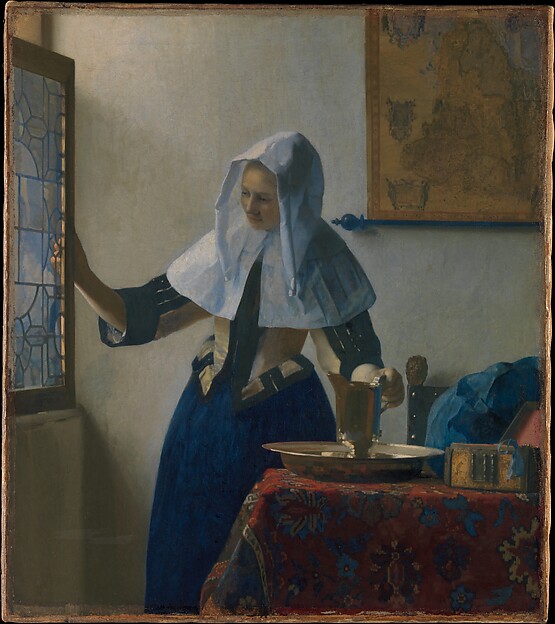
Put Young Woman with a Water Pitcher beside Woman Reading and attend to the viewer’s distance. Vermeer’s measured room asks you to move through light and objects before reaching a story. Manet’s figure offers a more immediate encounter with concentration. Then ask about the work behind these apparently quiet scenes: who made the room, the clothing, the page, the water pitcher? The pictures may not answer every question, but their choices tell you where to begin looking.
Who enters the scene?
Scale is one way painters change the stakes. A large canvas can give a modest action the authority of history painting, while a small picture can reward intimate, repeated attention. The everyday is therefore not one visual style. It is an argument about what deserves to be noticed.
An ordinary action becomes visible in art through selection. A room includes some people and excludes others; a street scene can show leisure while hiding the work that supports it. Viewpoint matters as much as subject. The close interior, the passing glance, and the staged public portrait give a viewer different access to another person’s day. Looking at those choices keeps “the everyday” from becoming a soft label for any familiar object placed on a canvas.
Vermeer and Manet
Vermeer’s Young Woman with a Water Pitcher and Manet’s Woman Reading both present ordinary actions, yet they place viewers very differently. One locates attention within a carefully measured room; the other offers a more immediate modern encounter with a reader. The gap between them shows how an everyday subject becomes meaningful through viewpoint, access, and the rhythm of looking, not through ordinariness alone.
Set Vermeer’s Young Woman with a Water Pitcher beside Manet’s Woman Reading. In one, light and measured space slow an action that remains partly unknown; in the other, the reader’s attention to the page keeps us at a different distance. Find the objects that establish each setting, then notice what the image withholds. These works do not prove that daily life has one visual language. They show how an apparently modest subject can support sharply different ways of seeing.
The details worth keeping
How ordinary rooms and streets became major subjects. The everyday in painting is never a single subject category. Care, leisure, labor, solitude, and commerce can share a room or a street. When a scene seems transparent, try naming the decision that made it appear so: a crop, a patch of light, a gaze directed away from us. Looking at those choices keeps the people pictured from becoming mere examples of an era and makes the familiar setting feel specific again.