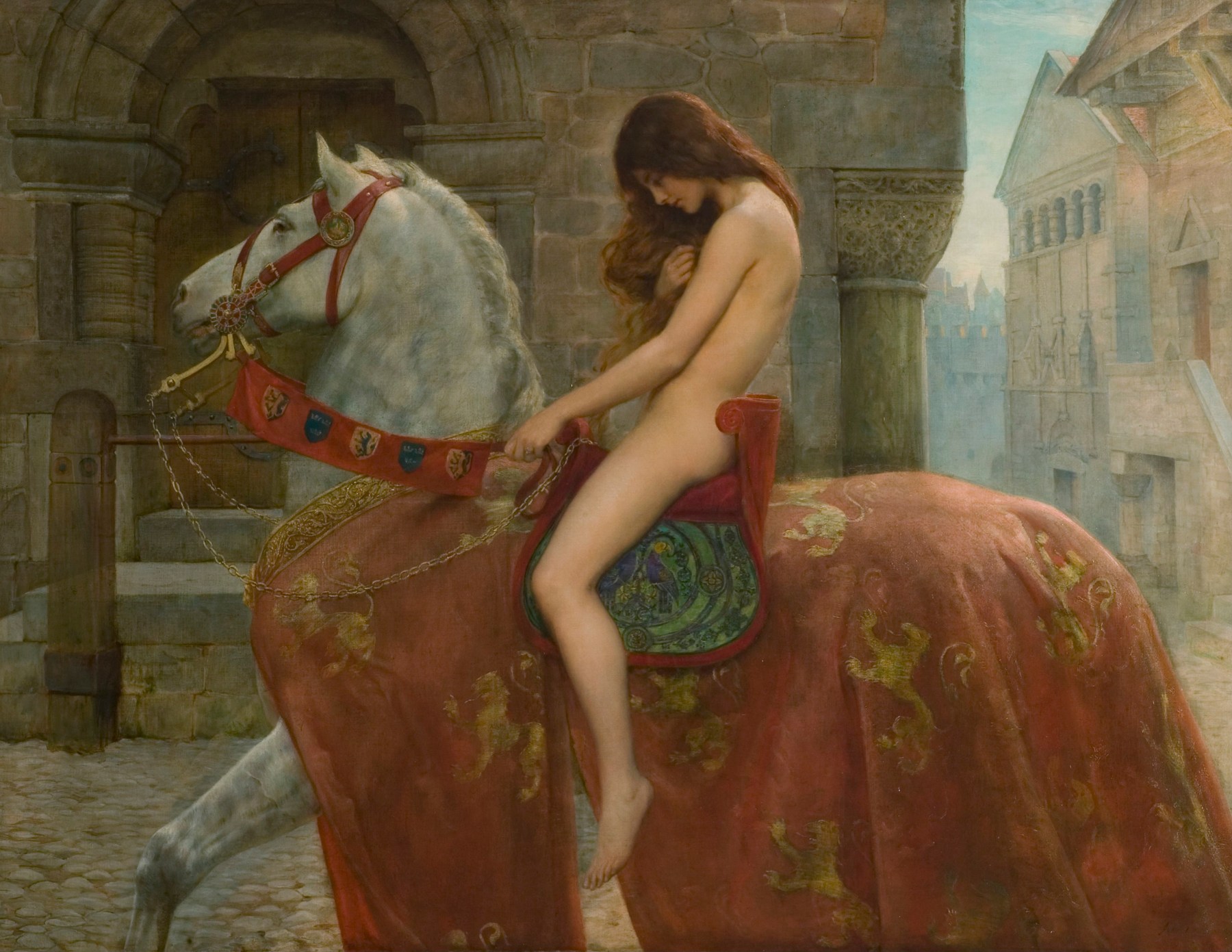
The horse seems ready for a procession. Its white coat catches the light, its ears stand alert, and a great red cloth spills almost to the ground. The rider could hardly look less interested in being seen. Her head is lowered, her shoulders draw inward, and her long auburn hair falls between her face and the street. Before we know anything about Lady Godiva, John Collier has given us two very different ways of occupying the same picture.
Completed in 1898, Lady Godiva belongs to the Herbert Art Gallery & Museum in Coventry. It is an oil painting on a substantial scale, roughly 142 by 183 centimetres. Reproductions make it easy to remember the woman and the white horse. Spend a little longer with it, though, and the empty street becomes just as important. Who has left it empty, and what are we doing here?
The story behind the ride
In the familiar legend, Godiva asks her husband, Earl Leofric, to ease the taxes burdening the people of Coventry. He offers a cruel bargain: he will grant her request if she rides naked through the town. She accepts. The townspeople remain indoors and keep their eyes away as she passes, allowing her to carry out the ride without an audience. Leofric then honours his promise.
That is the story Collier’s painting asks us to recognise. It should be treated as a legend, however. The historical Godiva was an eleventh-century noblewoman; the account of her ride was written down long after her lifetime. The Herbert’s account of the legend traces its telling through later pictures, poetry, and civic celebrations. The painting gives us a Victorian imagining of the tale, rather than evidence that the ride happened.
Why the red cloth matters
Look at how much of the canvas belongs to the horse’s covering. Its red surface spreads across the lower half of the picture, embroidered with gold creatures and edged with rich ornament. Small shields decorate the harness. This is an animal dressed to announce somebody’s rank, even though its rider has given up the clothes that would normally announce hers.
The contrast makes the scene stranger. Godiva’s bare foot hangs beside elaborate fabric; her unadorned arm crosses the decorated saddle. The horse carries the outward signs of wealth while she bears the cost of the bargain. Collier lets that difference sit in plain sight. We do not need to assign a hidden meaning to every gold thread to feel how carefully the two surfaces have been set against one another.
Colour holds them together. Warm flesh and coppery hair emerge from the cooler stone, while the horse’s pale neck lifts away from the dark doorway. The great sweep of red keeps the image from breaking into separate figures and buildings. Cover that lower area with your hand and the balance changes immediately: much of the painting’s weight has gone.
A city holding its breath
At the left, a shadowed arch stands close behind the horse’s head. To the right, the street opens towards lighter buildings and a narrow patch of blue sky. That small escape into distance prevents the stone setting from closing around the rider altogether. Yet there is nobody waiting at the far end. No face appears clearly in a window, and no crowd tells us what to feel.
The absence makes sense within the legend, where the townspeople agree not to look. In the painting it also has a practical effect. There is no second human expression to compete with Godiva’s lowered face. Even the buildings seem to turn away into their own shadows. The horse supplies the forward movement; the rider appears absorbed in getting through the moment.
Her hand near her chest and the fall of her hair suggest an effort to protect a little privacy. Whether we read her posture as embarrassment, concentration, or quiet resolve will depend on where we begin looking. Collier gives us enough to sense an ordeal without supplying a single expression that explains it away.
A medieval heroine for Victorian viewers
Godiva’s story had a particular appeal for nineteenth-century artists. Alfred Lord Tennyson’s poem, published in 1842, helped renew interest in the subject. Edwin Landseer and other painters explored different moments in the tale, from the preparations for the ride to the ride itself. Collier arrived at a subject that audiences already knew, with expectations built by poetry, pictures, and Coventry’s own celebrations.
His fondness for a legendary subject, richly worked fabrics, and close attention to appearances places this picture near the interests of the Pre-Raphaelite tradition. Collier was born in 1850, after the Brotherhood was founded, so calling him one of its original members would be misleading. Here, the appeal lies in the way a meticulously painted surface makes an invented past feel close enough to touch.
The person looking from outside the frame
There is a catch in all this looking. The townspeople show respect by staying out of sight, but the painting gives us a clear view. We occupy the position that the story asks everybody else to refuse. The later Peeping Tom episode, in which a man looks when he should not, makes that contradiction especially difficult to miss.
Art historian Kate Nichols has explored this problem in her study of Collier’s Godiva and Victorian attitudes to the nude. Her research is a useful companion to the picture because it asks how admiration, morality, and the act of looking can become entangled. Godiva’s courage is the reason for the scene, yet her body is what the painter puts before an audience.
Return to her face after noticing that. She still does not meet our eyes. The embroidered cloth remains splendid, the horse continues forward, and the street stays empty. We can follow every visible detail without gaining access to what she thinks. That small distance between seeing a person and knowing her is what makes this painting worth returning to.
Sources & further reading
For the collection and the legend, see the Herbert’s Godiva collection and its illustrated history of Lady Godiva. The museum gives the painting’s completion date as 1898 in its account of the 2024 Versailles loan. For the discussion of Victorian spectatorship, read Kate Nichols’s study, How should we look at Victorian nudes?
Image: John Collier, Lady Godiva, 1898. Oil on canvas. Herbert Art Gallery & Museum, Coventry. Public-domain reproduction via Wikimedia Commons.