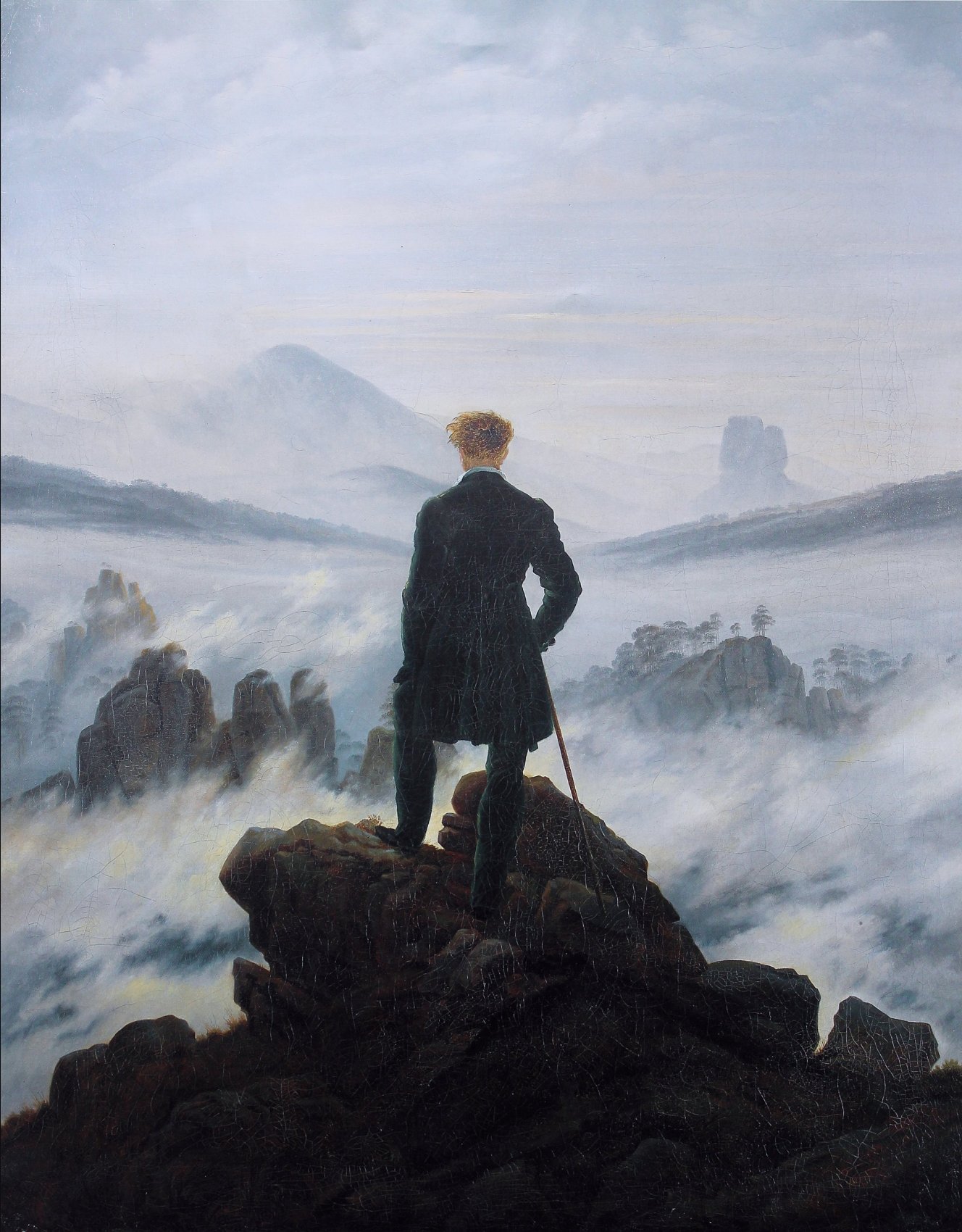
We meet the wanderer from behind. He has reached a rocky summit, but the land below has disappeared into fog. Friedrich gives him the best possible vantage point and then denies him a clear view. That small frustration is what makes Wanderer above the Sea of Fog more interesting than a simple image of conquest: the man stands high, and still he does not know what lies ahead.
A person turned into a viewpoint
Friedrich places the figure almost exactly where a viewer might wish to stand. His dark coat and walking stick separate him from the pale mist, while the rock at his feet gives him a precarious foothold. Because we cannot see his face, we cannot read his thoughts. We borrow his position without taking possession of his inner life.
The German term Rückenfigur is often used for a figure seen from behind. It helps name a device, but the painting is more than an example of a device. The man's body interrupts the panorama. We see around him, not through him. His presence turns a view into an encounter between one person and a place that exceeds him.
Fog makes distance active
Rocky peaks emerge at different depths, some near enough to seem solid, others reduced to faint blue shapes. Fog fills the valleys like a sea, hiding the paths that would connect them. Friedrich builds great depth while withholding the continuous ground a landscape usually supplies. The eye moves outward in leaps, never quite sure how far it has traveled.
The composition is carefully balanced. A dark foreground anchors the figure; lighter banks of vapor carry the gaze toward the horizon. The mist is not a blank waiting for sun to clear it. It is the substance that makes the mountains appear and disappear. Painting uncertainty requires as much structure as painting certainty.
A Romantic picture with no easy slogan
The work is usually dated to around 1817 or 1818 and is held by the Hamburger Kunsthalle. Its mountain forms draw on the landscape of Saxony, but the finished view is a pictorial construction rather than a route map. Friedrich was interested in what a landscape could prompt a viewer to imagine, not simply whether every peak could be identified from one spot.
The wanderer may feel triumphant to one viewer and lonely to another. A raised summit can suggest achievement; the hidden ground can suggest its limits. Neither reaction is wrong, and neither should become a caption imposed on the man. Friedrich has declined to show the face that would settle the matter.
What happens when we stand with him
A reproduction often turns this painting into an emblem of solitary confidence. Try looking instead at how small the person is compared with the weather. The fog seems to continue beyond the frame, and the figure cannot command its movement. He has reached a height, but the painting's real scale belongs to the land and air.
Follow the line of his shoulders outward into the mist. The view becomes less like a prize and more like an unfinished thought. Friedrich lets us enjoy the altitude while feeling the uncertainty that comes with it. The painting lasts because it does not make seeing everything the reward for climbing.