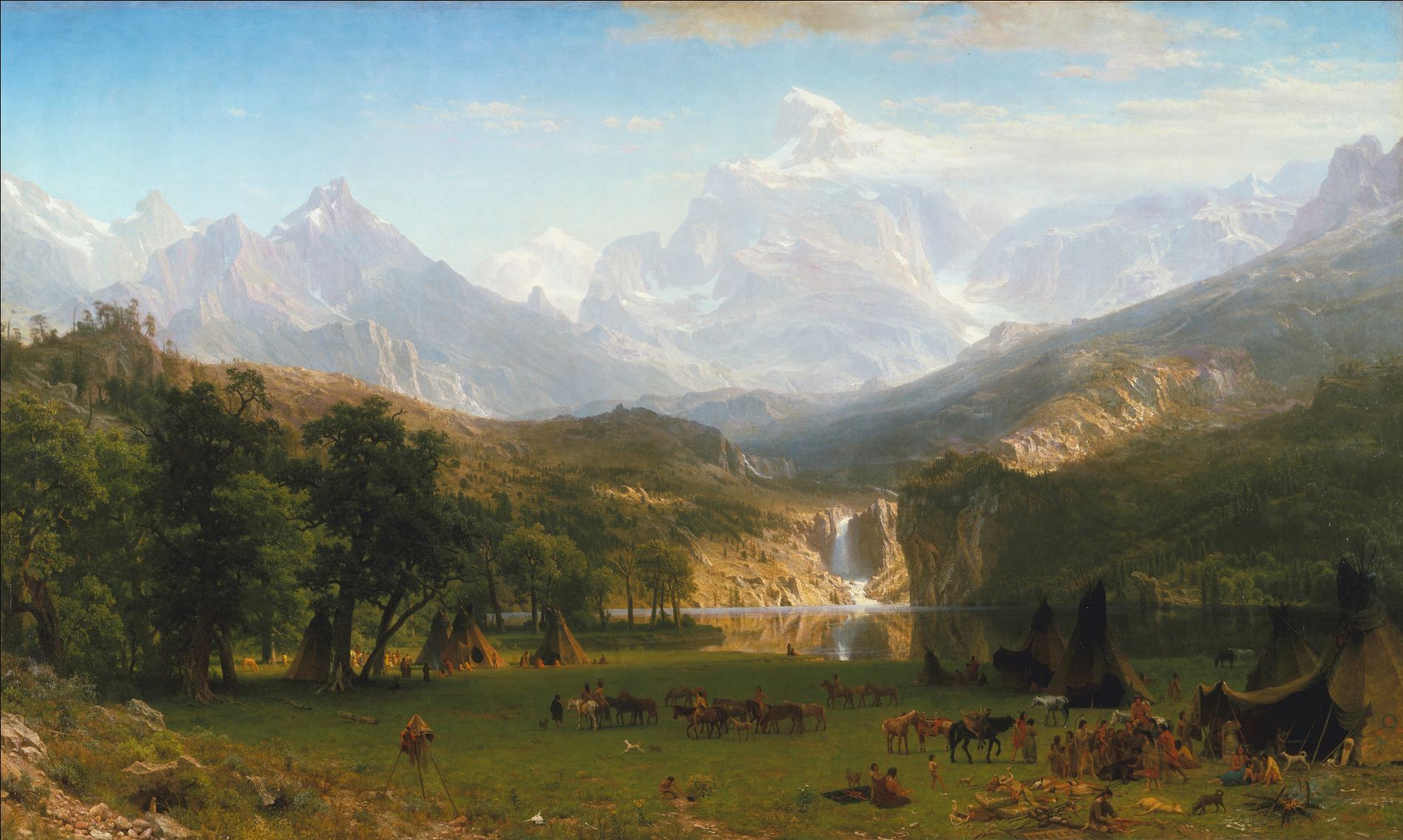
The mountains look impossibly clear in the distance, while a camp and its people occupy the valley below. Bierstadt's The Rocky Mountains, Lander's Peak is both a monumental landscape and a record of how nineteenth-century America imagined the West. Its glittering scale is real as paint; its claims about the land need to be read with equal care.
From expedition to exhibition
Bierstadt accompanied Frederick W. Lander's government survey party west in 1859 and reached the Wind River Range in present-day Wyoming. He painted this large canvas in New York in 1863. Field sketches and observation supplied material, but the final scene was assembled for an eastern audience. Its mountains rise with theatrical clarity above a valley that seems to invite entry.
At more than three metres across, the work could surround a viewer's field of vision. Light draws the eye through the camp and water toward distant peaks. The journey feels effortless because Bierstadt has arranged it so carefully. The valley is not an accidental stretch of scenery; it is the route through which the painting makes its promise of vastness.
Who is in the foreground?
The figures in the valley are Shoshone people. They are small in relation to the mountains but not absent. The Met's record now asks viewers to examine how the picture served the idea of Manifest Destiny, the belief that White settlement was ordained to spread across the continent. Such a belief ignored the sovereignty and lives of Indigenous peoples already there.
Looking carefully at the camp can interrupt the easy story of an empty frontier. The painting includes inhabitants while presenting the land for distant viewers to desire. That tension is not a detail to be tucked away beneath a beautiful sky. It shapes what the picture was able to do in its own time.
How distance becomes desire
Bierstadt keeps the foreground dark enough to make the sunlit mountains radiant. The lake repeats their light in softer form. Trees frame the view, and the central opening seems to offer a path inward. His technique combines precise detail with a controlled sense of atmosphere. The distance feels attainable even though the real terrain would demand time, labor, and local knowledge.
The painting's title names a peak associated with Lander, linking landscape to the survey expedition and its political setting. Names on maps are never neutral labels. Here the title and the view worked together to make a region legible to people who had never seen it. The work deserves admiration for its craft and examination for the history its craft helped carry.
The view after the applause
The Rocky Mountains, Lander's Peak drew enormous attention in the 1860s and is now at the Metropolitan Museum of Art. Its fame has outlasted the original publicity, but the questions in it remain current: who is allowed to describe land as open, who already belongs to it, and what does an image teach its distant audience to expect?
Start with the dazzling peak, then come back to the valley and its people. The painting wants the gaze to travel outward; a responsible second look brings it home again. Bierstadt's landscape is large enough to hold beauty and conflict in the same frame, even if its first admirers did not weigh them equally.