
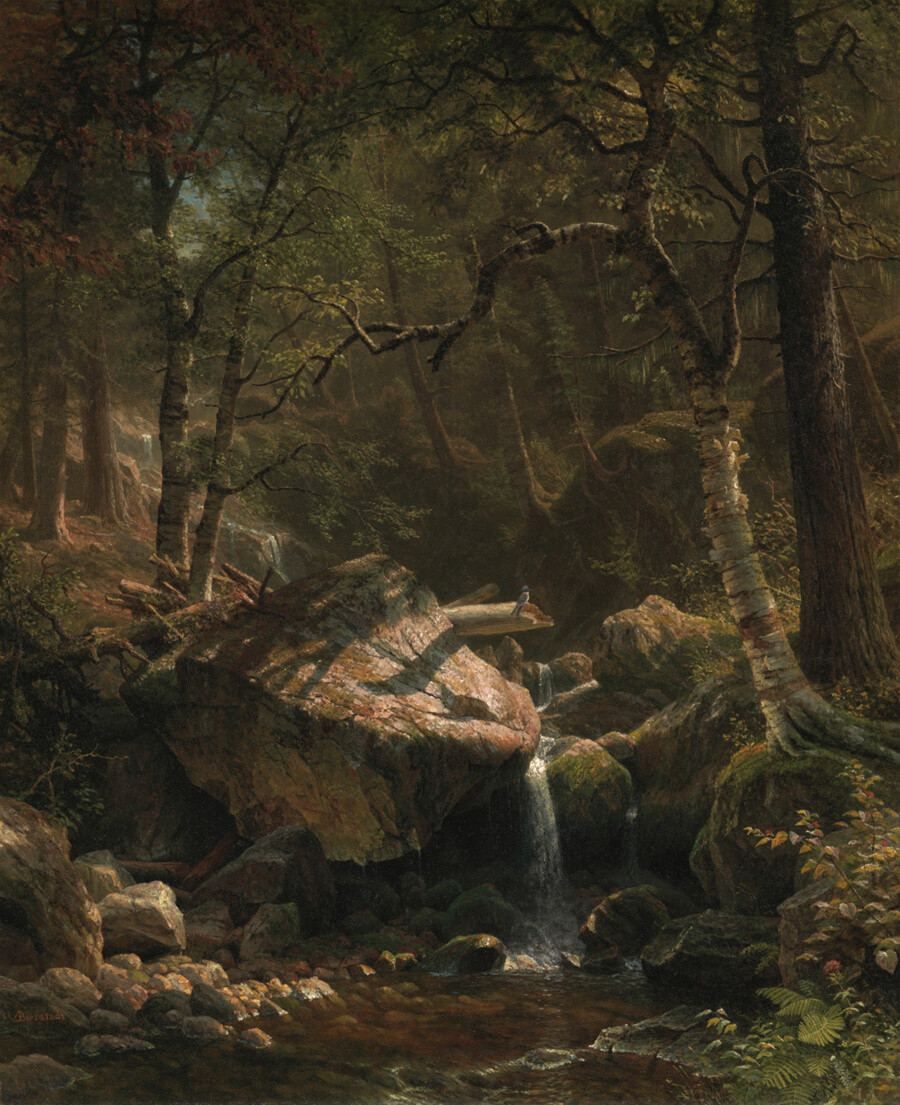
A painter of American landscapes
Bierstadt painted vast American landscapes filled with glowing skies, mountains, and theatrical shifts of scale. His large canvases were popular spectacles in the nineteenth century. Albert Bierstadt (1830–1902) worked in United States. Bierstadt’s large western landscapes entered a market eager for dramatic images of expansion. Their scale made viewing a public event as well as an encounter with a painted place. A life is easier to understand when its objects stay close. The linked works let Albert Bierstadt’s choices appear in several forms, not only in a familiar story.
Light on a vast scale
He used glowing distance, dark foregrounds, and carefully arranged peaks to create a feeling of discovery. These effects are designed, not neutral records of the land. The method is visible in Mountain Brook, but it is worth looking at the other linked objects before calling it a fixed style. Albert Bierstadt had room to revise a familiar solution.
Pictures of land and distance
Among the Sierra Nevada, California turns a mountain landscape into an immense, luminous stage. Its visual pleasure sits beside the history of settler expansion. Look at the projects through the material objects that survive. Mountain Brook records one moment of making, not a complete account of Albert Bierstadt’s intention. Its subject and visible form can be set beside the other works on this page. One may ask for close private attention; another may have been made to address a broader audience. Those conditions make the differences meaningful, even when a shared hand or concern remains easy to recognize.
Hudson River School and its limits
Albert Bierstadt is associated with Hudson River School. The label Hudson River School locates one strand of this career, but no short movement name can contain every decision in a lifetime of work. Use the movement as a route into Albert Bierstadt’s world, then allow Mountain Brook to complicate the route. The date and medium attach the work to a real moment of making. Its subject and arrangement may answer a shared question in a way no other artist chose. This is how a broad term can serve close looking without replacing it.
A closer look at Mountain Brook
Bierstadt composes a mountain stream through contrasting dark foreground and luminous distance. Bierstadt leads the eye from moving water into a larger mountain setting. Changes of scale turn a narrow brook into an entrance to a vast scene. The painting can be admired for its light while also prompting questions about how nineteenth-century landscape art pictured land and settlement. Now set it beside Canadian Rockies (Lake Louise). Bierstadt looks toward Lake Louise through steep mountain walls, balancing luminous distance with the close structure of a valley. Mountain slopes draw the eye toward Lake Louise. Bierstadt combines close geological shapes with distant light, constructing a view that feels both specific and vast. Both works are linked below this profile, with their own object records and images. They reward comparison because they show Albert Bierstadt making different decisions, sometimes with a different material, even when a familiar concern carries across the two.
Beauty and contested ground
Today they can be read for both visual ambition and historical context. Their visions of open wilderness often leave out the Indigenous communities whose lands were represented. Holding both facts together makes the paintings more revealing. Indigenous peoples were often minimized or absent from visions of supposedly empty wilderness. Reading the paintings today means holding aesthetic ambition and that omission together. A third work, Merced River, Yosemite Valley, complicates any account built from a single celebrated picture. Bierstadt turns Yosemite's river and cliffs into a broad composition, inviting a view of landscape at monumental scale. The Merced River leads into Yosemite Valley between cliffs and open sky. Bierstadt makes the scale of the land a central part of the painted experience. Fame draws attention to certain pictures, but this additional object widens the view. Albert Bierstadt’s work remains open to new comparisons as collections and records are studied.
Mountain Brook offers a route from close moving water toward distant light. Canadian Rockies holds the eye between valley walls and a luminous lake, while Merced River opens a broad path through Yosemite. The views have real visual differences, though each uses distance to shape a powerful encounter. Reading them together also makes the apparent emptiness of painted land a question: whose histories lie beyond the frame? The river pictures especially ask how a visitor might move through a landscape that seems untouched from afar.

