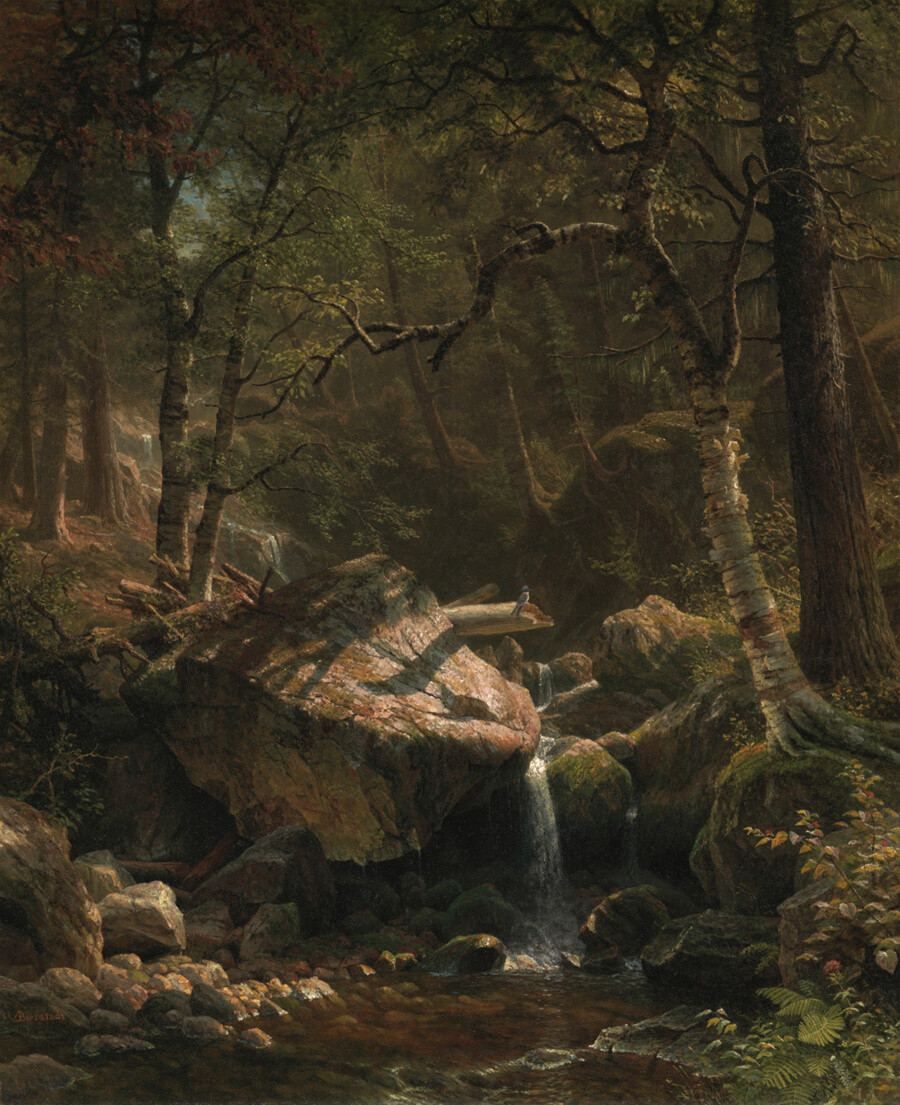
Canadian Rockies (Lake Louise) in its time
Bierstadt looks toward Lake Louise through steep mountain walls, balancing luminous distance with the close structure of a valley. Canadian Rockies (Lake Louise) is dated ca. 1889 and is held by The Metropolitan Museum of Art. The source record names it “Canadian Rockies (Lake Louise).” Knowing where Canadian Rockies (Lake Louise) belongs helps; it also leaves open the question of how the maker organized what we see.
A closer view
Mountain slopes draw the eye toward Lake Louise. Bierstadt combines close geological shapes with distant light, constructing a view that feels both specific and vast. Look at how Canadian Rockies (Lake Louise) handles distance. Its nearest forms and farthest spaces may be described with very different degrees of clarity. That difference affects where you feel invited to stand.
The surface of the work
The collection records Canadian Rockies (Lake Louise) as oil on paper mounted to board. He used glowing distance, dark foregrounds, and carefully arranged peaks to create a feeling of discovery. These effects are designed, not neutral records of the land. The material description for Canadian Rockies (Lake Louise) matters because an image seen at screen size can conceal how it was first made and handled. The image of Canadian Rockies (Lake Louise) invites another look at its arrangement; its collection entry gives the material description and further details about the work.
Albert Bierstadt and this work
Today they can be read for both visual ambition and historical context. Their visions of open wilderness often leave out the Indigenous communities whose lands were represented. Holding both facts together makes the paintings more revealing. The valley walls bring the viewer toward a lake held in distant light. Bierstadt uses that contrast of near rock and far brightness to make scale felt. An artist’s name can make a work feel familiar before we have really looked at it. Art rarely feels inevitable from the maker’s side. Its subject, medium, and visible emphasis may seem consistent with other works, or they may reveal a different route. Ask what this subject allowed the artist to test here and which decisions depend on its particular size or material. Each work had its own audience and task, and each can change the story we tell about the career. For Albert Bierstadt, Canadian Rockies (Lake Louise) was one particular solution among many. A second work can show which decisions were revisited and which were left behind.
The world around Canadian Rockies (Lake Louise)
A work dated ca. 1889 has a longer life than the moment of making. Canadian Rockies (Lake Louise) has been seen by later audiences in new settings, while its source records a particular historical object. A viewer first meeting Canadian Rockies (Lake Louise) in ca. 1889 may have known its subject and setting differently. That distance is one reason to keep both the image and its documented record in view. A record helps place Canadian Rockies (Lake Louise) in a collection. The details you notice in the image can then lead to more precise questions.
Image and object record
The Metropolitan Museum of Art identifies Canadian Rockies (Lake Louise) as a work by Albert Bierstadt from ca. 1889 and records its medium as oil on paper mounted to board. The collection credits the object to Bequest of Ruth Alms Barnard, 1981. Follow the linked object record for its catalogue entry and any further notes on its history.