
Mountain Brook in its time
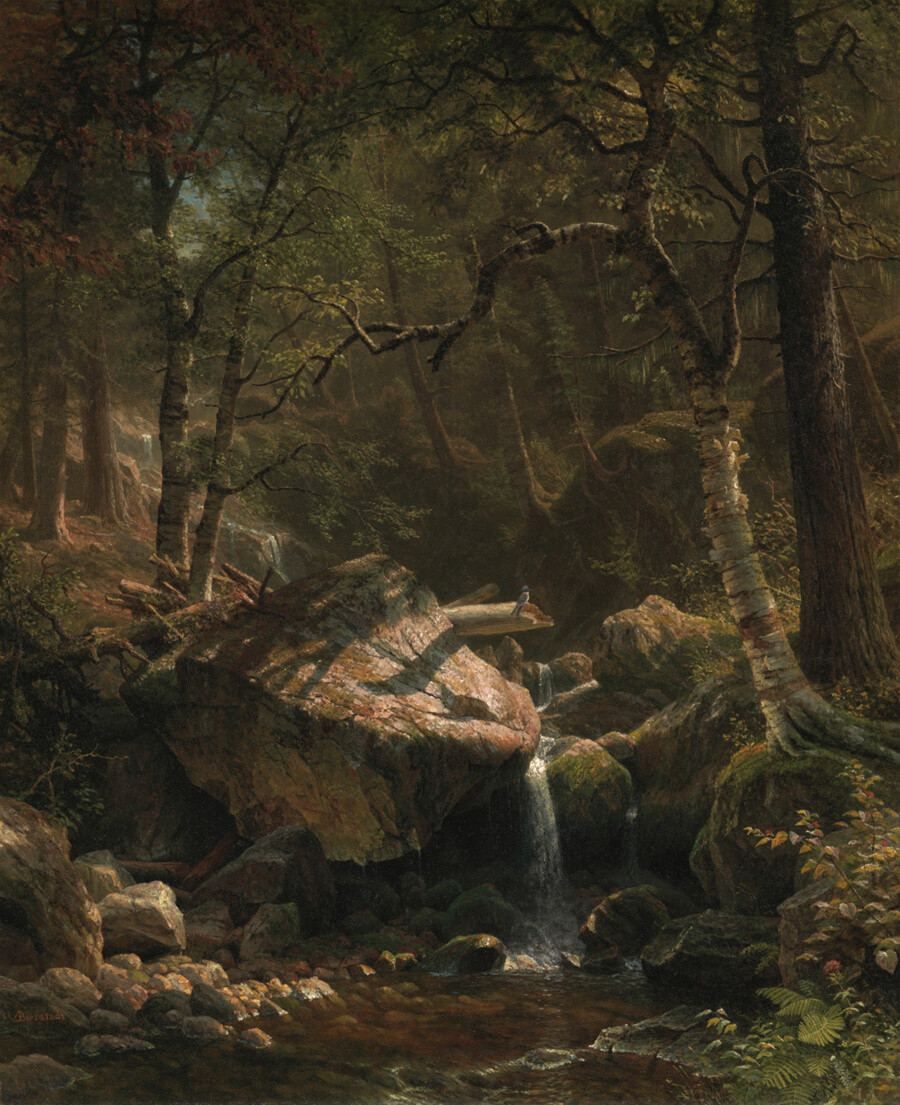
Bierstadt composes a mountain stream through contrasting dark foreground and luminous distance. Mountain Brook is dated 1863 and is held by Art Institute of Chicago. The source record names it “Mountain Brook.” The listed facts locate Mountain Brook in history, while its visible choices give the viewer something to discover directly.
A closer view
Bierstadt leads the eye from moving water into a larger mountain setting. Changes of scale turn a narrow brook into an entrance to a vast scene. The painting can be admired for its light while also prompting questions about how nineteenth-century landscape art pictured land and settlement. Try reading Mountain Brook from its outer edge inward. The first feature you noticed may no longer dominate. Artists can distribute attention so that a picture unfolds gradually rather than all at once.
Paint, paper, and process
The collection records Mountain Brook as oil on canvas. The stated materials of Mountain Brook limit what we can reasonably claim about its making. Follow the record for those details, then return to the image to look for their visible effects. Looking at Mountain Brook as an object means asking what the listed materials allow the artist to revise, repeat, or leave visible. Return to the image of Mountain Brook for the arrangement of forms, then use the source link to learn what kind of object carries them.
Albert Bierstadt and this work
Bierstadt painted vast American landscapes filled with glowing skies, mountains, and theatrical shifts of scale. His large canvases were popular spectacles in the nineteenth century. The brook is both a subject and a route into the painted landscape. Following its movement leads the viewer from close detail toward distant light, a passage Bierstadt has carefully arranged. In Mountain Brook, the viewer meets a work rather than a shorthand for Albert Bierstadt. Art rarely feels inevitable from the maker’s side. Its subject, medium, and visible emphasis may seem consistent with other works, or they may reveal a different route. Another work from the same career may answer those questions differently. A career story should follow actual pictures and the changes between them, not a legend of inevitable progress. The choices visible in Mountain Brook make one part of Albert Bierstadt’s career tangible without reducing that career to a single signature look.
The world around Mountain Brook
Bierstadt’s large western landscapes entered a market eager for dramatic images of expansion. Their scale made viewing a public event as well as an encounter with a painted place. The world of 1863 was the first setting for Mountain Brook. Its later life in collections and reproductions has changed how easily, and how often, people see it. The image of Mountain Brook and its source record belong together: one offers a close view, the other identifies the object and its material.
Image and object record
Art Institute of Chicago identifies Mountain Brook as a work by Albert Bierstadt from 1863 and records its medium as oil on canvas. The collection credits the object to Purchased with funds provided by Mrs. Herbert A. Vance; fund of an anonymous donor; Wesley M. Dixon Jr. Fund and Endowment; Henry Horner Straus and Mr. and Mrs. Frederick G. Wacker Jr. endowment funds; through prior acquisitions of various donors, including Samuel P. Avery Endowment, Mrs. George A. Carpenter, Frederick S. Colburn, Mr. and Mrs. Stanley Feinberg, Field Museum of Natural History, Mr. and Mrs. Frank Harding, International Minerals and Chemicals Corp., Mr. and Mrs. Ralph Loeff, Mrs. Frank C. Miller, Mahlan D. Moulds, Mrs. Clive Runnells, Mr. and Mrs. Stanley Stone, and the Charles H. and Mary F.S. Worcester Collection. Follow the linked object record for its catalogue entry and any further notes on its history.

