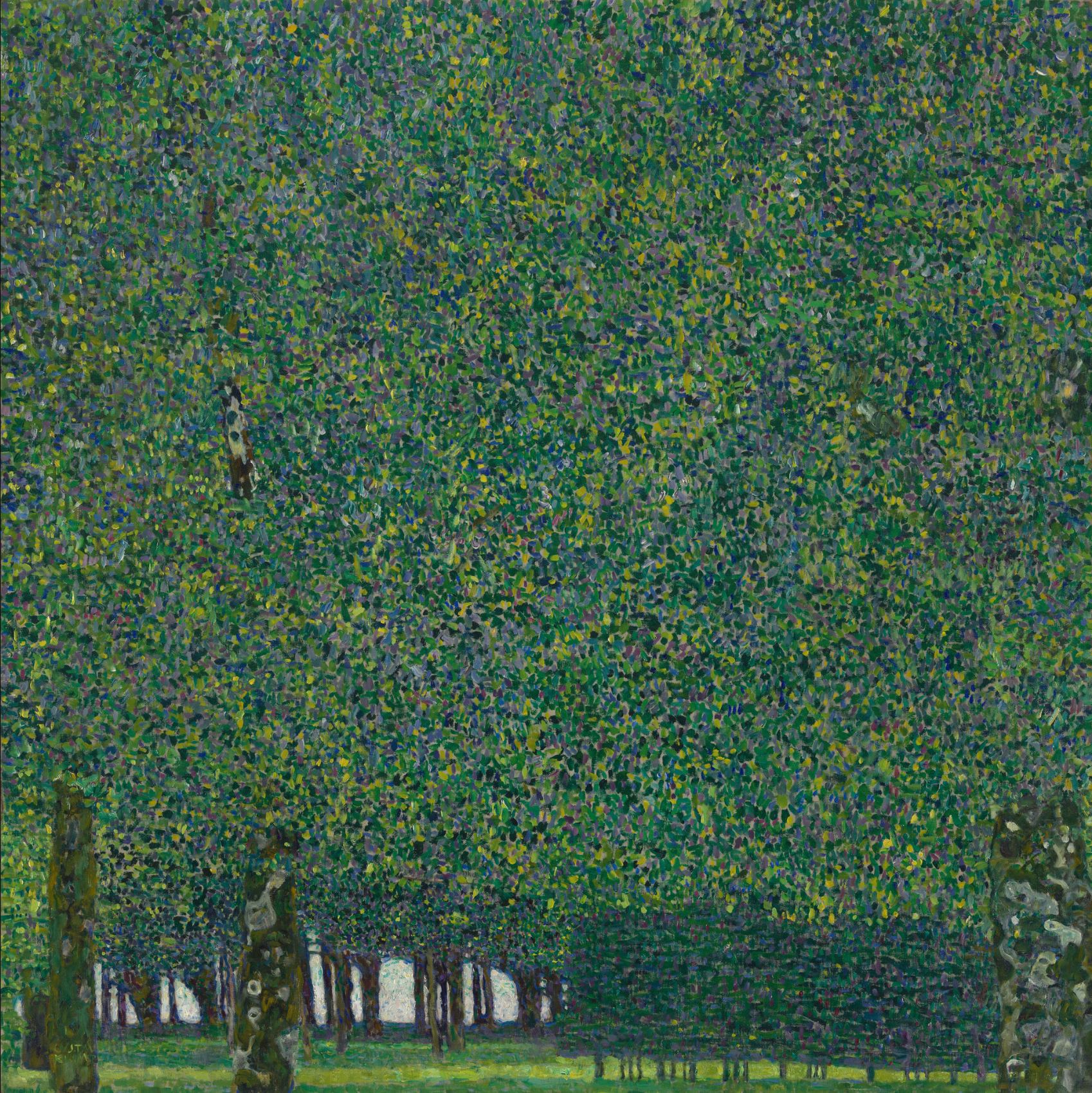
A patch of grass sits beneath a canopy so dense that the sky nearly disappears. Klimt's The Park can look like a field of green dots before it resolves into trees. No golden figure or elaborate robe is needed. The artist's love of pattern moves outdoors, where leaves and light make ornament seem to grow by itself.
A square of shade
Klimt chose an almost square canvas and filled most of it with overlapping foliage. Trunks descend into the lower part of the picture, where a little grass and a glimpse of distance offer breathing room. The compression matters. We do not look through the park toward one grand destination; we are asked to spend time with the trees themselves.
The branches blend high above, making a canopy that is difficult to separate into individual crowns. That density can feel protective or a little overwhelming. Klimt keeps both possibilities open. The small brighter gap near the bottom is enough to assure us that space continues beyond the painted leaves, even while the surface holds our attention close.
Green is many colors
The foliage is built from countless short marks. Greens lean toward blue, yellow, or brown, and darker notes keep the light patches from flattening. At a distance the colors make a tree-filled place. Nearer, their separate touches make the painting feel like a patterned textile. Klimt lets observation and design strengthen one another rather than choose between them.
MoMA notes that he used a square viewfinder outdoors to select scenes. That tool helps explain the painting's concentrated frame. The Park is not the whole park; it is a decision about what a small square of seeing can contain. A tree trunk becomes a line in a larger arrangement, while remaining recognizably a tree.
A different Klimt
Many viewers know Klimt through portraits and allegories with gold and carefully staged bodies. His landscape painting offers a useful correction to that narrow image of his career. Here ornament is not applied to a person. It grows from an encounter with leaves, shade, and repetition. The subject allows him to pursue pattern without abandoning the visible world.
The museum dates the canvas to 1910 or earlier. A broad date is more honest than pretending the exact summer is known. The painting belongs to a period when Klimt was attentive to outdoor subjects, often narrowing a view until landscape and surface design became almost inseparable. The Park shows that investigation with unusual clarity.
A place to lose and find your bearings
Try locating one trunk at the bottom and following it into the canopy. Its outline soon becomes hard to hold among the small touches. Look away to the grass and the tree returns as part of a larger place. Klimt makes the viewer alternate between recognizing nature and enjoying the independence of paint.
There is no path to follow and no figure to stand in for us. The work grants a more modest invitation: stay under these trees long enough for the green to become varied. The Park makes a dense summer view feel both immediate and inexhaustible. It is a landscape with almost no horizon and plenty of room for looking.