Male Nude with Left Foot on a Pedestal in its time
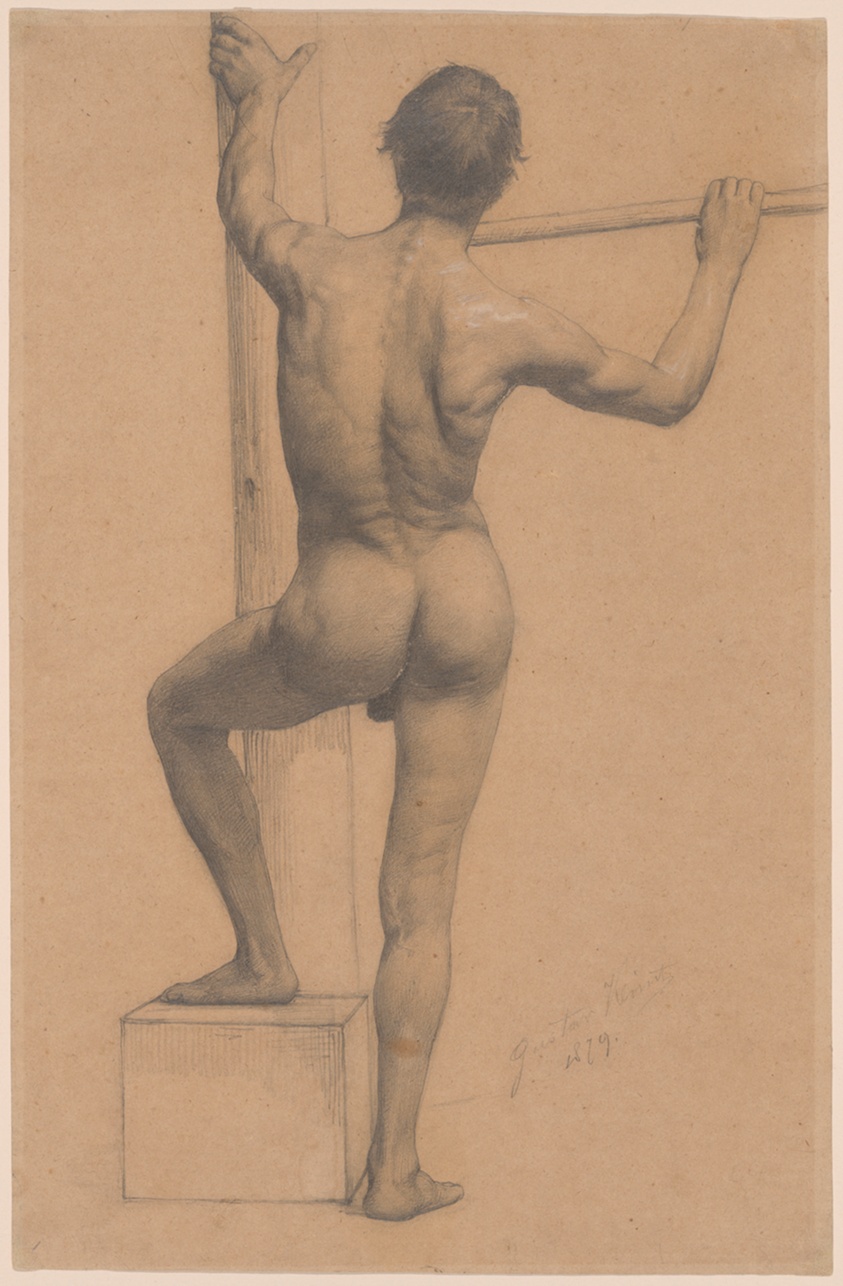
Klimt studies a standing male figure in graphite and white highlights, recording pose and balance before ornament enters the picture. Male Nude with Left Foot on a Pedestal is dated 1879 and is held by Art Institute of Chicago. The source record names it “Male Nude with Left Foot on a Pedestal.” With Male Nude with Left Foot on a Pedestal, the catalogue provides the facts of the object; the visual relationships carry the experience further.
Inside the composition
The figure's raised leg and outstretched arms make balance the drawing's central problem. White highlights and graphite let Klimt test weight against the brown paper. Follow one repeated shape or direction across Male Nude with Left Foot on a Pedestal. Even when the forms differ, their relation can make the picture feel held together. This rhythm is easy to miss if you look only for a story.
Paint, paper, and process
The collection records Male Nude with Left Foot on a Pedestal as graphite and white heightening on brown wove paper. Gold, pattern, and flattened areas can surround a carefully observed face. The friction between a person and ornament makes his portraits more searching than their luxury first suggests. The listed materials give Male Nude with Left Foot on a Pedestal a physical history beyond its familiar digital image, including a support, surface, and scale. Look between the image of Male Nude with Left Foot on a Pedestal and its object record. Each answers different questions about appearance, material, and scale.
Gustav Klimt and this work
Gold leaf, flat pattern, and richly worked surfaces make many of his pictures instantly recognizable. Beneath the decoration are complex questions about desire, identity, and the relationship between a person and the designs that surround them. The raised foot makes balance visible as a problem Klimt is working through. White touches against brown paper clarify weight and position without dressing the body in later ornament. No single work can summarize Gustav Klimt. That combination matters more than a quick description of the artist’s usual style. Another image by the same maker may use a related method toward another end, or change the method altogether. Another work from the same career may answer those questions differently. Each work had its own audience and task, and each can change the story we tell about the career. No single image can contain Gustav Klimt’s career. Male Nude with Left Foot on a Pedestal is a vivid place to begin, with other works nearby to complicate the view.
The world around Male Nude with Left Foot on a Pedestal
The date 1879 places Male Nude with Left Foot on a Pedestal within a particular career and set of viewers. The source link supplies the documented object details; the image still keeps some of that encounter open. Male Nude with Left Foot on a Pedestal carries a date, 1879, but it has also had a later life. Each collection, display, or reproduction offers another meeting with the same historical object. The linked source keeps Male Nude with Left Foot on a Pedestal tied to a particular object while you continue exploring what its image makes visible.
Image and object record
Art Institute of Chicago identifies Male Nude with Left Foot on a Pedestal as a work by Gustav Klimt from 1879 and records its medium as graphite and white heightening on brown wove paper. The collection credits the object to Gift of Shin'enKan, Inc., Bruce Goff Archives. Follow the linked object record for its catalogue entry and any further notes on its history.