Seated Woman with Hat in its time
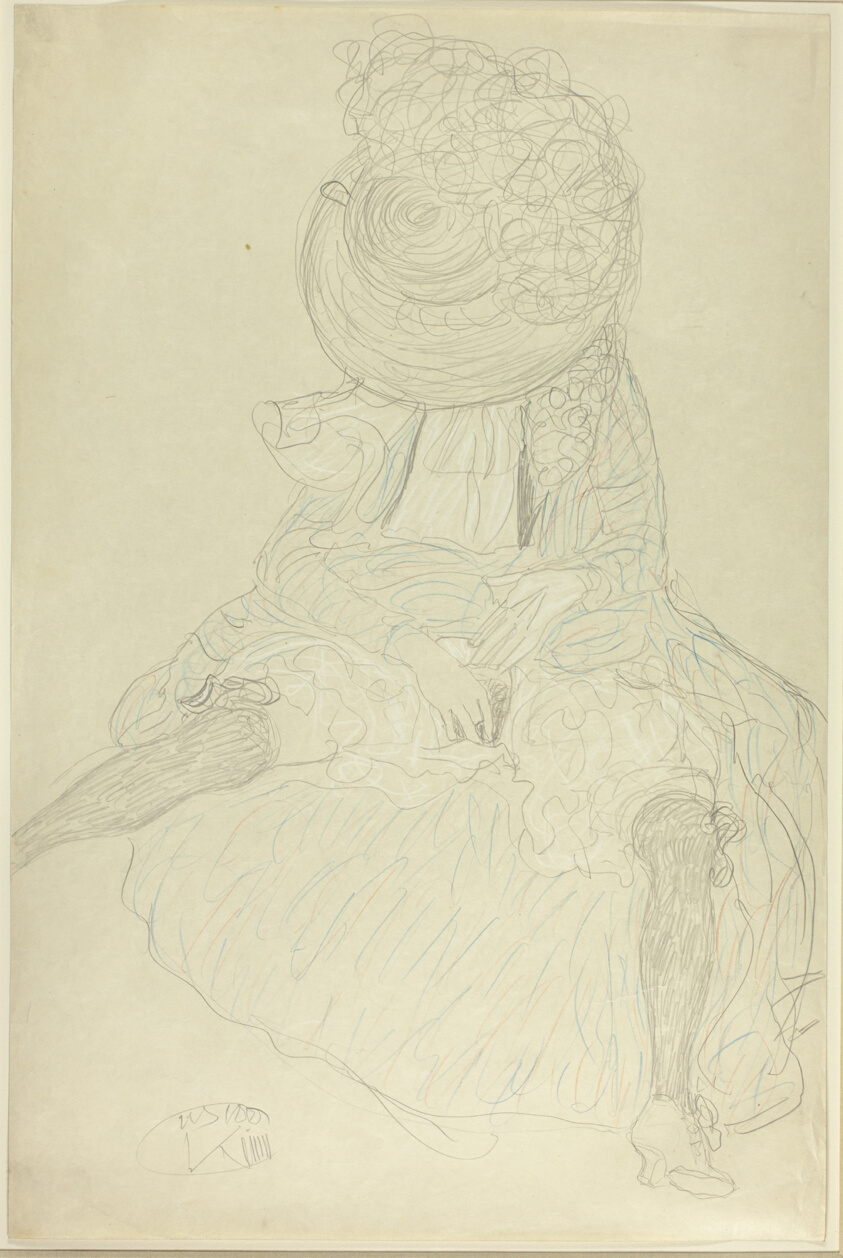
Klimt's drawing studies a seated figure through posture, line, and the concealed expression beneath a hat. Seated Woman with Hat is dated 1910 and is held by Art Institute of Chicago. The source record names it “Seated Woman from the Front with Hat, Face Hooded.” A title and date can orient us to Seated Woman with Hat, but neither replaces the experience of following its forms across the image.
Inside the composition
Klimt brings the figure and her hat into a setting where ornament competes with description. The sitter is present, yet pattern refuses to behave as a quiet background. That interplay helps explain how Klimt could make portraiture both an image of a person and an experiment in decorative form. Follow one repeated shape or direction across Seated Woman with Hat. Even when the forms differ, their relation can make the picture feel held together. This rhythm is easy to miss if you look only for a story.
What the medium can tell us
The collection records Seated Woman with Hat as graphite, with colored pencil, on ivory wove paper. In Seated Woman with Hat, materials help determine how marks could be laid down and how the result met its first viewers. The collection entry describes the surface on which those choices were made. For Seated Woman with Hat, the collection’s medium label is a clue to the work of the hand and to the surface that first carried the image. On a screen, Seated Woman with Hat has a convenient size. Its actual dimensions and support belong to the source record linked beside the work.
Gustav Klimt and this work
Klimt moved from decorative commissions toward paintings that blend portraiture, ornament, and symbolism. As a founder of the Vienna Secession, he helped create new exhibition space for artists beyond academic institutions. The hat partly withholds the sitter’s face, shifting attention toward the angle of her body and the economy of Klimt’s line. The drawing leaves room for a presence that is not fully described. No single work can summarize Gustav Klimt. For Gustav Klimt, a visual effect was never an abstract signature floating free of materials and purpose. Another image by the same maker may use a related method toward another end, or change the method altogether. Another work from the same career may answer those questions differently. Its differences from nearby works are worth noticing; they restore a little of the uncertainty and invention within the practice. Seen with Gustav Klimt’s other works, Seated Woman with Hat shows how one maker could return to a concern while changing material or scale.
The world around Seated Woman with Hat
Klimt’s early decorative commissions gave way to a central role in the Vienna Secession. The group created new spaces for artists at a time of argument over academic taste. Seated Woman with Hat began as an object in 1910, made for viewers with their own habits and expectations. Today its collection record offers a route back to that material history. For Seated Woman with Hat, use the collection link to check date and medium before returning to the visual choices made on the surface.
Image and object record
Art Institute of Chicago identifies Seated Woman with Hat as a work by Gustav Klimt from 1910 and records its medium as graphite, with colored pencil, on ivory wove paper. The collection credits the object to Gift of the Gecht Family. Follow the linked object record for its catalogue entry and any further notes on its history.