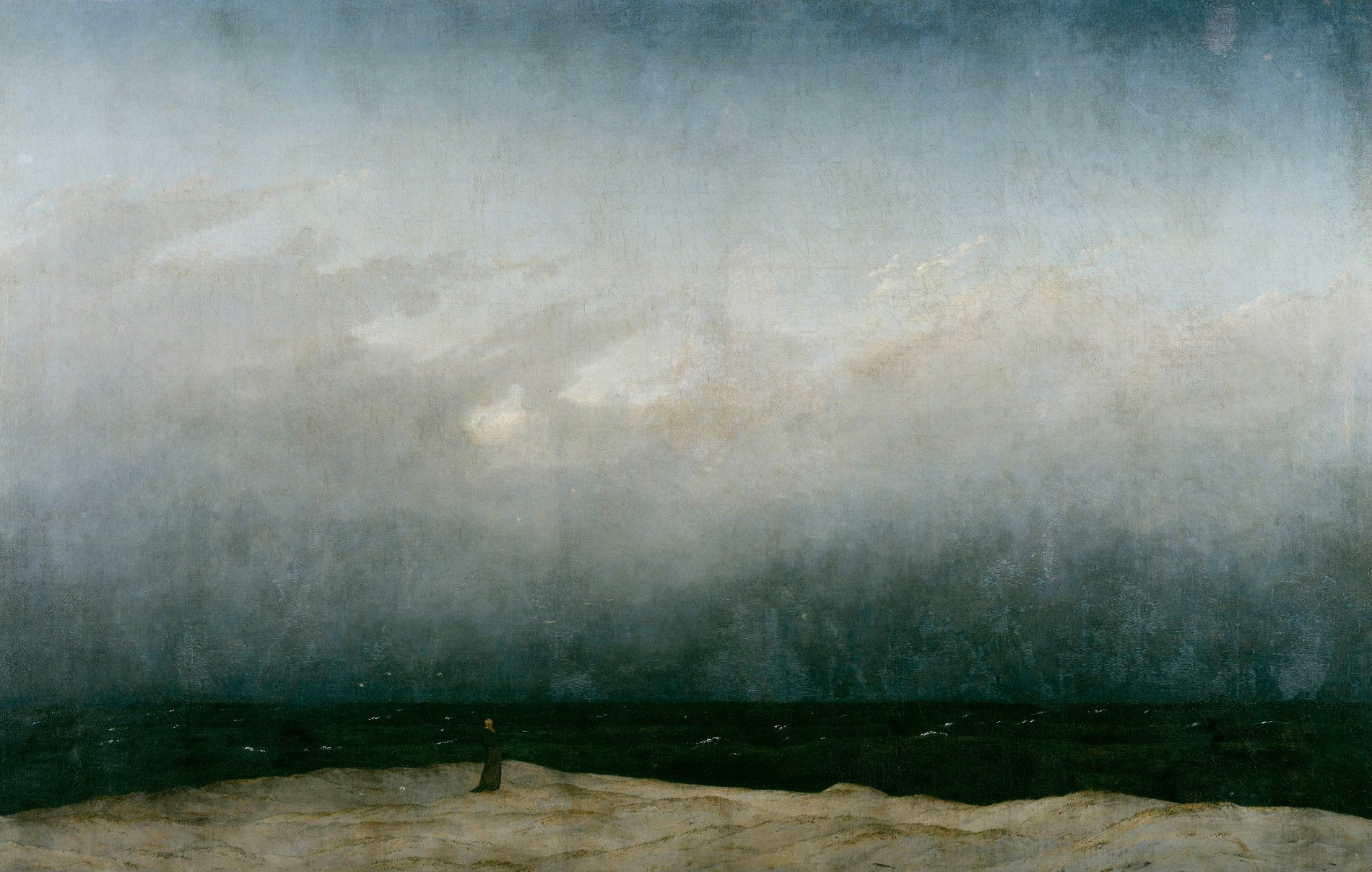
There is almost nothing to do in The Monk by the Sea except look out. A tiny dark figure stands on a bare shore. Beyond him lie a strip of sea and a sky that takes most of the canvas. Friedrich removed the usual landmarks that tell a viewer where to go. The painting can feel empty at first, then immense.
One person and three great bands
Land, sea, and sky divide the picture into broad horizontal zones. A few gulls and changes of tone interrupt the apparent simplicity, but there is no boat to follow or cliff to climb. The monk's dark shape is the one secure human measure. Even he offers no story we can complete from his face, because we see him at a distance, turned toward the water.
In a more conventional coastal view, foreground rocks might lead us inward and a distant vessel might reward the journey. Friedrich withholds that route. The eye meets open water and then more open sky. The lack of incident is not a lack of care; it is the means by which the painting makes scale felt.
Painting a nearly empty sky
The sky changes gradually from darker blue-grey near the horizon to paler tones above. Those shifts keep the large area alive. The shoreline is rougher and more particular, a place where the monk can actually stand. Between them, the sea has a thin, uncertain edge. Friedrich asks the eye to work across subtle changes instead of jumping between familiar objects.
The painting was developed between 1808 and 1810. Its unusual spareness emerged through revision, not a refusal to finish. The result can feel startlingly modern, but calling it 'almost abstract' should not make us forget the person on the sand. That single figure changes the sky from color and space into an experience someone is having.
The shore is no answer
Viewers have long read the monk through religious or existential questions. That makes sense; a solitary figure faces something larger than himself. Yet the painting does not tell us whether he seeks comfort, fears the sea, prays, or simply watches. It gives a human position and leaves the thought open. The title identifies his role, not the content of his mind.
Friedrich painted The Monk by the Sea alongside a very different canvas, Abbey in the Oakwood. The pairing placed an open coast beside ruins and trees, enlarging the possible conversation about time and mortality. Seen alone, the monk's scene remains less a lesson than a sustained pause.
The courage of leaving space
Most landscapes offer many things to recognize. This one gives us room to notice our own desire for more: a destination, a sign, a decisive mood. Friedrich lets the simple proportions of shore, water, and air do the work. The monk is tiny, but without him the picture would be a different sort of silence.
Move your attention between the figure and the high, light sky. The distance is immense, yet the painted surface holds both together. The Monk by the Sea does not ask us to conquer the emptiness. It asks us to remain with a view that will not turn itself into a reassuring story on demand.