You can walk past The Lacemaker in three seconds. The painting is scarcely larger than a sheet of office paper, and its subject appears to be doing something almost comically quiet. Stop, though, and the stillness turns busy. A woman bends over her bobbins; color spills out of a sewing cushion; Vermeer asks your eyes to move between things that are sharp and things that are barely there.
A world the size of a book
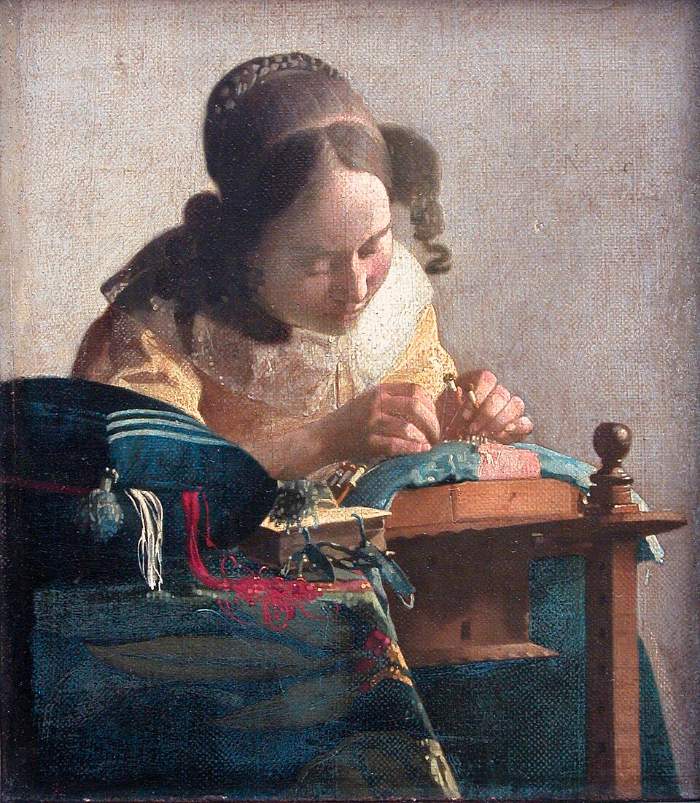
The Louvre's canvas measures roughly 24 by 21 centimetres. Vermeer had no room for the furniture and maps that make some of his interiors feel spacious. He brought the viewer almost to the edge of the table instead. The lacemaker's lowered face, the little apparatus of her craft, and a book at the right fill the scene. It feels private, although the closeness is an artistic arrangement rather than a window into a named woman's life.
Her concentration is the painting's strongest movement. Nothing suggests that she has looked up to greet us. Her fingers are involved with a task whose results would be delicate and painstaking. The picture does not show a finished piece of lace for us to admire. It catches the work before it becomes an object that can be worn, given away, or sold.
When a thread goes soft
At the left, red and white threads emerge from a cushion in loose, almost liquid strokes. The second plane, around the woman and her working hands, is much more exact. That contrast is not a failure to finish the foreground. Vermeer has organized the act of looking: what is very close can become hard to resolve, while attention fastens on the task a little farther away.
It is tempting to call this a camera effect and leave it there. A camera may help us describe the shift, but the painter made choices about where to let the surface dissolve. Follow the bright threads with your eyes and they lead toward a person whose own eyes are fixed on even finer lines. The painting becomes a quiet joke about how difficult it is to see everything at once.
A virtue, a job, or simply a moment?
Seventeenth-century viewers could read needlework as a sign of domestic virtue. The Louvre notes that the nearby book may be a Bible or prayer book, but the identification is not certain. Nor is there proof that the woman is Vermeer's wife or a professional lacemaker. Those gaps matter. If we name her too confidently, we turn an unknown person into a convenient illustration of somebody else's theory.
One reading need not cancel another. Lace-making required skill, patience, good light, and time. The picture can take part in an old moral language about respectable work while also showing the difficulty of that work. Vermeer does not write a slogan across the table. He gives us a body absorbed in a practiced action.
Light from an unexpected side
Vermeer is famous for rooms lit from the left, yet here the light approaches from the right. The difference is easy to miss if we come expecting a familiar formula. Warm flesh, pale cloth, and the small gleams on the tools carry the light through a cramped composition. It gives the woman a presence without turning her into a portrait whose identity we are supposed to solve.
The painting belonged to the Delft collector Pieter van Ruijven, one of Vermeer's important supporters. That history reminds us that a scene of domestic labor could also be a finely made object for a collector's close attention. The worker's concentration and the buyer's pleasure are not the same experience, even if the painting places them in one frame.
The reward for slowing down
Look once at the woman's hands, once at the threads nearest you, and once at the dark space between them. Each pass changes the apparent center of the picture. The Lacemaker does not need a dramatic event to hold our attention. Its event is attention itself: someone working so closely that the rest of the room seems to fall away, and a painter making us feel the limits of our own view.