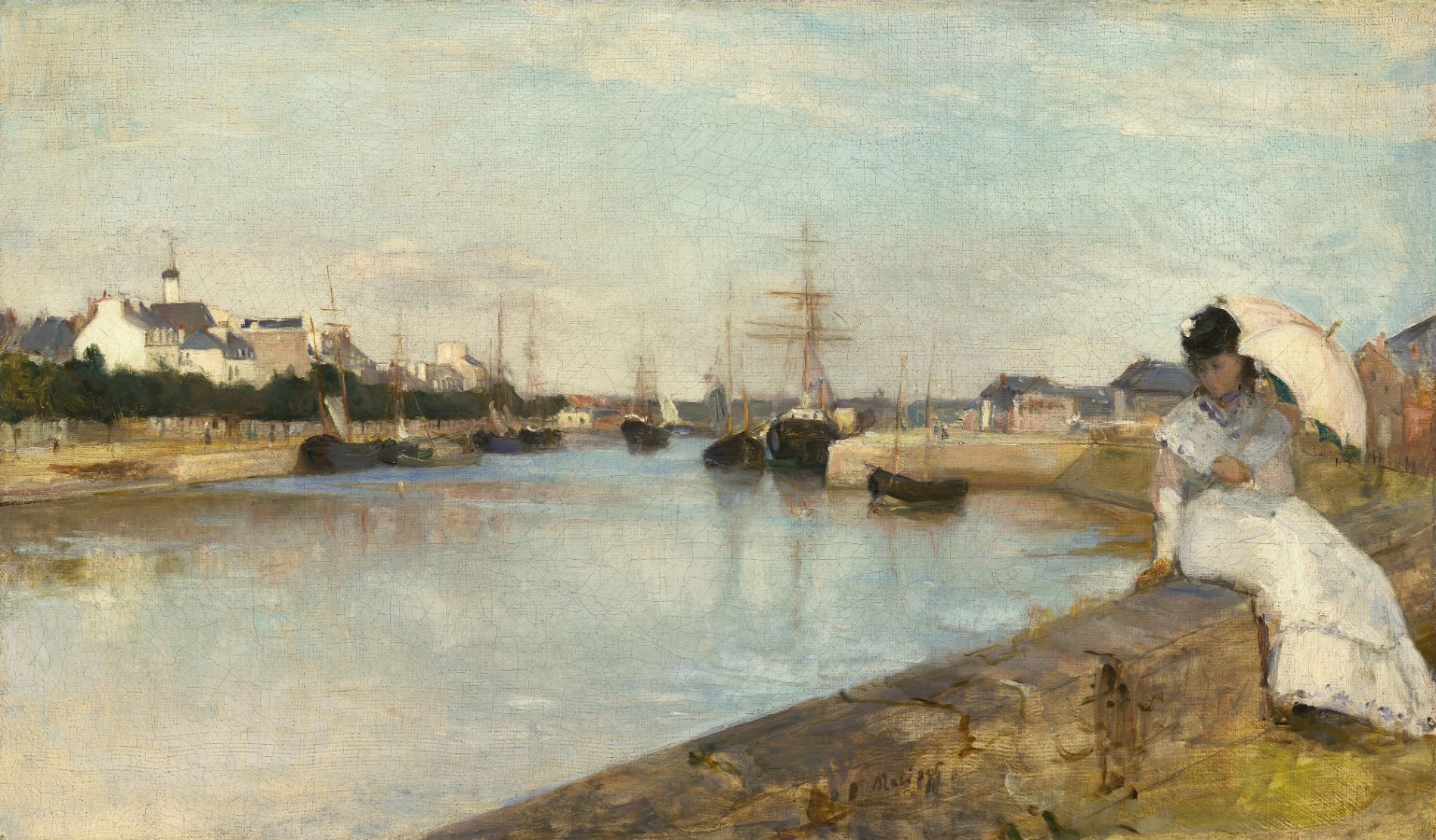
A woman sits on a low wall with a parasol, the harbor opening behind her. Morisot gives us the pause of one person and the busy distance of ships in the same breath. The Harbor at Lorient is a landscape that does not push its figure aside. Her stillness gives the water and far shore a human measure.
A visitor at the edge of the water
Morisot painted Lorient in 1869, before the first Impressionist exhibition. The woman is often identified as her sister Edma, who posed for Morisot in other works. She looks downward rather than toward the viewer or the distant vessels. That reserved pose leaves her thoughts private. We can see her place in the harbor scene without claiming to know exactly what she sees or feels.
The low wall runs diagonally into the distance, joining the seated figure to the waterway. It is an ordinary piece of harbor architecture, but it gives the composition its path. The boats beyond suggest a place of work and passage. Morisot sets a personal moment against that larger movement without making one cancel the other.
Water made from quick decisions
Pale blues and greens spread across the water in loose strokes. Reflections do not line up like entries in a ledger; they flicker and break. The far buildings are just clear enough to mark a shore. Morisot gives us enough to understand the geography while preserving the sensation of light changing across a broad surface.
The parasol's pale pink offers a gentle counterweight to the cool harbor. The figure's white dress catches light without becoming a hard, smooth shape. Morisot's brushwork keeps clothes, stone, water, and air connected. Close inspection shows the painter making distinctions quickly, then allowing them to mingle again.
Before a familiar movement had a name
Because Morisot later became central to Impressionism, it is tempting to read every early outdoor scene as a rehearsal for that label. The Harbor at Lorient deserves its own date. In 1869, she was exploring how a figure could occupy an open setting and how a sketch-like surface might carry a finished composition. The painting stands on those choices even without a movement name.
Morisot's access to public space and her subjects was shaped by the expectations placed on women artists in her time. A harbor view with a woman seated nearby does not erase those limits. It also shows what she could do within and beyond them: make an intimate moment part of a larger, active world.
The place beyond the parasol
The National Gallery of Art holds the painting in Washington. From a distance, the figure can draw the eye first; then the quiet stretch of water opens out. Return to the woman afterward. She has not changed, but the harbor now feels like a space she inhabits rather than a backdrop placed behind her.
Morisot allows both readings to remain alive. We can study the pattern of ships and shore or the way the parasol shelters one person from light. The Harbor at Lorient is memorable because neither task is enough on its own. The landscape becomes particular through a pause, and the pause gains scale from the water beyond.