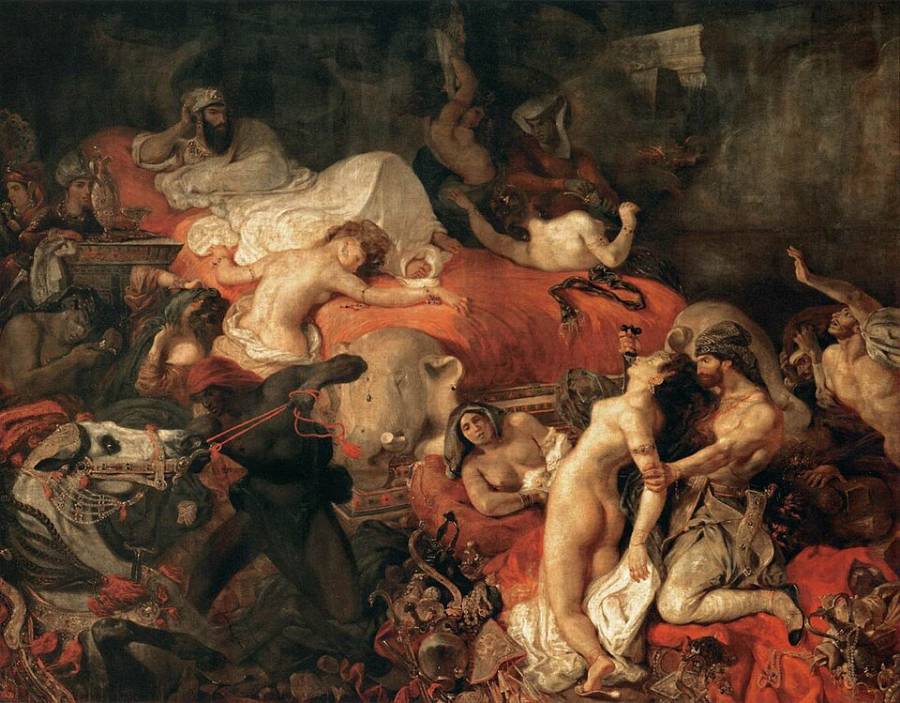
The first challenge of The Death of Sardanapalus is deciding where to look. A king reclines above a scene of panic, but your eye slips away from him toward a horse, a blade, red cloth, and bodies struggling at the edge of the bed. Delacroix gives a ruler the power to order catastrophe and then refuses to make him the most interesting person in the room.
The order that fills the canvas
The story tells of Sardanapalus, an Assyrian king facing defeat, commanding the destruction of his possessions and household before his own death. Delacroix exhibited the vast canvas in the Salon of 1827–28. The Louvre records that its painted story was explained in the Salon booklet, so the violence was not meant to be a puzzle solved only by experts. Yet knowing the plot does not make the scene easy to watch. People and animals become the property a ruler believes he can erase.
At 3.92 by 4.96 metres, the picture is nearly a room-sized event. Sardanapalus lies high on a richly draped bed, detached from the killing he has ordered. Below, the action spills across a steep diagonal. The composition makes power look strangely idle and its consequences terribly active. That difference is the painting's hardest point, not a colorful extra around its hero.
A kind of order inside the chaos
Red ties the scene together. It travels through the bed, cloth, ornaments, and flashes of flesh, while darker passages interrupt it. Follow one diagonal from the raised bed toward the lower right and the apparent confusion gains a disturbing logic. Delacroix choreographed where the eye would land, even as he painted a world losing control. His dramatic color is not a substitute for structure; it is one of the ways the structure works.
The horse at the lower edge is particularly difficult to ignore. It reminds us that the king's command extends beyond human courtiers to anything he regards as his own. The crowded surface makes the viewer search and search again, discovering another small act of force after believing the scene was already understood.
Romantic spectacle has a cost
Delacroix drew on a fashionable European fascination with imagined Eastern courts. The costumes and luxuries make a spectacular painting, but they also turn a distant culture into a theater for fantasies of excess and cruelty. We can admire the painter's invention and still question whose bodies bear its drama. The women in the scene are given little choice by either the fictional king or the story's visual tradition. That tension should remain visible, not be polished away by praise for the color.
The painter had no documentary access to an ancient Assyrian palace. His image belongs to nineteenth-century Romantic art, where literature, desire, history, and invention often met without firm borders. Treating it as a factual reconstruction would miss both its ambition and its blind spots. It is a painting about power imagined by a modern artist, not an eyewitness account of antiquity.
A difficult reception
The Salon audience did not reward this experiment with a sale. Delacroix kept the painting for eighteen years before a private collector bought it in 1846. Only in 1921 did it enter the Louvre. That delay matters because the work now looks like a landmark of Romanticism. Its later fame can hide the risk of showing such an unruly, morally uncomfortable canvas to viewers who expected a grand scene to offer clearer order and nobler conduct.
We should resist the easy reversal that says the critics were simply foolish and the painter simply brave. The objections had a subject: an image of suffering made dazzling. A modern viewer can feel the same unease while recognizing how deliberately Delacroix assembled the spectacle. The painting's power lies partly in refusing to let either response settle the matter.
Who is really at the center?
Stand back and the king seems to anchor the composition. Come closer and the victims interrupt his command of it. The Death of Sardanapalus keeps forcing this change of scale. Its title names one man's end, but the picture makes us reckon with the many lives he treats as extensions of his own. That is a far more troubling story than the death of a king.