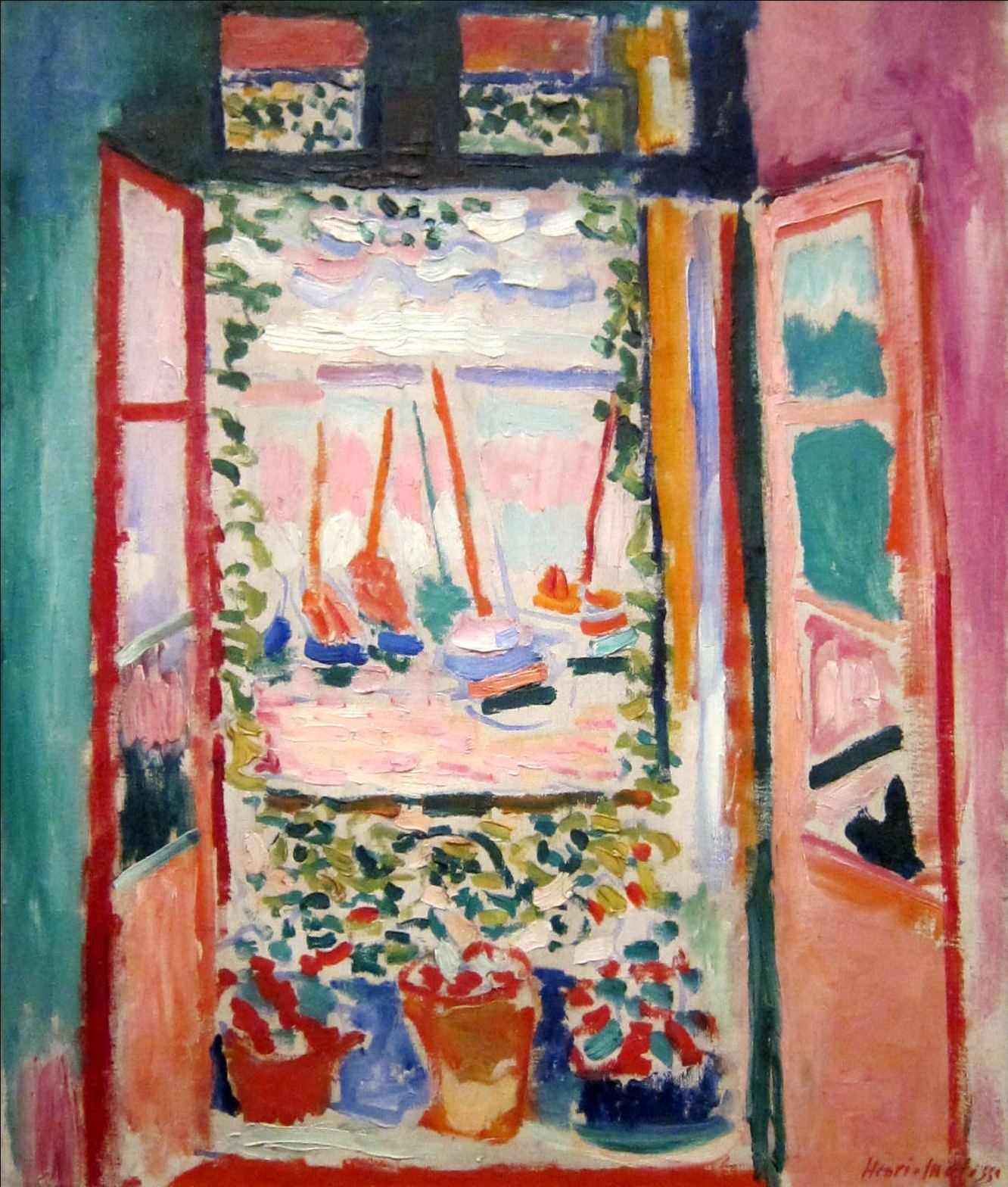
The window is open, but it does not quietly lead us outside. Matisse surrounds the harbor with red, pink, blue, and green, making shutters and sill as vivid as the boats beyond. Open Window, Collioure turns a simple room with a view into an argument about where a landscape begins. Is it the distant water, or the painted threshold that changes how we see it?
A harbor seen through color
Matisse worked in the Mediterranean town of Collioure in 1905. The boats beyond the window are described with quick strokes rather than detailed rigging. Inside, flowerpots and open shutters interrupt the view. A more conventional painter might have made the room a neutral frame for scenery. Matisse gives every part of the frame its own force.
The National Gallery of Art notes the vivid changes of color across the doors, walls, water, and sky. Those colors do not obediently imitate one afternoon's light. They make relationships: a red shutter speaks to a pink boat; a blue patch near the sill intensifies the water beyond. The landscape is made in the eye as much as in the harbor.
The edges refuse to behave
Look where an open door meets the outside. Its boundary can be clear in one stroke and almost lost in the next. Matisse allows the paint to remain visibly brisk, so the window seems both a real object and a pattern of colored marks. The high transom, flowerpots, and boats create several frames inside one canvas. We keep moving between them.
The view is not empty of human activity, even though no figure poses in the room. Masts signal boats and the use of the harbor. The open window suggests that someone has made a choice to let air and light in. Matisse gives us traces of daily life, then lets color become the most active presence.
A small canvas with a large effect
Open Window, Collioure belongs to the brief, intense experiments that helped define Fauvism. That label can make the picture sound like a deliberate attack on every rule. Its color is radical, but its subject is familiar and carefully organized: a window, a balcony, a bay. The painting works because Matisse knows how an ordinary room directs attention outward.
The canvas is held in Washington by the National Gallery of Art. Seen among larger works, its scale can surprise. It does not need to be monumental to make an impact. Concentrated color lets a modest view feel expansive, and the brushwork keeps the path between room and harbor open.
Stay on the threshold
Start with the water alone and note how little conventional description it contains. Then look at the colored doors and wall around it. The bay's brilliance depends partly on those neighbors. Matisse makes a landscape by showing how a view is encountered, not by pretending the viewer floats outside any particular room.
The window remains the painting's most useful question. It opens onto a place, yet it is also a painted structure filled with its own pleasures. We can enjoy the boats and the riot of color without deciding which is the 'real' subject. Matisse lets the answer change every time the eye crosses the sill.