
Searching for a freer color
Matisse treated color as a force that could organize a picture and carry feeling. After early experiments with bright, unmixed pigment helped define Fauvism, he continued to explore interiors, portraits, textiles, and gardens. Henri Matisse (1869–1954) worked in France. Matisse’s early experiments with bright color led critics to call a group of painters Fauves. He kept changing his methods across interiors, portraits, sculpture, and late cut paper. The place and dates locate Henri Matisse, while the objects below show what such a life could produce. Their differences deserve as much attention as their resemblance.
Color as structure
Strong color can create the architecture of a room without describing every shadow. Pattern, contour, and open space work together rather than competing for realism. Look at Still Life with Geranium and then at a different work below. The comparison makes clear which choices Henri Matisse returned to and which belonged only to one image.
The room remade by paint
The Red Studio makes its environment a field of color. The late cut-outs, including The Snail, allowed scissors and colored paper to carry long-standing questions about rhythm. What survives from a career is uneven: famous objects, studies, commissions, and works valued differently by later audiences. Still Life with Geranium deserves attention as one of those objects, with a date and medium that can be checked. A close look may reveal a decision missing from the standard story of Henri Matisse. Moving from this work to another on the page helps restore an experimental life behind the short account of a style.
Fauvism and its limits
Henri Matisse is associated with Fauvism. The label Fauvism locates one strand of this career, but no short movement name can contain every decision in a lifetime of work. Movements are conversations held through exhibitions, training, images, and later writing. Henri Matisse participated in one such history, and Still Life with Geranium gives that story a specific surface. A comparison with a peer can show where the artists met and where they parted. The label works best when it leads us back to that particularity instead of taking it away.
A closer look at Still Life with Geranium
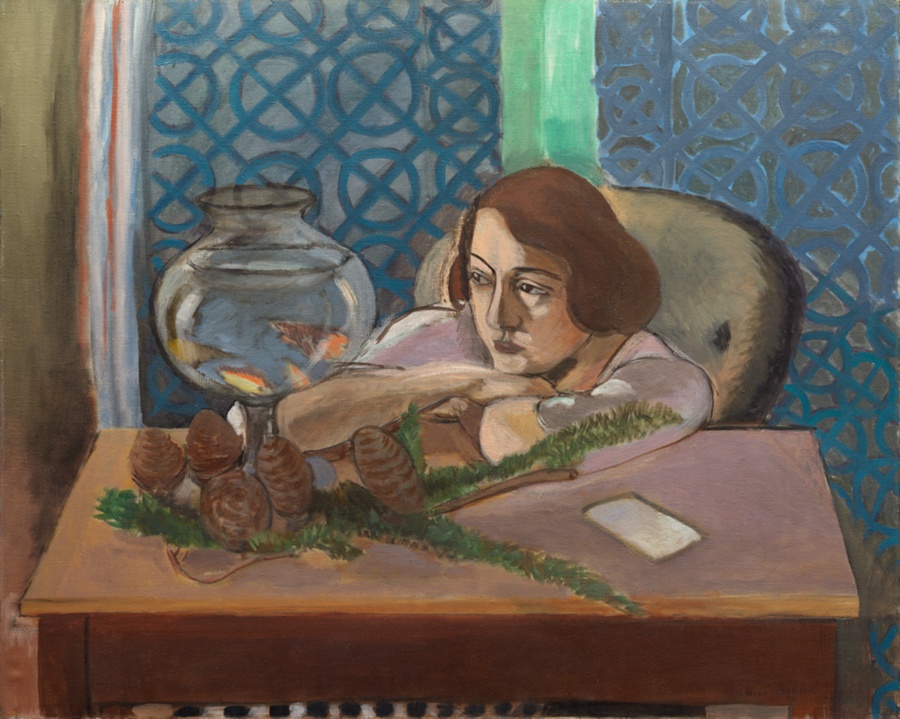
Matisse brings fruit, flowers, and objects into a still life whose color organizes the room. Matisse gives plants and household objects a vivid color life that exceeds their descriptive role. The still life becomes a field of relationships among shapes and hues. Looking at those relationships makes the work more revealing than simply naming each thing on display. Now set it beside Woman before an Aquarium. Matisse places a woman before an aquarium, setting domestic objects and brilliant color into a tightly arranged interior. The woman, aquarium, and objects on the table share a compact field of color. Matisse lets each form alter the balance of its neighbors. Both works are linked below this profile, with their own object records and images. They reward comparison because they show Henri Matisse making different decisions, sometimes with a different material, even when a familiar concern carries across the two.
Matisse’s long experiment
Late in life, physical limitations led him toward cut-paper works of astonishing clarity. Rather than a retreat from painting, these shapes extended his lifelong search for rhythm, balance, and intensity. The common description of his work as joyful is only a beginning. Its apparent ease depends on revision and exact decisions about the relationship between one shape and another. A third work, Apples, complicates any account built from a single celebrated picture. Matisse gives a plate of apples an unexpected intensity, making color and placement more important than ordinary description. Apples on a plate become concentrated shapes and hues. The painting's bright rim and dark surroundings make color, rather than an elaborate story, carry the image. Read beside the earlier works, this object makes the arc of Henri Matisse’s career less predictable. Its survival lets us notice decisions a short label might hide.
Still Life with Geranium and Apples give modest objects an active color life, though one spreads among several plants and furnishings while the other concentrates on a plate. Woman before an Aquarium makes color organize a room around a figure. Looking from one to another shows Matisse testing placement as carefully as hue. Familiar objects become different compositions as their neighboring colors and intervals change. In each, the edge of an object matters as much as the color filling it; a plate, vase, or aquarium can hold one patch apart from another. That attention gives a quiet interior its peculiar energy.