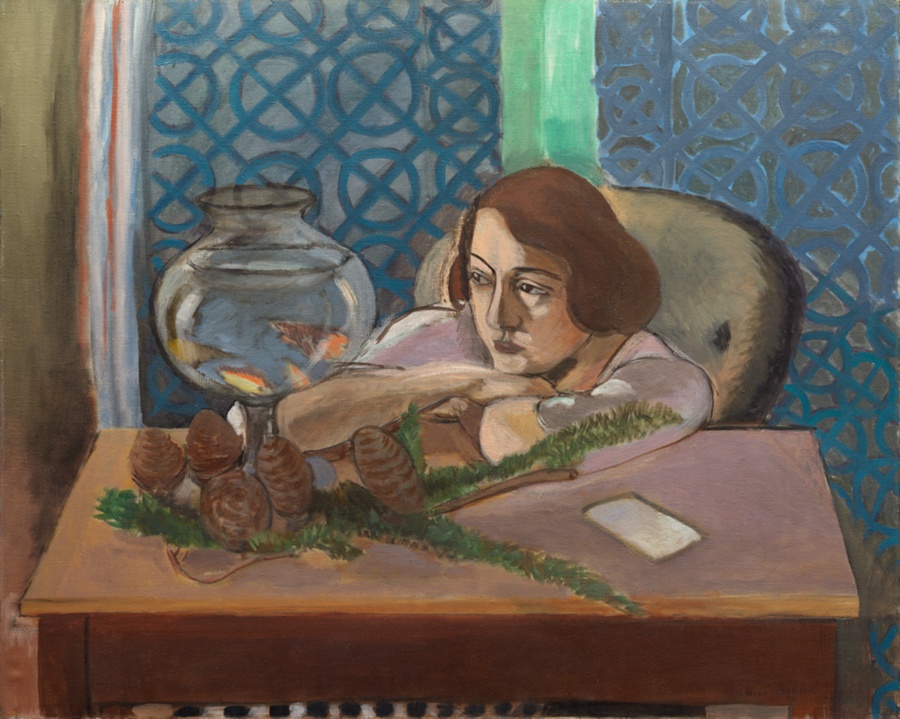
Still Life with Geranium in its time
Matisse brings fruit, flowers, and objects into a still life whose color organizes the room. Still Life with Geranium is dated 1906 and is held by Art Institute of Chicago. The source record names it “Still Life with Geranium.” The source tells us which object this is. Looking at Still Life with Geranium reveals decisions that no short catalogue line could contain.
What appears at first glance
Matisse gives plants and household objects a vivid color life that exceeds their descriptive role. The still life becomes a field of relationships among shapes and hues. Looking at those relationships makes the work more revealing than simply naming each thing on display. One way into Still Life with Geranium is to notice what the image withholds. A face may turn away, an action may be incomplete, or a space may continue past the frame. Such openings allow the viewer to keep looking.
The surface of the work
The collection records Still Life with Geranium as oil on canvas. What appears in Still Life with Geranium began on a specific support. Its material description and dimensions offer clues about the artist’s process and the work’s intended scale. In Still Life with Geranium, process and appearance meet; the materials in the record help explain what kind of surface carried these choices. Compare Still Life with Geranium with another work by the artist. Its medium and size can help explain why the two works meet the eye differently.
Henri Matisse and this work
Matisse treated color as a force that could organize a picture and carry feeling. After early experiments with bright, unmixed pigment helped define Fauvism, he continued to explore interiors, portraits, textiles, and gardens. The flowers do not sit quietly among the other household objects. Matisse gives each color an active place in the arrangement, so the room feels made through relationships rather than a list of things. The public life of Still Life with Geranium can make it seem inevitable that Henri Matisse would have made it this way. Art rarely feels inevitable from the maker’s side. Another image by the same maker may use a related method toward another end, or change the method altogether. Notice which visual problem seems newly urgent here, and which one the artist has approached before. Treating each object as a fresh decision makes room for change, experiment, and the practical conditions under which an artist worked. The other works linked from Henri Matisse’s profile give Still Life with Geranium a useful company: their differences make this image more specific.
The world around Still Life with Geranium
Matisse’s early experiments with bright color led critics to call a group of painters Fauves. He kept changing his methods across interiors, portraits, sculpture, and late cut paper. The date attached to Still Life with Geranium, 1906, is more than a period marker. It places the work among the people and circumstances in which its first audience could encounter it. With Still Life with Geranium, the source entry anchors attribution and materials; it does not settle every possible reading of the work.
Image and object record
Art Institute of Chicago identifies Still Life with Geranium as a work by Henri Matisse from 1906 and records its medium as oil on canvas. The collection credits the object to Joseph Winterbotham Collection. Follow the linked object record for its catalogue entry and any further notes on its history.