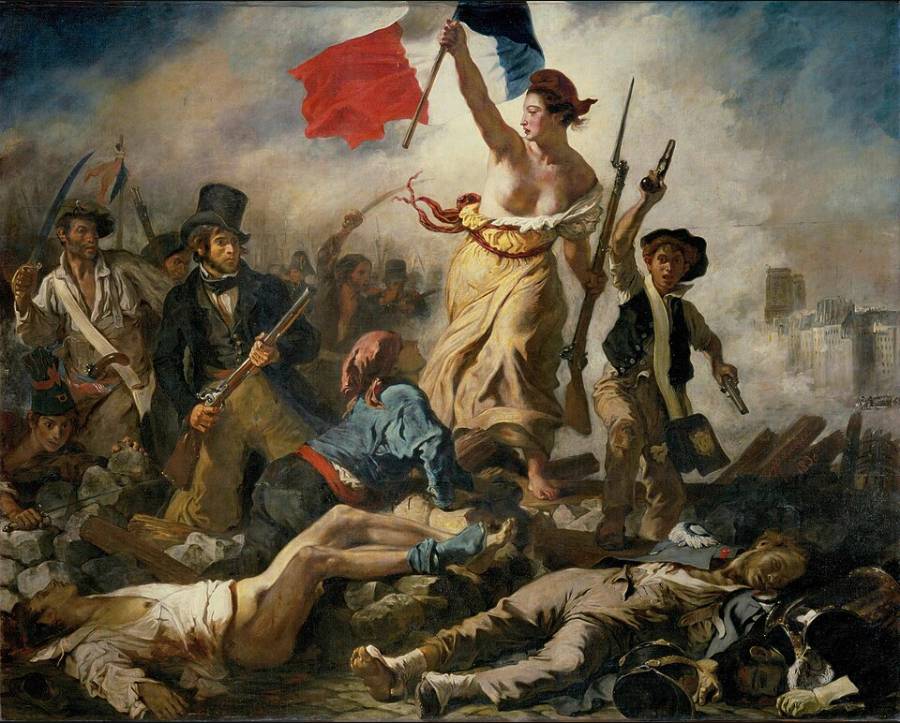
A woman lifts the French tricolour above a barricade. A boy runs beside her with pistols. At their feet lie the people who did not make it across. Liberty Leading the People is famous enough to look familiar before we have really seen it. Delacroix makes that familiarity dangerous: the painting will not let an inspiring symbol walk forward without the cost of the fighting beneath her.
This is July 1830
The picture commemorates the July Revolution of 1830, when an uprising in Paris overthrew King Charles X. It is not a scene from the French Revolution of 1789, though the flag and the figure of Liberty can make those histories blur in memory. Delacroix painted the canvas in the months after the July events and showed it at the Salon in 1831. The Louvre's full title, The 28th of July 1830: Liberty Leading the People, anchors the allegory to a particular day.
There is no single reporter's viewpoint here. The woman is both a body moving across debris and an idea given human form. Around her, people of different ages and dress join the surge. The city is visible through smoke, but it does not offer a clean stage. Delacroix constructs a crowded route forward, with just enough room for us to imagine following.
Look down before you look up
The flag commands the sky; the dead command the foreground. One figure is partly stripped, another sprawls near the barricade, and the advancing crowd must step over them. These bodies are not a decorative border for triumph. They make the viewer feel the height of the climb. A familiar reproduction often shrinks them into a strip of dark paint. In front of the full canvas, they are too large to dismiss.
Delacroix's color helps the eye move between the living and the fallen. Red, white, and blue recur in clothing, smoke, and cloth before they gather in the flag. The tricolour is a destination for the gaze, not the only place where the revolution exists. It has been assembled from the people below.
A symbol with bare feet
Liberty is not a portrait of a named woman. She wears a Phrygian cap, an established sign of freedom, and bares her breast in the manner of an allegorical figure. Yet she also grips a gun, plants her feet on rubble, and pulls bodies into motion. Delacroix makes her improbable and convincing at the same time. That double identity is why the picture can feel like both a historical scene and a political argument.
The boy at her side is equally difficult to reduce to a slogan. His raised pistols bring urgency, youth, and danger into one small figure. He is not proof that every Parisian fought together in harmony. The crowd suggests shared action while leaving its differences visible. Political paintings rarely become more truthful by pretending a coalition had no fractures.
The politics of being displayed
The new French state bought the painting after its Salon appearance, but its public life was not a straight line of celebration. Revolutionary energy could be useful as a founding image and unsettling as a continuing demand. The canvas moved through periods of display and storage before becoming one of the Louvre's best-known works. Its institutional history is part of its meaning: the same image can be hailed as national memory and feared as a call to act.
What should a viewer take from it now? The painting does not supply one policy or one account of 1830. It shows how an ideal gains force when people give it their bodies, and how quickly a victorious image can hide the injured. Let your eye rise to the flag. Then return to the ground. Delacroix made both journeys necessary.
A scene that resists a tidy ending
Nothing tells us what happens after the group reaches the top. The flag is raised, but the air is still smoky and the street still contested. That unfinished motion gives the painting its staying power. It honors a political moment without allowing history to end at its most photogenic second.