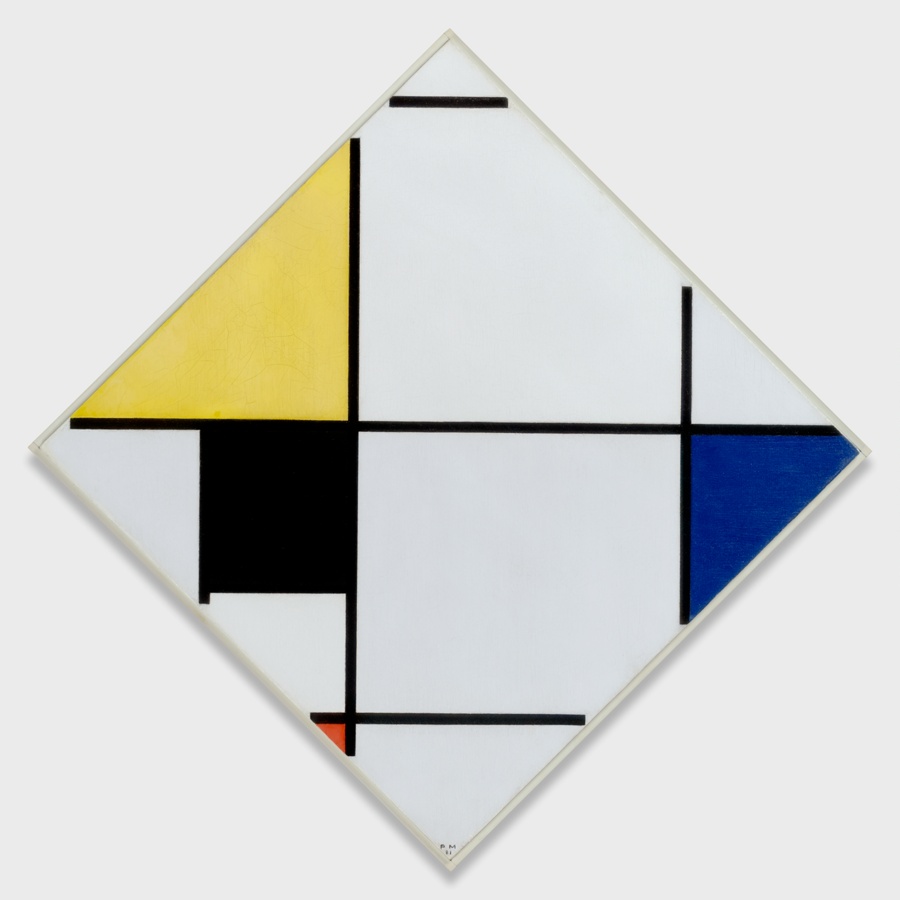
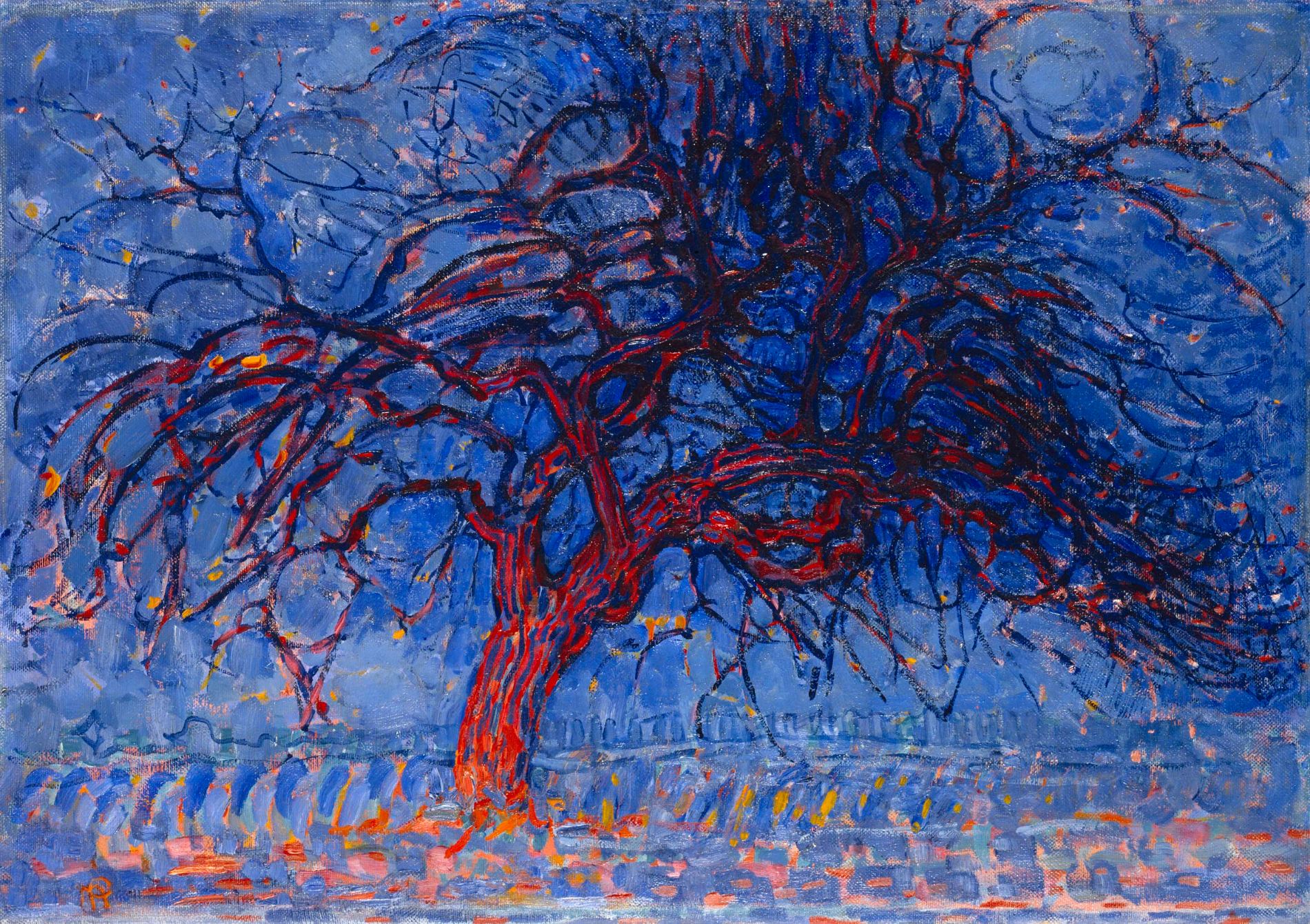
Before Mondrian became famous for black grids and primary-color rectangles, he painted a tree that seems to set the sky alight. Evening: The Red Tree spreads crimson branches across a blue field. It is a landscape with one unmistakable subject, and an early sign that Mondrian was willing to let color and line lead far beyond ordinary description.
A tree that fills the frame
The trunk rises from the lower edge and branches outward until they almost touch every side. There is little ground to stroll through and no distant building to locate. Mondrian gives the tree the scale usually reserved for a landscape panorama. Its many limbs make a network that the eye can enter at several points and never trace in one easy sweep.
The blue behind it does not behave like a conventional evening sky. It deepens and lightens around the red, making their contrast the central event. The branches are recognizably botanical, yet their curves and intersections feel increasingly independent. Mondrian keeps the tree present while testing how much of its force can be carried by rhythm.
Evening as a color decision
The title gives us a time of day, but the palette does not offer a literal weather report. Red branches can suggest late light, heat, or something more inward and expressive. Mondrian uses color to change the tree's emotional temperature. A brown trunk against a pale sky would describe the same object and make an entirely different painting.
Small touches of warmer and cooler color prevent the two large color families from becoming flat cutouts. The trunk has weight; the sky has depth. Still, neither is forced into the smooth tonal finish of an academic landscape. The surface makes us aware of painting as a set of chosen relationships, not simply a transparent window.
A step in a longer search
Kunstmuseum Den Haag dates Evening: The Red Tree to about 1908–1910. Mondrian would return to trees, simplifying branches and spaces across later works before developing the abstract vocabulary for which he is best known. It would be a mistake to treat this canvas as only a preliminary exercise. The tree's urgent color and spread have their own complete presence.
Knowing the later grids can sharpen our view of its branching structure, but it should not make us hunt for rectangles that are not there. Mondrian was responding to a living form and discovering how strongly its lines could organize a surface. The future work did not erase the encounter that produced this one.
The landscape that stays a tree
Follow one red branch from the trunk until it divides into smaller lines. The route may disappear into the crowded top and begin again elsewhere. That difficulty is part of the painting's energy. The tree feels too expansive for the frame, as if its growth and the canvas's edges are in a friendly argument.
Evening: The Red Tree shows an artist thinking with a subject, not merely leaving representation behind. We can admire its color as color and still feel the presence of a particular tree at dusk. Mondrian would later ask different questions with very different shapes. This painting remains a reminder that those questions grew from long attention to the world outside.