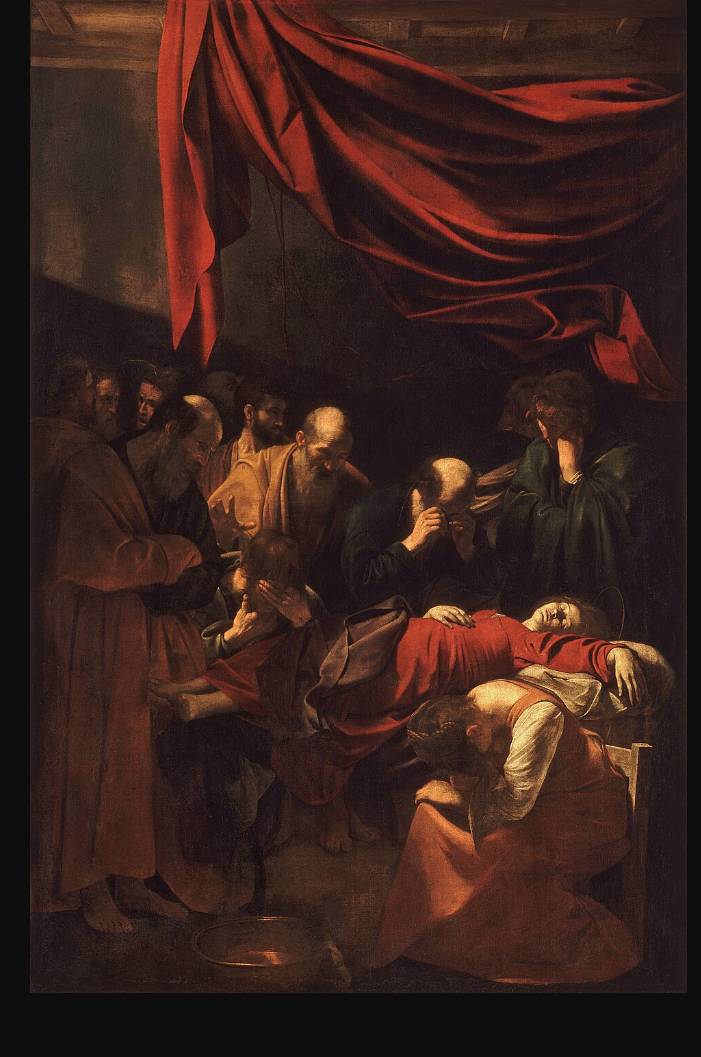
The first thing you may notice is the red curtain. It hangs above Caravaggio's Death of the Virgin like a stage prepared for a revelation. Under it, nobody is performing a miracle. Mary lies still; the people around her have run out of words. The painting's great shock is how ordinary grief looks at this enormous scale.
A sacred story with a human weight
At almost 3.7 metres high, the painting was meant to address a church congregation, not one viewer leaning close. Caravaggio gathers the mourners in a shallow room around the Virgin's body. The sweeping drapery above them gives the scene ceremony, but the mourners' bowed heads and heavy postures bring it back to the floor. There is little architecture to escape into. We stay with the people who have lost someone.
Mary's death, or Dormition, was a familiar religious subject. Many artists made it a passage toward heavenly glory. Caravaggio holds the passage at its most difficult earthly moment. The body has weight. The faces do not all register grief in the same manner. This is a sacred image that trusts the visible facts of mourning to carry part of its meaning.
The curtain cannot tidy the room
The red canopy is spectacular, but it does not behave like a curtain closing over an untidy event. Its broad folds echo the broad grief below, pulling the eye from one side of the picture to the other. Light picks out a shoulder, a face, and the white cloth near Mary, then leaves much of the gathering in shadow. The result is theatrical in its control and untheatrical in its refusal to make sorrow look elegant.
Notice how the figures occupy one another's space. Their bodies make a rough shelter around the dead woman, yet none can undo what has happened. Caravaggio's close arrangement keeps us from treating the mourners as separate symbols to be decoded. They form a group because loss has brought them together.
The painting that was turned away
Laerzio Cherubini commissioned the work for Santa Maria della Scala in Rome. According to the Louvre's record, it was completed around 1605 or early 1606 and refused by the church's clergy. That much is documented. Later stories about the precise reason for its rejection are more dramatic and less secure. The claim that Caravaggio used a drowned sex worker as his model is often repeated as fact, but the surviving object record does not establish it.
Rejection did not make the painting disappear. It entered the Gonzaga collection in Mantua, passed through the collection of Charles I of England, and eventually came to Louis XIV. Its route across courts and collections is almost the opposite of the fixed church setting for which it had been planned. Each new audience met the same uncompromising image for different reasons.
What Caravaggio asks of a viewer
Caravaggio was capable of making a beam of light feel like a command. Here light offers no easy conclusion. It helps us register people trying to bear an absence. The kneeling or seated mourner near the front is neither heroic nor decorative; the figure gives sorrow an ordinary, physical duration. We can imagine this room after the visitors have gone, when the red drapery will still be there and the loss will not be resolved.
The painting's honesty is not the same as a photograph's. Every figure and fold was arranged. Caravaggio has chosen the pause, the lighting, and the angle from which the congregation would see it. His realism is a way of shaping attention, not proof that he simply copied a scene from life.
Standing before it now
The Louvre holds a work made for devotion, rejected by one intended audience, and admired by many later ones. Stand back to see how the red canopy controls the whole canvas; move closer and the large design breaks into small, differing acts of grief. The two distances belong together. This is why Death of the Virgin remains unsettling: it allows a monumental painting to admit that even monumental faith is lived through human bodies.