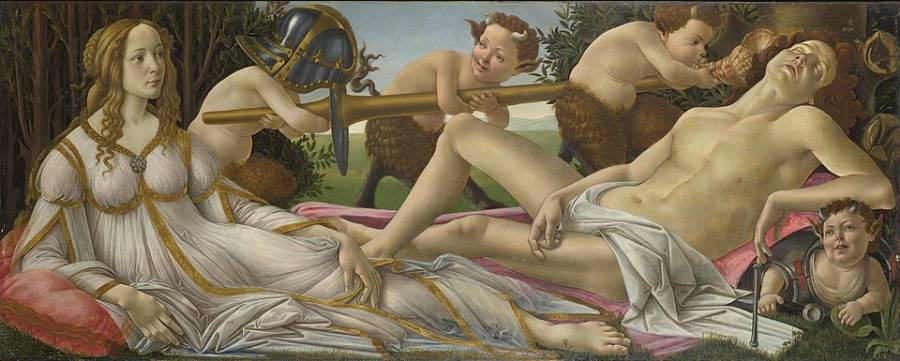
Mars has fallen asleep, Venus is wide awake, and a small band of satyrs has discovered what can be done with an unattended warrior's armor. Botticelli's Venus and Mars stages a joke with unusually serious polish. Its comedy works because the goddess never needs to raise her voice.
A god defeated by a nap
The Roman god of war reclines with his eyes shut and mouth slightly open. Venus sits opposite, alert and composed. Between them, satyrs make mischief with his helmet, lance, and other equipment. One blows a conch near Mars's ear, apparently without success. The armor that normally signals power has become a toy. Botticelli gets a visual punchline from the difference between what Mars represents and what he can do at this moment.
Venus does not appear frightened of the armed figure beside her. Her steady gaze and upright posture hold the long, low composition together. That balance suggests love prevailing over war, a familiar interpretation, but the picture is too playful to become a flat moral emblem. It also enjoys the sheer absurdity of a god who will not wake up.
A painting made for a room
At about 173 centimetres wide and under 70 high, the panel has the proportions of a furnishing rather than a chapel altarpiece. It was likely made for a domestic interior, perhaps as a spalliera painting set into furniture or wall paneling. Marriage is often proposed as a context, and the pair of love and war suits that setting. The original commission is not securely documented, so the imagined room should remain a possibility rather than a fact.
Botticelli worked in Florence around 1485, using tempera and oil on a wooden panel. The precise contours make bodies, cloth, and weapons easy to follow across the narrow field. The scene can look effortless at first. Trace the satyrs' movements, though, and the long format turns into a sequence of little discoveries.
The trouble with clever clues
Wasps hover near Mars, and their presence has led to a famous proposal: they might point to the Vespucci family because the Italian word for wasp is vespa. The theory is intriguing. It is also a theory, not a label Botticelli left behind. A painting full of wit encourages us to hunt for private jokes, but we should keep the difference between evidence and an attractive guess in view.
The satyrs need no secret code to amuse. Their scale makes them bold enough to meddle and small enough to escape consequence. One peers from armor that should have protected a fighter. Another tests the conch's noise. Their game gives the painting a lively clock: how long can they keep playing before Mars finally stirs?
Desire without a tidy answer
Venus and Mars have a mythological relationship, but Botticelli does not illustrate one clear episode with a beginning and end. He offers an aftermath. Mars is spent; Venus is thoughtful; the minor characters seize the moment. Viewers may see a triumph of love, a teasing account of desire, or a joke about masculine bravado. The painting makes room for those readings by leaving its central woman's expression open.
A domestic audience might have known the myths and enjoyed the allusions, but it also could have delighted in the scene as a beautifully arranged comedy. We need not choose between intelligence and pleasure. Botticelli gives us both in a panel that rewards moving from the gods' faces to the smallest prank.
Watch the one who stays awake
The National Gallery acquired the painting in 1874. Today its mythic figures are often reproduced as a neat pairing, yet the full panel has a slower rhythm. Let your eye follow each satyr and return to Venus. Mars remains asleep through it all. The joke lasts because her attention, unlike his, never wanders.