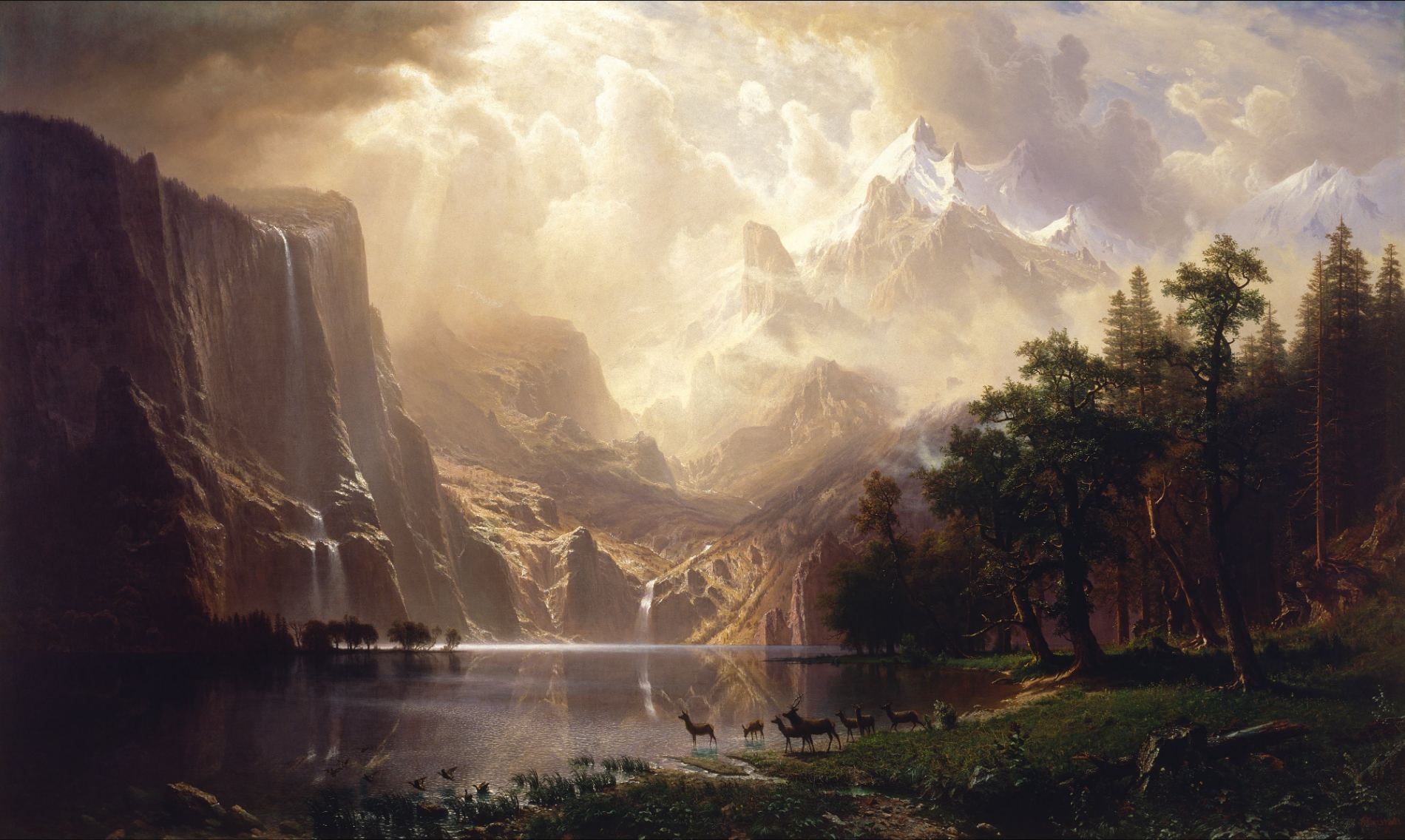
A bright break in the clouds pours light toward a lake, cliffs, and distant snow. Among the Sierra Nevada, California was designed to stop viewers in their tracks, and it still does. Bierstadt painted it on a vast canvas in 1868, bringing travel sketches and studio invention together for an audience eager to see the American West as spectacle.
A landscape staged at full size
At roughly three metres wide, the painting asks for the kind of attention usually given to a history scene. The glowing center pulls us between dark trees and rock faces into a luminous distance. Deer near the water offer a small scale for the huge cliffs. They also make the place seem serenely available to the viewer, a choice that deserves scrutiny alongside admiration.
Bierstadt knew how to present a canvas as an event. The Smithsonian notes that he used theatrical displays and publicity to build anticipation for large western scenes. That history does not make the painting merely commercial. It tells us that its sudden light and grand size were part of a carefully planned public encounter.
What travel became in the studio
Bierstadt traveled in the West and made studies he could later use in New York. The finished canvas is not a neutral survey photograph of one standing point. Mountains, cloud, water, and animals have been arranged for a persuasive whole. The light is so concentrated that the valley appears to open precisely for the viewer. This is the craft of landscape painting operating on a monumental scale.
Look at the darker masses on both sides. They work almost like theatre curtains, sharpening the effect of the bright opening. The reflections below repeat that light and keep the eye near the center. It is easy to call the picture realistic because the rocks and trees are detailed. Its drama depends just as much on selective illumination.
The word wilderness has a history
Nineteenth-century viewers often greeted western landscapes as images of unclaimed wilderness. California's mountains and valleys were, and remain, part of Indigenous histories and homelands. The absence of people in this particular view does not prove absence from the land. Bierstadt's art belongs to an era when beauty, tourism, expansion, and dispossession were deeply entangled.
Recognizing that context need not dim the painting's visual achievement. It helps us see what the canvas makes especially visible, and what its chosen frame leaves out. The lake and dramatic cliffs are real kinds of places, but the idea of an empty paradise was also being made and sold.
A light worth questioning
Follow the beam from the clouds to the water and back up to the mountains. The route is extraordinarily effective. Then look to the dark margins where the painting withholds detail, and ask why the center feels like a revelation. Bierstadt manages our gaze with the confidence of a stage designer.
Among the Sierra Nevada, California remains a spectacular picture. It becomes a more interesting one when we let the spectacle raise questions about the audience it was built for. The painting shows a landscape and a nineteenth-century desire to see that landscape in a particular way. Both are part of its story.