From London to the sea
Turner transformed landscape and seascape into experiments with weather, light, and motion. Trained in watercolor and active at the Royal Academy, he traveled widely and studied both natural spectacle and modern industry. J. M. W. Turner (1775–1851) worked in Britain. Turner developed through watercolor and the Royal Academy before making landscape painting a testing ground for modern weather, travel, and industry. Sketching journeys fed his studio work. The place and dates locate J. M. W. Turner, while the objects below show what such a life could produce. Their differences deserve as much attention as their resemblance.
Weather in paint and watercolor
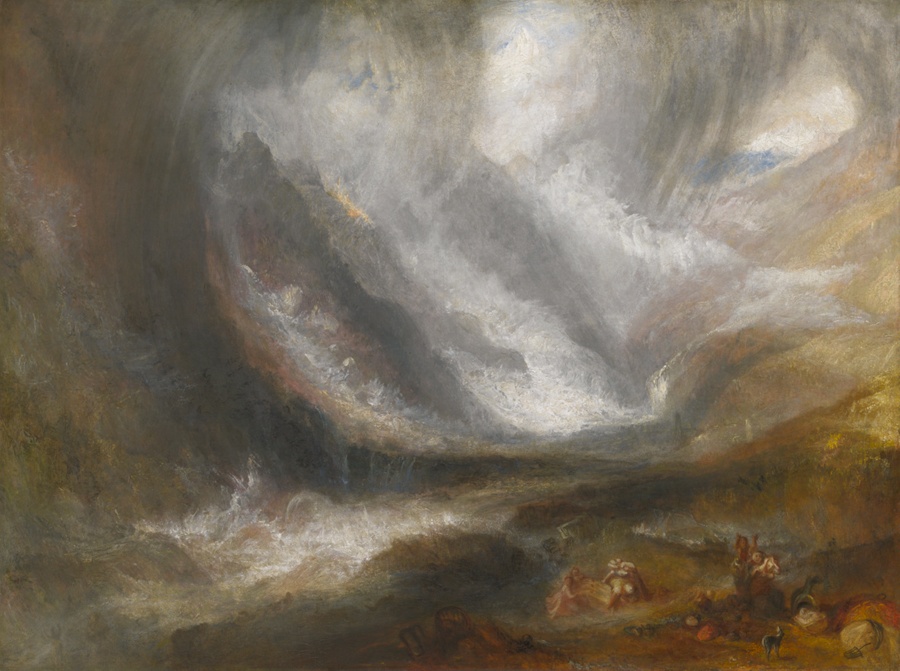
He could make a ship, bridge, or shoreline nearly disappear without abandoning the observed world. Layers of color and loose edges let atmosphere organize the scene. Look at Valley of Aosta: Snowstorm, Avalanche, and Thunderstorm and then at a different work below. The comparison makes clear which choices J. M. W. Turner returned to and which belonged only to one image.
Journeys and changing light
Rain, Steam and Speed places a locomotive within a turbulent field of weather and movement. His sea pictures likewise make human engineering feel vulnerable to larger forces. What survives from a career is uneven: famous objects, studies, commissions, and works valued differently by later audiences. Valley of Aosta: Snowstorm, Avalanche, and Thunderstorm deserves attention as one of those objects, with a date and medium that can be checked. A close look may reveal a decision missing from the standard story of J. M. W. Turner. Moving from this work to another on the page helps restore an experimental life behind the short account of a style.
Romanticism and its limits
J. M. W. Turner is associated with Romanticism. Romantic artists explored feeling, imagination, history, and the power of nature. A landscape might suggest freedom, fear, memory, or the limits of human control. The movement crossed borders and media, taking very different forms in Friedrich’s quiet horizons, Turner’s weather, and Delacroix’s color. Movements are conversations held through exhibitions, training, images, and later writing. J. M. W. Turner participated in one such history, and Valley of Aosta: Snowstorm, Avalanche, and Thunderstorm gives that story a specific surface. A comparison with a peer can show where the artists met and where they parted. The label works best when it leads us back to that particularity instead of taking it away.
A closer look at Valley of Aosta: Snowstorm, Avalanche, and Thunderstorm
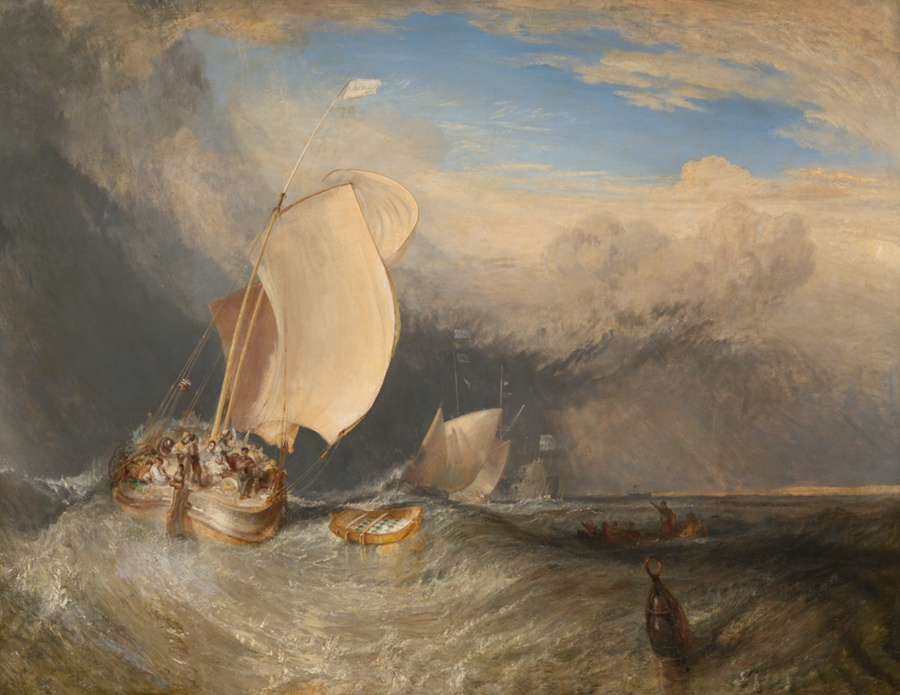
Turner's alpine view lets storm and avalanche unsettle the apparent solidity of mountain scenery. Turner uses the mountain weather to put vision itself under pressure. Solid ground, moving snow, and cloud seem to trade places as the eye searches for a stable path. The work is a reminder that a landscape can represent an encounter with forces that resist clear description. Now set it beside Fishing Boats with Hucksters Bargaining for Fish. Turner gives a fishing scene the movement of boats, work, water, and exchange at the edge of shore. Turner joins working boats and bargaining figures to a coastal scene. Trade and weather both shape what happens near the shore. The picture is useful for seeing how a landscape painter could treat labor, movement, and atmosphere within one view. Both works are linked below this profile, with their own object records and images. They reward comparison because they show J. M. W. Turner making different decisions, sometimes with a different material, even when a familiar concern carries across the two.
Turner’s continuing challenge
His later paintings can seem almost abstract, yet they remain rooted in observed storms, rivers, and skies. Turner made atmosphere a central subject and opened possibilities that later painters would pursue in very different ways. Calling the late paintings abstract can be useful, but it can also erase the rivers, storms, fires, and technological changes that prompted them. A third work, View of Lucerne, complicates any account built from a single celebrated picture. Turner builds a view of Lucerne through transparent watercolor and scraped highlights, making light and distance central to the scene. Watercolor gives the lake, distant buildings, and atmosphere different degrees of definition. Turner lets broad washes carry distance while sharper passages keep the view tied to a particular place. Read beside the earlier works, this object makes the arc of J. M. W. Turner’s career less predictable. Its survival lets us notice decisions a short label might hide.
Valley of Aosta presses weather against the mountain until the view seems unstable. View of Lucerne, made in watercolor, allows light and distance to gather with greater delicacy. The fishing boats introduce trade and work at the shore. These are not three versions of one picturesque interest: Turner uses different materials and settings to ask how an image can hold forces that seem to be changing while we look.
Explore Romanticism ↗