Valley of Aosta: Snowstorm, Avalanche, and Thunderstorm in its time
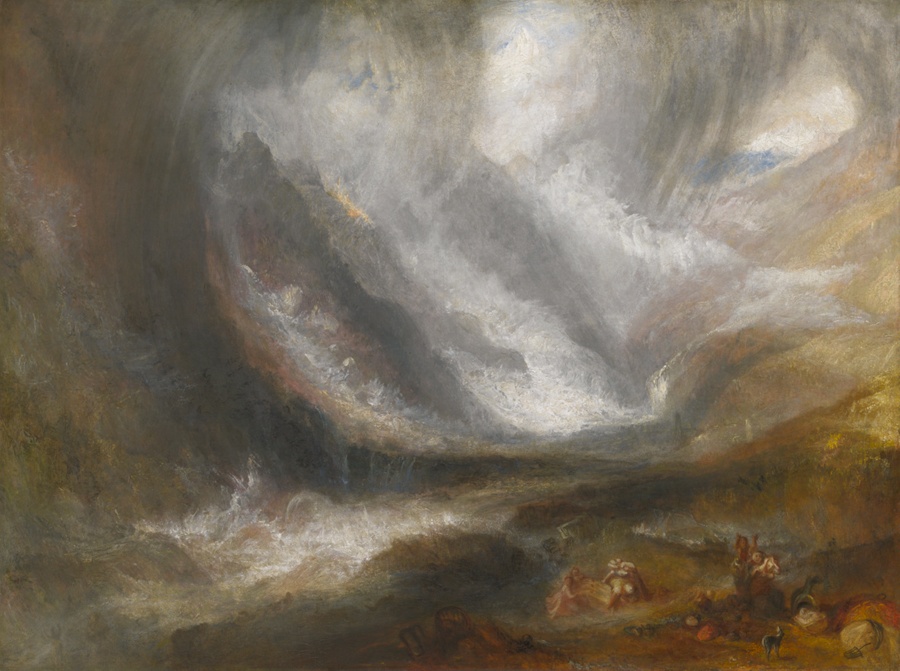
Turner's alpine view lets storm and avalanche unsettle the apparent solidity of mountain scenery. Valley of Aosta: Snowstorm, Avalanche, and Thunderstorm is dated 1836–37 and is held by Art Institute of Chicago. The source record names it “Valley of Aosta: Snowstorm, Avalanche, and Thunderstorm.” With Valley of Aosta: Snowstorm, Avalanche, and Thunderstorm, the catalogue provides the facts of the object; the visual relationships carry the experience further.
Inside the composition
Turner uses the mountain weather to put vision itself under pressure. Solid ground, moving snow, and cloud seem to trade places as the eye searches for a stable path. The work is a reminder that a landscape can represent an encounter with forces that resist clear description. Follow one repeated shape or direction across Valley of Aosta: Snowstorm, Avalanche, and Thunderstorm. Even when the forms differ, their relation can make the picture feel held together. This rhythm is easy to miss if you look only for a story.
How it was made
The collection records Valley of Aosta: Snowstorm, Avalanche, and Thunderstorm as oil on canvas. In Valley of Aosta: Snowstorm, Avalanche, and Thunderstorm, materials help determine how marks could be laid down and how the result met its first viewers. The collection entry describes the surface on which those choices were made. The listed materials give Valley of Aosta: Snowstorm, Avalanche, and Thunderstorm a physical history beyond its familiar digital image, including a support, surface, and scale. Look between the image of Valley of Aosta: Snowstorm, Avalanche, and Thunderstorm and its object record. Each answers different questions about appearance, material, and scale.
J. M. W. Turner and this work
Turner transformed landscape and seascape into experiments with weather, light, and motion. Trained in watercolor and active at the Royal Academy, he traveled widely and studied both natural spectacle and modern industry. The title lists several forces at once, and Turner refuses to sort them into a calm view. Snow, cloud, and rock compete for definition, so the difficulty of seeing becomes part of the event pictured. No single work can summarize J. M. W. Turner. A subject can be revisited without producing the same picture twice: scale, material, and audience all alter the problem. Another image by the same maker may use a related method toward another end, or change the method altogether. Those shifts are easier to recognize when the works are treated as objects with dates and materials. Treating each object as a fresh decision makes room for change, experiment, and the practical conditions under which an artist worked. No single image can contain J. M. W. Turner’s career. Valley of Aosta: Snowstorm, Avalanche, and Thunderstorm is a vivid place to begin, with other works nearby to complicate the view.
The world around Valley of Aosta: Snowstorm, Avalanche, and Thunderstorm
Turner developed through watercolor and the Royal Academy before making landscape painting a testing ground for modern weather, travel, and industry. Sketching journeys fed his studio work. Valley of Aosta: Snowstorm, Avalanche, and Thunderstorm carries a date, 1836–37, but it has also had a later life. Each collection, display, or reproduction offers another meeting with the same historical object. The linked source keeps Valley of Aosta: Snowstorm, Avalanche, and Thunderstorm tied to a particular object while you continue exploring what its image makes visible.
Image and object record
Art Institute of Chicago identifies Valley of Aosta: Snowstorm, Avalanche, and Thunderstorm as a work by J. M. W. Turner from 1836–37 and records its medium as oil on canvas. The collection credits the object to Frederick T. Haskell Collection. Follow the linked object record for its catalogue entry and any further notes on its history.