
The modern city and its stages
Degas was fascinated by movement, rehearsal, and the work behind performance. Ballet dancers, laundresses, and racehorses offered him forms that could be cropped, repeated, and studied from unexpected angles. Edgar Degas (1834–1917) worked in France. Degas was close to the Impressionists but often preferred theaters, studios, and working spaces to open-air landscape. Drawing and repeated revision remained central to his practice. The settings of Edgar Degas’s life mattered to the opportunities and constraints of making art. The works collected here let those conditions meet visible choices.
Drawing bodies in motion
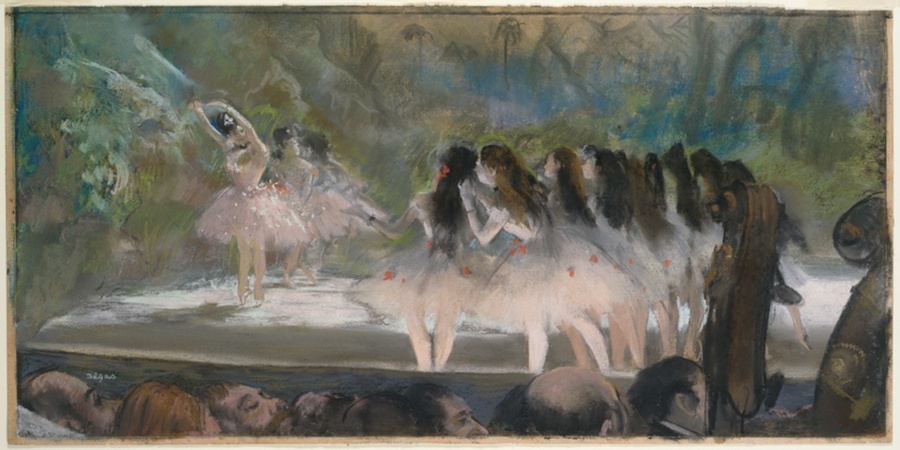
Cropping can make a figure look accidentally seen, although the arrangement is deliberate. Pastel, sculpture, and painting gave him different ways to test movement and pose. A career can contain both practiced habits and departures. Ballet at the Paris Opéra gives a concrete place to study how Edgar Degas balanced the two in one made object.
Rehearsals and working rooms
Rehearsal images show dancers stretching, waiting, and correcting their positions. The Little Fourteen-Year-Old Dancer likewise raises questions about training, class, and the public display of a young performer. The named projects are landmarks, but a career also happens between landmarks. Ballet at the Paris Opéra offers a way to slow that history down. Describe its most active passage, then notice the quieter choices that keep the composition together. Its source entry gives material and date, facts that help place this particular object. Follow another work by Edgar Degas and the line between preparation, revision, and fresh experiment becomes less tidy and more interesting.
Impressionism and its limits
Edgar Degas is associated with Impressionism. The Impressionists made changing light, modern leisure, and everyday experience central to painting. Their independent exhibitions challenged the authority of the official Paris Salon. Open brushwork and unusual cropping varied from artist to artist; the group included Monet’s outdoor studies, Degas’s rehearsal rooms, and Morisot’s intimate scenes. A shared label is not proof of a shared aim. Edgar Degas worked among people, institutions, and images that may be grouped under one movement today, yet Ballet at the Paris Opéra needed its own composition. Notice which choices appear tied to its first audience and which speak to a broader artistic concern. This way of looking allows the history around the work to matter without swallowing the work itself.
A closer look at Ballet at the Paris Opéra
Degas puts dancers and performance within a composition alert to rehearsal, labor, and the viewpoint of the observer. Degas treats ballet as a pattern of bodies, costume, light, and interrupted views. The performance setting gives him opportunities to contrast theatrical display with the work of preparation and movement. Cropping keeps the scene active, as though its edges extend into a larger life off the page. Now set it beside The Millinery Shop. Degas places hats and women inside a shop, making commerce, labor, and display part of the scene. Degas fills the shop with hats, fabric, and the work of selection. Display and labor occupy the same interior, complicating any quick reading of it as a fashionable scene. The angled view makes the viewer aware of how much activity continues beyond the frame. Both works are linked below this profile, with their own object records and images. They reward comparison because they show Edgar Degas making different decisions, sometimes with a different material, even when a familiar concern carries across the two.
What Degas makes visible
Unlike many Impressionists, he often built compositions in the studio and experimented across drawing, pastel, painting, and sculpture. His art asks viewers to notice the labor and repetition hidden behind a polished spectacle. His work can reveal labor behind beauty, but it also places the viewer in an uneasy position of observation. That tension is part of its modernity. A third work, Jockey, complicates any account built from a single celebrated picture. Degas studies a jockey through spare graphite marks, showing his interest in movement before a finished racing scene. Degas records a jockey with a few lines that locate weight and posture. The incomplete drawing helps reveal how a figure in motion can be studied before being placed in a larger scene. The surviving work gives us more than a list of achievements. Its contrasts show Edgar Degas revising, repeating, and sometimes leaving behind earlier solutions.
Ballet at the Paris Opéra suggests the public stage and the work that supports it. The Millinery Shop finds another world of display and labor, while the drawing Jockey follows posture before any finished racing scene is needed. Degas’s cropped viewpoints are famous, but these subjects show a broader curiosity about preparation, performance, and the people who make a scene work. The drawing and the shop deserve attention beyond the ballet image.
Explore Impressionism ↗
