
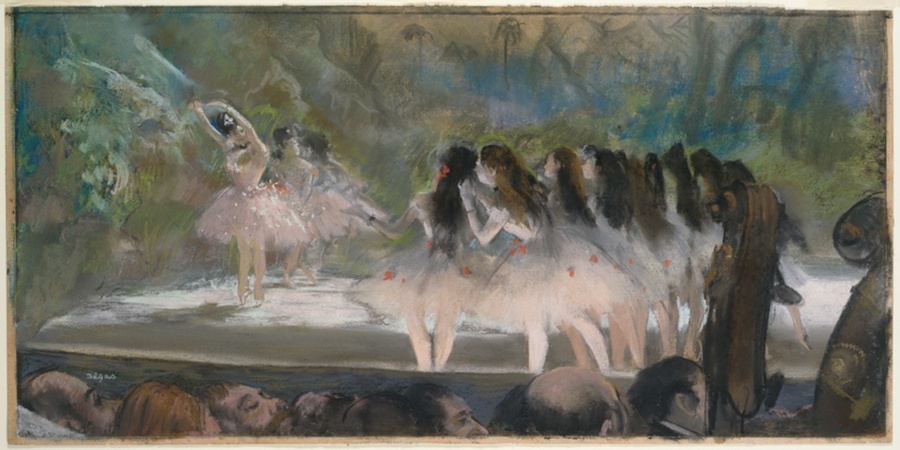
Ballet at the Paris Opéra in its time
Degas puts dancers and performance within a composition alert to rehearsal, labor, and the viewpoint of the observer. Ballet at the Paris Opéra is dated 1877 and is held by Art Institute of Chicago. The source record names it “Ballet at the Paris Opéra.” The record identifies Ballet at the Paris Opéra; the image itself invites a slower look at how its parts meet.
A closer view
Degas treats ballet as a pattern of bodies, costume, light, and interrupted views. The performance setting gives him opportunities to contrast theatrical display with the work of preparation and movement. Cropping keeps the scene active, as though its edges extend into a larger life off the page. Look at how Ballet at the Paris Opéra handles distance. Its nearest forms and farthest spaces may be described with very different degrees of clarity. That difference affects where you feel invited to stand.
The surface of the work
The collection records Ballet at the Paris Opéra as pastel over monotype on cream laid paper. The stated materials of Ballet at the Paris Opéra limit what we can reasonably claim about its making. Follow the record for those details, then return to the image to look for their visible effects. In Ballet at the Paris Opéra, the recorded material is part of the encounter: it affects the scale, marks, and finish that the original object can hold. Look again at the strongest visual accent in Ballet at the Paris Opéra. The linked record supplies dimensions and materials that help place that detail within the whole work.
Edgar Degas and this work
Degas was fascinated by movement, rehearsal, and the work behind performance. Ballet dancers, laundresses, and racehorses offered him forms that could be cropped, repeated, and studied from unexpected angles. The picture gives its dancers a setting shaped by watching, rehearsal, and display. Degas’s crop makes the stage world seem to continue outside the sheet, where more work and movement remain unseen. An artist’s name can make a work feel familiar before we have really looked at it. Even when two objects share a subject, they need not share the same emphasis. Its subject, medium, and visible emphasis may seem consistent with other works, or they may reveal a different route. Those shifts are easier to recognize when the works are treated as objects with dates and materials. The pace of Ballet at the Paris Opéra deserves attention; another work by Edgar Degas may move the eye quite differently. Ballet at the Paris Opéra belongs to Edgar Degas’s longer practice, and the other works in this collection let you test what changed from one subject to another.
The world around Ballet at the Paris Opéra
Degas was close to the Impressionists but often preferred theaters, studios, and working spaces to open-air landscape. Drawing and repeated revision remained central to his practice. Ballet at the Paris Opéra has been seen under different conditions since 1877. Its first setting shaped its audience; the linked record documents the object as it is known today. Read the documented title and medium for Ballet at the Paris Opéra beside the image; the record can settle object details while leaving interpretation open.
Image and object record
Art Institute of Chicago identifies Ballet at the Paris Opéra as a work by Edgar Degas from 1877 and records its medium as pastel over monotype on cream laid paper. The collection credits the object to Gift of Mary and Leigh Block. Follow the linked object record for its catalogue entry and any further notes on its history.

