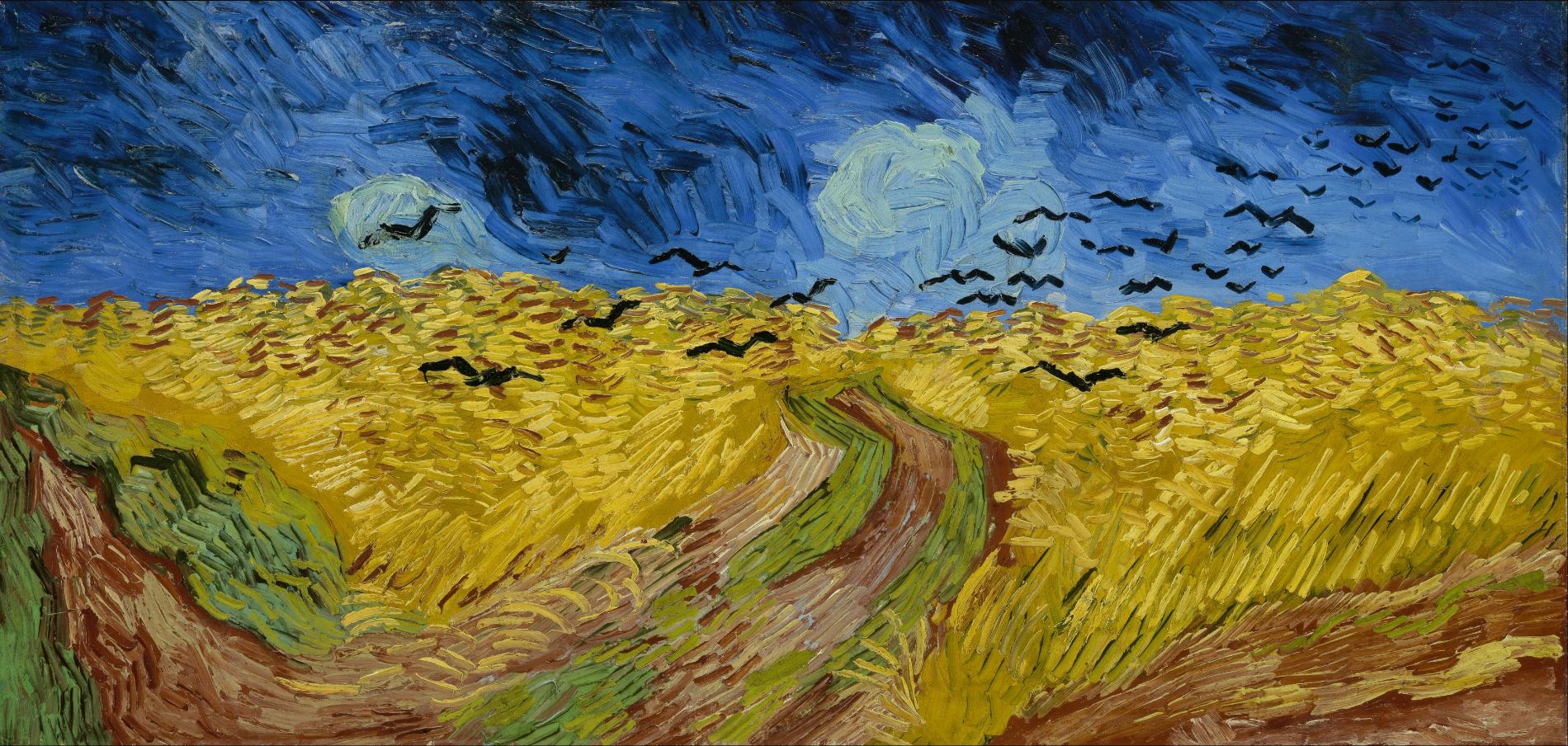
Three paths cut into a yellow field, crows cross a dark sky, and none of the routes offers a clear arrival. Wheatfield with Crows is often presented as Van Gogh's final painting, a ready-made farewell. The Van Gogh Museum says that story is false: he made other works afterward. Leaving the myth behind makes the actual painting more demanding, and more moving.
A field that refuses a single route
The central path approaches us, then seems to stop in the wheat. Two others turn toward the edges. Van Gogh does not provide the gentle recession that would lead us safely to a far farmhouse or town. The crop fills the view, and the horizon sits beneath heavy blue. The eye must keep choosing among routes that the picture never confirms.
The crows do not form one neat flock. They scatter across the sky in quick dark strokes, adding motion to a scene whose ground feels strangely fixed. A bird may be arriving or leaving; we cannot tell which. That ambiguity is stronger than a symbolic equation in which every crow must mean death.
Color makes the weather urgent
Yellow-orange wheat pushes against a blue sky so dark that it can feel almost solid. Red-brown paths strike through the field, and bands of green heighten their heat. Van Gogh uses these contrasts to make the landscape feel immediate, as though color itself is a change in pressure before rain. The thick marks do not politely imitate separate stalks. They keep the surface alive with the effort of looking.
At over a metre wide, the painting spreads sideways rather than inviting a distant panoramic escape. It places us near the crop and under the sky. That format makes the paths' uncertainty physical: our eyes move laterally, searching for a way through. The field is not simply a symbol placed behind a mood. It has scale and weight.
Auvers in July 1890
Van Gogh painted Wheatfield with Crows at Auvers-sur-Oise in July 1890. In a letter about wheatfields beneath troubled skies, he spoke of 'sadness, extreme loneliness' but also of what was 'healthy and fortifying' in the countryside. The two feelings belong together in his account. The landscape could register difficulty without losing its strength as a place to work and look.
A myth about the artist's last days can make every brushstroke look like a prediction. Van Gogh was still actively painting and testing what a broad field and low horizon could do. Knowing that he made further pictures does not remove the painting's unease. It restores its place within a continuing practice rather than turning it into a staged final message.
What remains open
Try following the left path only as far as the edge of the frame. Then follow the middle one and notice where it seems to dissolve. The canvas does not reward either choice with a destination. Its energy lies in keeping us within the field, surrounded by color and weather that are still changing.
The Van Gogh Museum holds the painting in Amsterdam. Its fame has traveled far, often accompanied by a story that is easier to remember than the view itself. Return to the visible facts: wheat, crows, three paths, and a turbulent sky. They are enough to make the work uncertain and compelling without asking it to serve as a final sentence for a life.