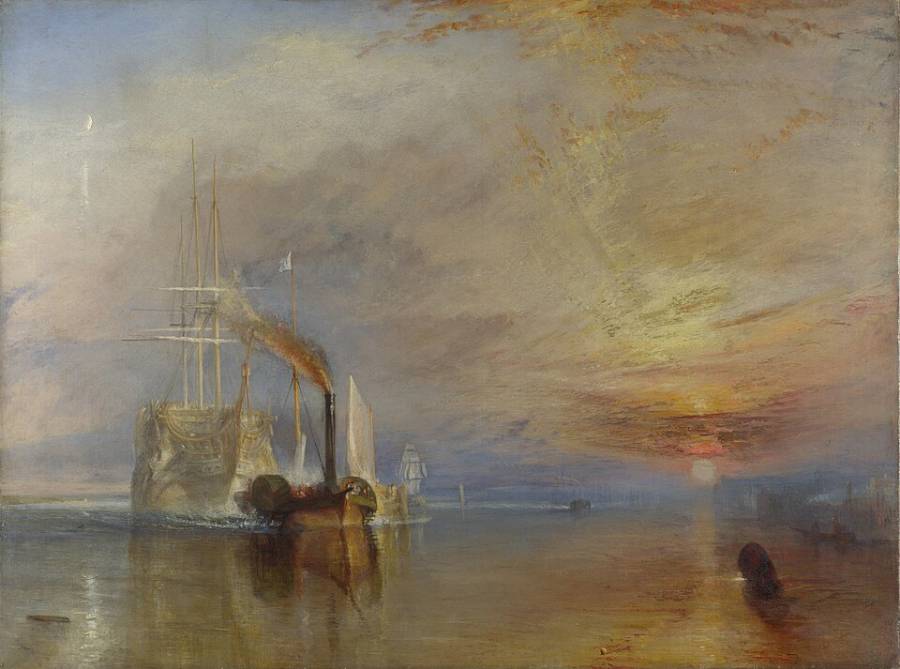
A small black tug drags a pale warship toward the place where it will be broken up. Turner gives the old vessel a sunset big enough for a farewell, then slips a new kind of power into the foreground. The Fighting Temeraire is about the end of one ship, but it also asks what a country chooses to remember when its machines change.
The veteran and the tug
The Temeraire fought at Trafalgar in 1805, part of the British fleet that defeated a combined French and Spanish force. By 1838 the vessel was retired and being taken up the Thames to a breaker. Turner painted the journey the following year. The tug moves with a practical purpose; the ship behind it looks almost ghostly. History and industry share the water, but they do not seem to belong to the same hour.
The title calls the ship 'the Fighting Temeraire', holding on to its old identity even as the canvas shows it unable to move under its own power. That gap between name and condition makes the painting poignant without requiring a single human figure on deck. The vessel itself bears the story.
A beautiful scene that never quite happened
Turner was not making a documentary record of the tow. The Temeraire had already lost its masts, yet he restores them. The real operation involved two tugs, while the painted scene gives one main tug the visual role. The sunset, too, is arranged for poetic effect rather than navigation. These choices are worth noticing because the picture's historical force depends on invention as well as memory.
The pale ship seems to float above its own reflection. Its delicate rigging and high, quiet mass make the tug look busy and almost rude. But the tug is doing the work. Its dark chimney and smoke pull us toward the future that will replace the era of sail. Turner does not ask us to cheer that future or to pretend it can be stopped. He lets its engine chug through an elegy.
Two suns, two kinds of fire
On the right, the sky burns orange and red around the setting sun. Near the tug, darker smoke rises from coal. Turner sets natural radiance and industrial fire within the same spectacle. It is easy to see the sunset as the end of the age of wooden warships; it is harder, and more rewarding, to follow the color back into the smoky little machine that moves the old giant.
Water makes the divide less tidy. Bright streaks and dark reflections mix below both vessels. The river is a working route, a mirror, and a passage out of sight. If the Temeraire looks like a ghost, that effect is made from paint, light, and the very ordinary fact that it is being hauled away.
What does a nation keep?
Trafalgar was a defining British naval victory, and the painting invites patriotic feeling. Yet there is no battle here, no heroic officer to salute, and no promise that the ship will be preserved. Its timber will be sold. Turner takes national memory to the moment when a useful object becomes material again. That makes the farewell sharper than a picture of the ship at full sail might have done.
The National Gallery received the painting through the Turner Bequest in 1856. Seen there now, it can feel securely treasured. Its subject remains an act of dismantling. The painting survives because Turner looked at something that would not.
Follow the towline
Look from the tug to the ship, then from the ship to the sky. The eye keeps reversing the journey: forward toward scrap, backward toward glory, outward toward the day ending. Turner gives no single direction all the authority. His sunset is spectacular, but the small tug keeps moving. That is the painting's quiet, stubborn truth.