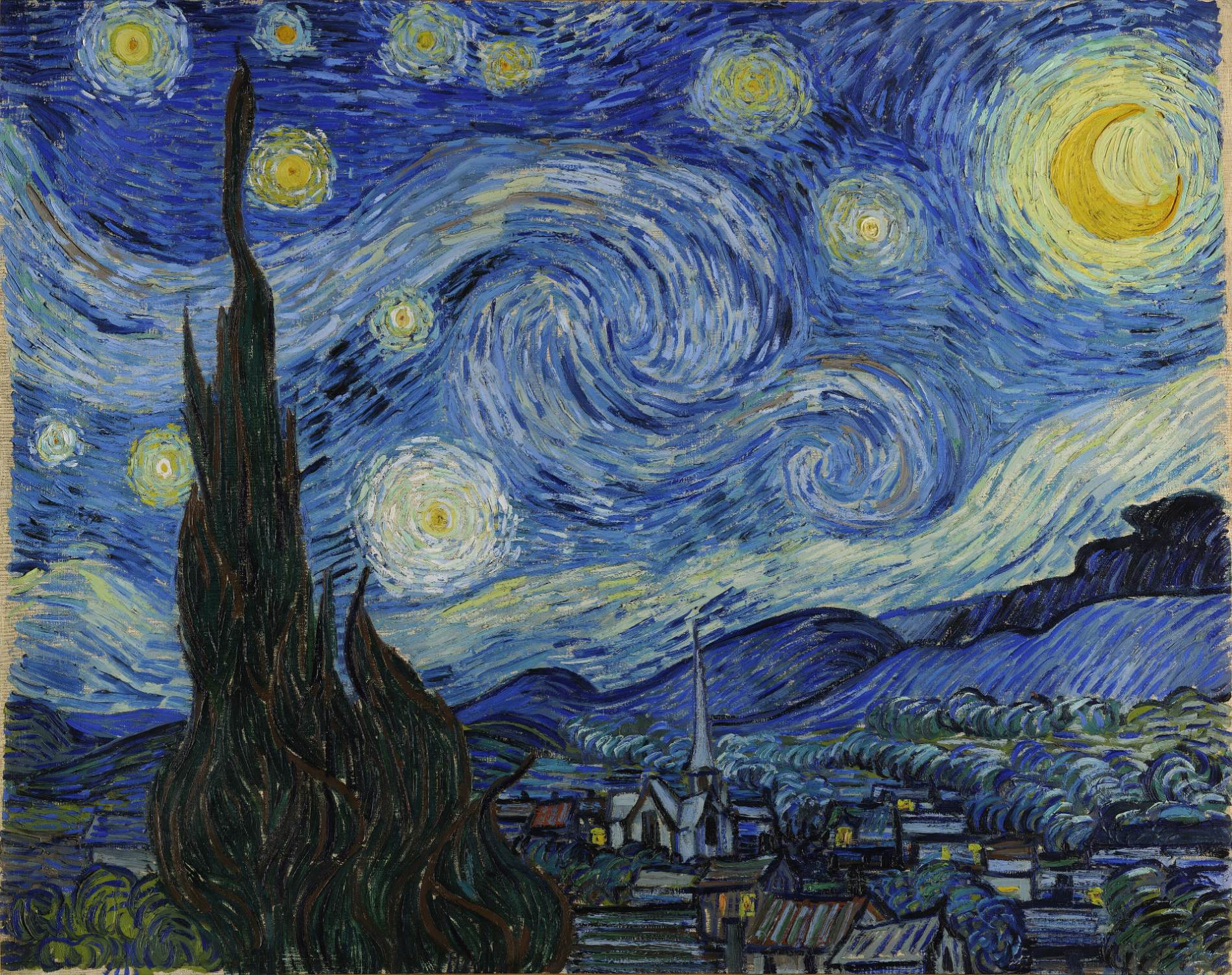
A cypress rises like a dark flame, the sky turns in bright currents, and a village sleeps below. The Starry Night has been reproduced so often that it can feel like a symbol before it feels like a painting. Van Gogh made it at Saint-Rémy in 1889, drawing on the view from his asylum window while changing that view in ways that made a private night into an unforgettable image.
What Van Gogh could see, and what he added
The hills and night sky connect to the landscape around Saint-Paul-de-Mausole, where Van Gogh was receiving care. MoMA notes that he painted the canvas in daylight over several sessions, not in one nocturnal burst. The village below was not visible from his window as shown. Observation gave him a starting point; memory and invention supplied a place for the sky to meet human life.
The cypress in the foreground is close enough to interrupt the stars. It joins earth and sky without becoming a simple bridge between them. Its near-black shape makes the yellow lights appear brighter and the blues deeper. If you cover it with your hand, the composition loses much of its pressure.
The sky is built, not spilled
Broad bands of paint curve around stars and moon. Shorter marks describe hills and rooftops below. The brushwork is energetic, yet its paths are organized. Van Gogh moves the eye in circles above and in quieter diagonals across the village. The contrast gives the painting a rhythm that a single description such as 'swirling' cannot capture.
Blue is not one color here. It ranges from dark passages near the cypress to cooler, lighter currents around the stars. Yellow halos push into those blues, and the paint's thickness catches light in its own right. The night has a physical surface. A small reproduction preserves the design, but it can flatten the ridges that make the image feel made.
A life is larger than one famous night
Van Gogh's illness is part of the work's history, but The Starry Night should not be treated as an automatic transcript of distress. He was making deliberate choices about composition, color, and the expressive possibilities of landscape. He produced many works during his stay at Saint-Rémy, revisiting cypresses, olive trees, fields, and skies with persistence.
It is also easy to call the village peaceful and the sky turbulent, then stop. Look closer: some of the curving strokes continue the shapes of the hills, while small warm lights appear in the town. The painting keeps the two zones in conversation. It does not ask us to diagnose a mind by assigning all emotion to the heavens.
A window that became a world
The work now lives at MoMA in New York. Its international fame can make the specific Saint-Rémy setting easy to forget. Yet the picture began with a person looking at nearby land and sky under difficult circumstances. Van Gogh made that ordinary act of attention ambitious enough to carry invention without losing its roots in a place.
Follow one star's halo until it meets the next current of blue; then look down to the still church and houses. The movement from sky to village is never final. The Starry Night keeps inviting the eye upward again. Its lasting power lies in that restless return, not in a single secret meaning waiting to be found.