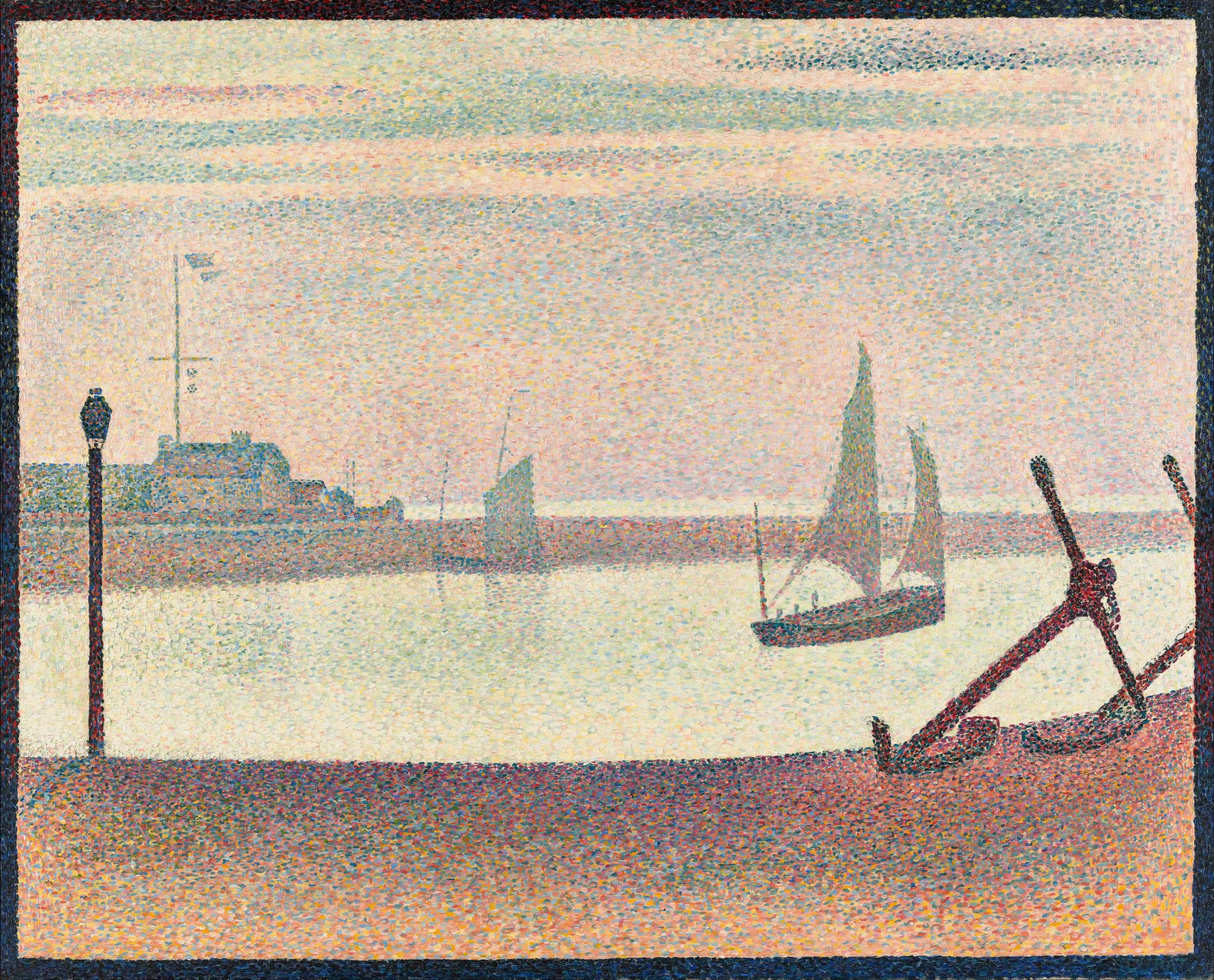
A harbor can be noisy, crowded, and hurried. Seurat paints Gravelines in the evening as if someone has lowered the volume without stopping the work. A few boats and markers hold the channel in place beneath bands of soft color. The Channel at Gravelines, Evening is quiet, but its quiet is carefully made from thousands of small decisions.
An open route through a working port
The channel gives vessels a way between land and sea. Seurat keeps that practical geography visible: vertical posts, distant structures, and small boats interrupt the horizontal water. We are not looking at a wilderness sunset. Navigation has shaped the scene, even when no large ship dominates it. The port's everyday purpose remains within the evening calm.
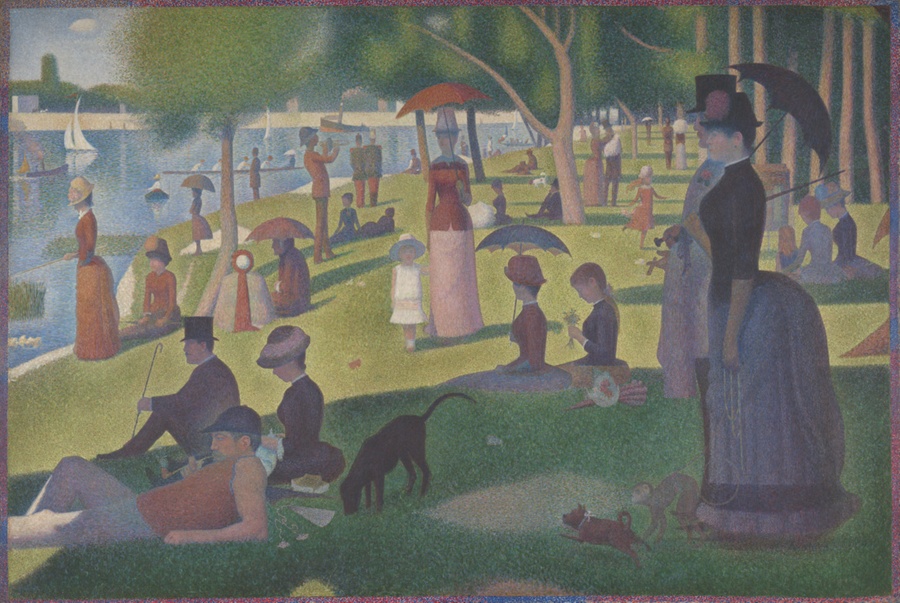
The composition gives the eye room to cross. Low land sits under a wide sky; the water holds a second, paler version of the light above. A few dark accents make the great stretches of color measurable. Seurat's restraint is striking after his crowded Bathers at Asnières and La Grande Jatte. He can make scale felt with almost no figures at all.
What a small mark can do
Seurat developed a method of placing tiny touches of color beside one another so that the viewer's eye would combine them. In this 1890 painting, the separate marks do not merely decorate a fixed outline. They build the air and water, letting colors vibrate at the edges of objects. The effect asks for two viewing distances: near enough to notice the touches, far enough to let them meet.
A channel marker may read as a single dark shape from across the room. Closer up, its edge is a negotiation among surrounding colors. The same is true of the far bank and the fading light. Seurat's patience does not freeze the evening. It gives the slow change of dusk a surface that seems to shimmer.
The last summer of a short career
The painting belongs to a group of views made at Gravelines in the summer of 1890. Seurat died the following year, still in his early thirties. Knowing that can give the scene an elegiac cast, but the painting was not made as a farewell. It was another attempt to see what his method could do with coastal light, open space, and sparse human signs.
MoMA holds this canvas in New York. Its museum label can place it inside the story of Pointillism, a useful term for the method. The image itself stays particular: a northern French port near evening, where a practical waterway becomes a stage for extremely measured color.
A stillness full of work
Try counting the upright shapes that punctuate the view, then let your gaze return to the horizontal bands. The channel will seem more engineered the first time and more atmospheric the second. Seurat holds both impressions together. The boat route was made for movement, yet in this moment it can appear almost still.
The Channel at Gravelines, Evening rewards attention without demanding a dramatic story. Its subject is the slow visibility of things as light changes: post, sail, shore, water. Seurat's marks make the port feel both exact and difficult to grasp, the way a familiar place can become strange just before night.