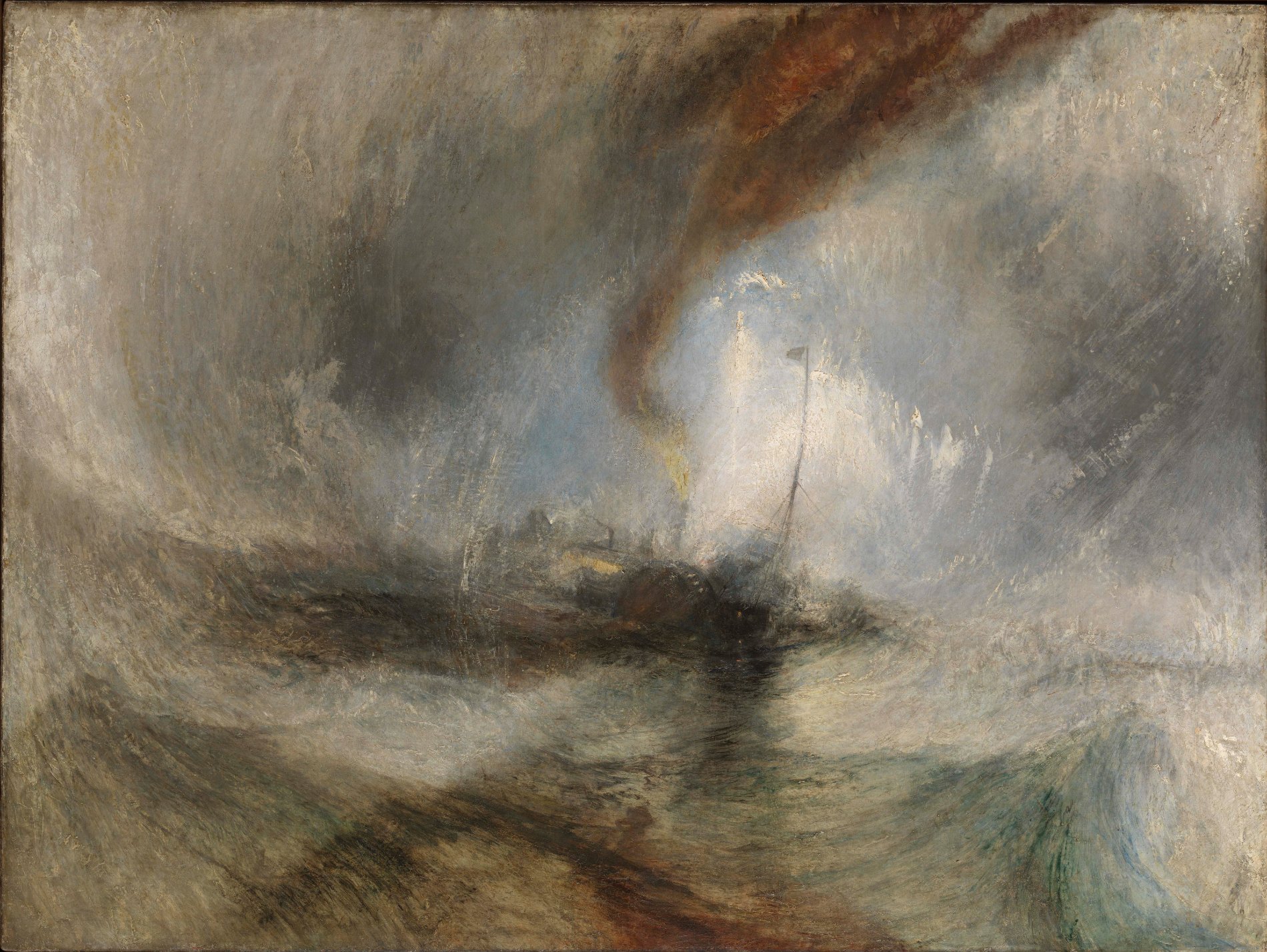
A steam-boat is somewhere inside this weather. Turner gives us a mast and a few dark hints of a hull, then lets wind, water, and smoke pull the scene apart. Snow Storm: Steam-Boat off a Harbour's Mouth is not a puzzle with a hidden object to win. It is a painting about the difficulty of keeping one's bearings when the world will not hold still.
The boat is not in charge
Turner exhibited the canvas in 1842 with a long title describing a steam-boat in shallow water, making signals and going by the lead. The lead was a weight lowered to sound the depth. Even before we study the paint, the title tells us that navigation is uncertain. The crew needs information from below the surface just as the viewer searches for visual bearings above it.
The vessel does not rule the composition. It is caught within a spiral of light and dark that seems to turn the sea, sky, and smoke together. The harbor's mouth should promise shelter, yet the picture holds us outside it. Turner makes the threshold between safety and danger hard to place.
A storm made of marks
There is no clean horizon to divide the elements. Brown, grey, white, and flashes of warmer light sweep across the surface in energetic curves. A dark form gathers where the boat might be, only for the paint to scatter it again. The brushwork is doing more than describing bad weather. Its very refusal to settle gives the eye an experience of being buffeted.
Look for places where a pale passage cuts through a darker one. The apparent chaos is carefully organized around a turning center. If the image were equally blurred everywhere, it would become a foggy blank. Turner keeps just enough contrast for us to feel the storm's direction without being allowed to stand outside it.
A famous story deserves caution
A tale says that Turner had himself tied to a ship's mast to observe a storm. It has become inseparable from the painting's reputation, but the evidence for that exact adventure is uncertain. The story is appealing because the picture feels so physical. Yet the canvas does not need a verified ordeal to explain its force. Turner spent a lifetime studying seas, light, and the limits of representation.
The steam-boat also places modern technology in a subject with a long artistic history. Storms had tested sailing vessels in countless paintings. Here an engine offers power but not mastery. The weather still sets the terms.
Why the blur stays with us
Viewers who expect every object in a landscape to be outlined may find this painting evasive. That response gets close to its subject. The boat's crew would also want clearer information. Turner does not offer the safe distance of an observer on shore. We are asked to work through the storm with the vessel, seeing in brief fragments rather than complete facts.
Return to the dark center, then follow the surrounding whirl to the edge of the canvas. The image can feel as if it is moving even while the paint stays fixed. Turner makes the landscape an event rather than a backdrop. A century of later experiments in abstraction does not make this sea less real; it shows how far he was willing to push paint to convey it.