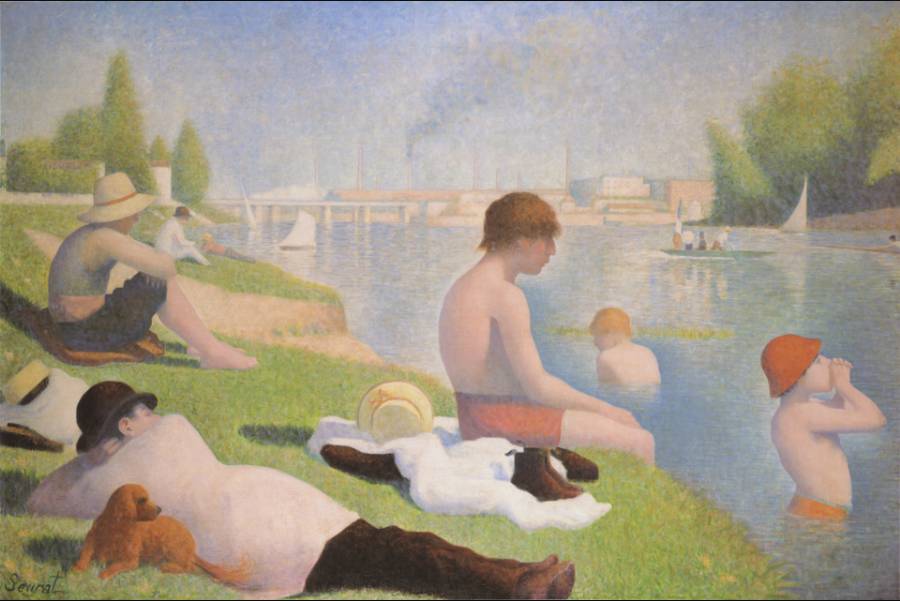
A boy at the edge of the Seine calls toward the opposite bank. Nobody in Seurat's Bathers at Asnières seems in a hurry to answer. The summer scene is huge, strangely hushed, and full of small clues about a city working even while its residents rest.
The river is not far from work
Seurat painted the industrial suburb of Asnières in 1884, when Paris was expanding along the Seine. Men and boys sit on a bank, wade, or cool themselves near the water. Behind them stand bridges, chimneys, and factory buildings. A day off does not erase the labor that makes the city run. The river holds recreation and industry in the same broad view.
The canvas measures roughly two by three metres. That scale had often served biblical or historical drama. Seurat gave it to ordinary bodies in ordinary heat. The choice does not make the bathers heroic in the usual sense; it asks how seriously a viewer might look at a working person's leisure. Their stillness can be read as dignity, fatigue, or simply the pleasure of having nowhere else to be for an hour.
Who gets which shore?
Across the water a boat carries a better-dressed couple. The distance between the riverbanks is small enough to see and large enough to suggest different social worlds. Seurat does not write a class argument on the canvas, and we should not pretend that every figure has a documented occupation. The clothes, setting, and separate forms of recreation nevertheless make inequality hard to miss.
Look at the boy who cups his hands to shout. His call seems to cross the picture, yet the scene remains almost silent. Another figure lies stretched out in the grass, face turned away from us. Seurat gives each person a place within the design without handing us a biography. The result is a social scene that remains partly unreadable, much like a real afternoon among strangers.
Before the dots became famous
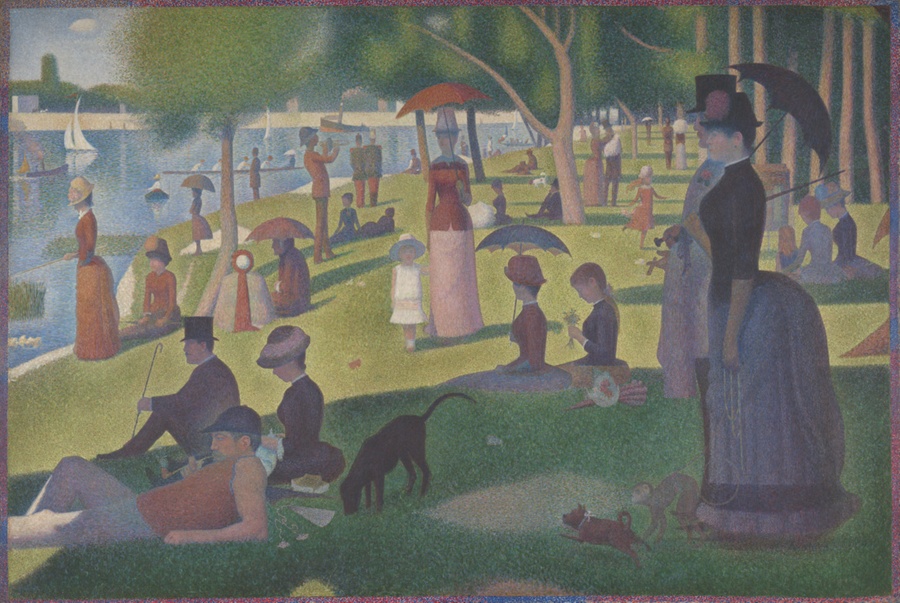
Seurat later became famous for arranging small, separate marks of color, especially in A Sunday on La Grande Jatte. Bathers at Asnières belongs earlier in that investigation. Its figures are built largely with broader, smoother passages, although Seurat returned to parts of the surface with more divided touches. Calling the whole painting a pointillist work skips the interesting question of how his method was developing.
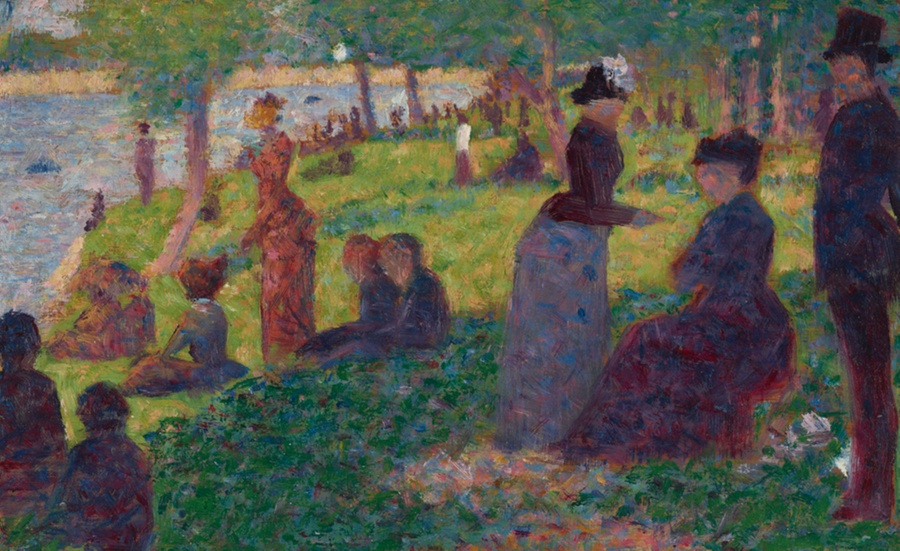
The figures feel stable and oddly suspended. Their outlines are clear, but the light over the grass and water softens the edges of the day. Seurat made many studies before arriving at this large composition. Its calm is not the result of an unplanned glance. It was constructed through repeated looking and deliberate arrangement.
A rejection, then a different audience
The official Salon rejected the painting in 1884. It appeared instead at an exhibition organized by artists seeking a different route to the public. That change of venue fits the work's subject: new audiences were being asked to take new kinds of scenes seriously. A bather on the suburban riverbank was not the stock protagonist of a grand canvas.
Since 1924 the painting has belonged to the National Gallery in London. Its museum setting can make the day look timeless, but the factories will not let it drift free of history. The painting catches a particular place in the making of a modern city, where leisure is visible precisely because work is close by.
Listen to the painted silence
Begin with the calling boy, then let your eye travel left along the resting figures and back to the distant bank. No one supplies a neat ending. The call crosses the water; the city goes on working; the bathers keep their pause. Seurat made an afternoon large enough to contain all three.