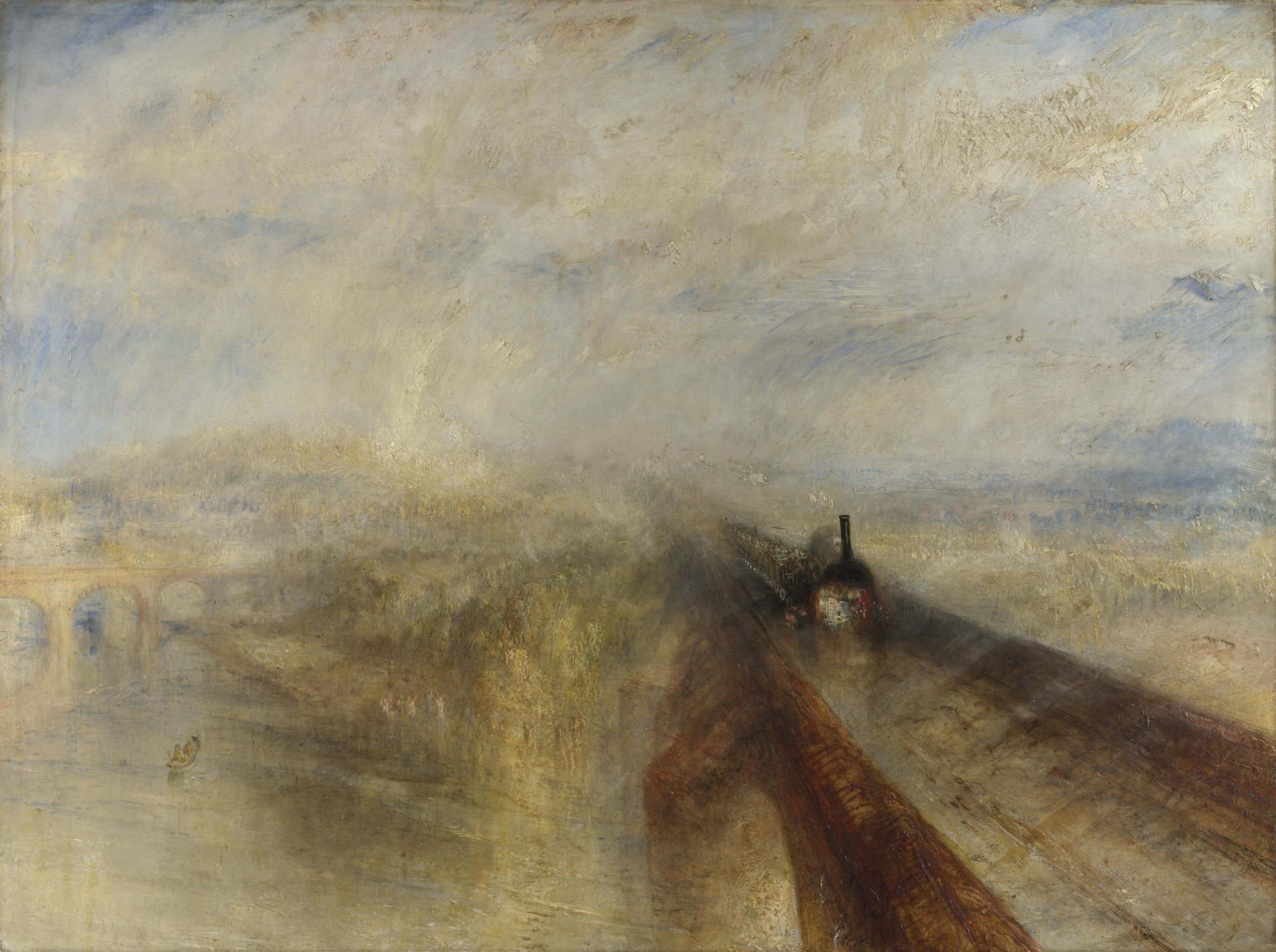
The train is coming toward us so fast that it seems to bring its own weather. Rain, Steam, and Speed lets the railway cross Turner's canvas before we can sort bridge from river, smoke from cloud. A small hare runs on the track ahead. It is a daring comparison between natural and mechanical speed, but the painting's real excitement lies in the way Turner makes both hard to hold in focus.
A bridge into a new century
The train crosses the Maidenhead Railway Bridge over the Thames, designed by Isambard Kingdom Brunel and completed in 1838. Turner painted the picture in 1844, when rail travel had become an increasingly visible part of British life. He places the engine on a steep diagonal that drives straight toward the viewer, compressing the distance between us and the machine.
There is a bridge to the left as well, quieter and easier to lose in the rain. Turner could have offered a clear comparison of old and new transport, but he does not lay the scene out like a diagram. Every structure has to be found through the same damp air. Progress appears as an experience arriving at speed, not as a tidy lesson.
Can you catch the hare?
The National Gallery identifies a hare running roughly along the track ahead of the train. It can be hard to spot even when you know where to look. That smallness matters. A painter making a simple allegory might have enlarged the animal. Turner lets the hare nearly vanish into the marks that describe the railway, so the comparison stays unstable and alive.
The train is darker and heavier than the air around it, but its outlines still soften. The chimney, carriages, and rushing track are partly absorbed by rain. Turner does not ask us to admire a polished locomotive as an object. He asks what it feels like when movement changes how a whole landscape is perceived.
A landscape in motion
Much of the canvas is made from veils of yellow, brown, and pale grey. River and sky seem to trade color; steam and rain meet in the middle. Sharp details would slow the eye, so Turner withholds many of them. The engine appears because the rest of the painting gives it a blurred world to move through.
A viewer may call the scene abstract, but its bridge and railway are specific. That is the pleasure of looking longer. Turner balances a recognisable place with a visual sensation that exceeds a precise map. He painted modern infrastructure without surrendering the landscape to engineering. Weather and water still have their own authority.
What arrives with the train
Railways changed who could travel, how quickly goods moved, and what it meant to look out across a field. The canvas does not measure those changes or declare them all good. Its diagonal makes speed thrilling and a little threatening. The hare reminds us that other forms of motion share the same ground, however briefly.
Stand before the painting and try to locate the instant it records. The train seems too near for comfort, yet the rain keeps spreading around it. Turner stretches one approaching moment into a whole atmosphere. That is why Rain, Steam, and Speed remains more than a period picture of a locomotive: it shows how a new machine could rearrange the very act of seeing.