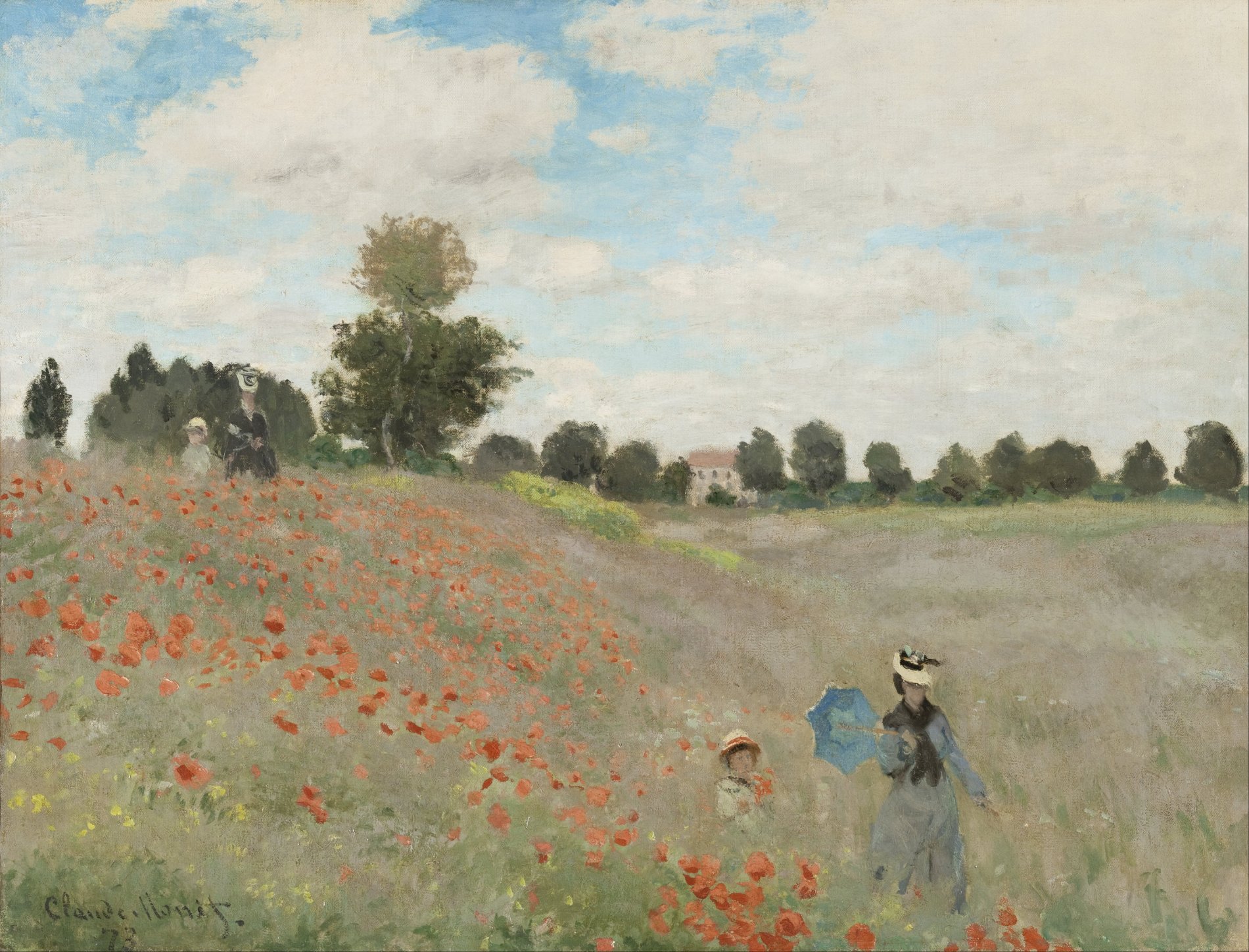
Red poppies scatter down a hillside, and two figures seem to stroll through them without a destination. Monet's Poppies looks effortless from a distance. Up close, its red strokes are bold, uneven, and carefully placed. The picture asks us to enjoy a summer walk and to notice the work of making such a walk appear as a passing moment.
Two pairs on a sloping field
The eye can follow a diagonal from the distant figures near the top of the hill toward a woman and child lower down. The repeated pairing gives the landscape a gentle rhythm. They may be read as Monet's wife Camille and their son Jean in the foreground, although the painting's effect does not depend on turning every figure into a firm biographical identification.
The field is not uniformly covered in red. Some patches thin out, allowing green and pale ground to carry the eye between the flowers. Monet places the poppies in clusters that suggest both movement through the field and the way color can flicker in bright light. A botanical inventory would be more exact and much less convincing as a remembered afternoon.
Argenteuil within reach of Paris
Monet made the painting in 1873 while living at Argenteuil. The town gave him accessible outdoor subjects: fields, riverside views, boats, and the changing edges of modern leisure. The Musée d'Orsay records that Poppies appeared at the first Impressionist exhibition in 1874. A walk through meadow grass could therefore enter the same public argument about painting as pictures of streets and stations.
It is easy to imagine the scene as far from work and commerce. Argenteuil was also connected to Paris by rail and shaped by the movement of people and goods. The painting chooses a field and a brief human passage through it. That choice is not a denial of the larger world; it is a focused slice of it.
Red as a path for the eye
The nearest blooms are hardly outlined at all. Their strokes are larger than the flowers themselves would seem at that distance, and their edges blur into surrounding green. Farther up the slope, the marks shrink. Monet uses scale and repetition to make the field recede, while the red keeps pulling us forward again.
Above the flowers, clouds drift in a light sky. The surface feels airy partly because the painter did not fill every part with equal detail. Loose passages leave room for the viewer's eye to complete the sensation of grass, blossom, and warm air. The technique is visible, and the field is no less persuasive for it.
Why the walk never ends
There is no event to resolve. The figures will leave the frame; the poppies will fade; the light will move. Monet gives us enough to imagine those changes without painting any of them. That open time makes Poppies easy to return to. Its pleasure is not a hidden plot but the feeling of being briefly among color and weather.
Try looking first at the foreground red marks, then at the more distant pair of figures. Your eye travels the hill as the walkers do, but in reverse. The painting is both a place to linger and a route through it. Monet's quick-seeming strokes turn that double experience into its quiet subject.