Water Lilies in its time
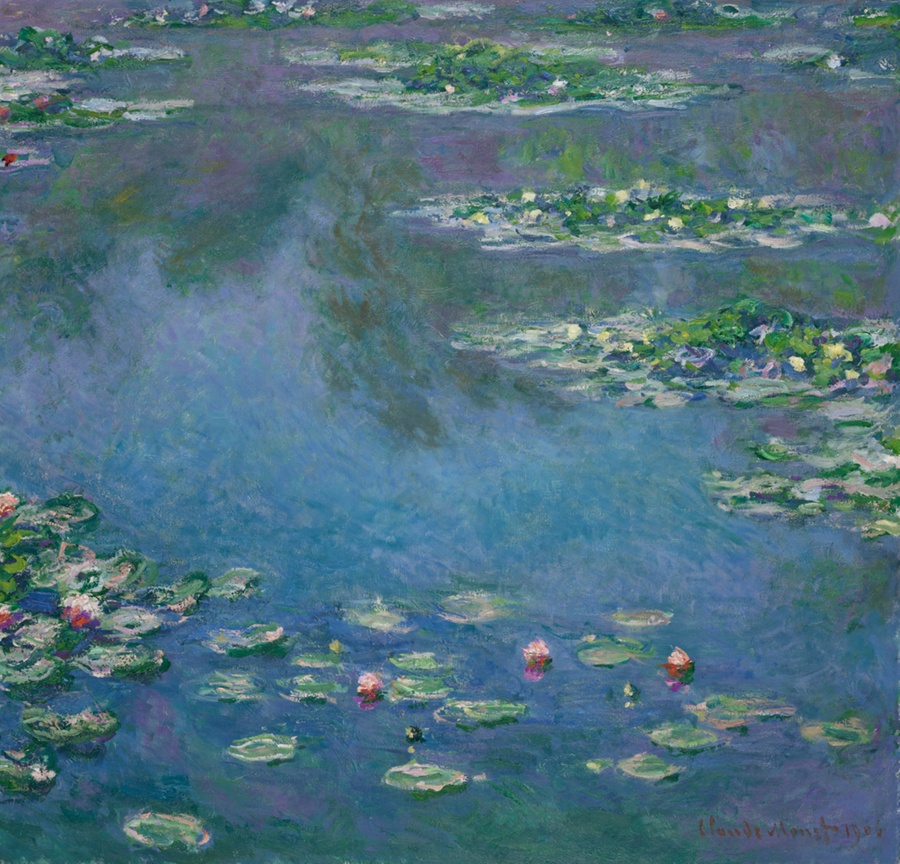
Monet's pond becomes an expanse of reflected sky, floating leaves, and shifting patches of color. Water Lilies is dated 1906 and is held by Art Institute of Chicago. The source record names it “Water Lilies.” Knowing where Water Lilies belongs helps; it also leaves open the question of how the maker organized what we see.
Where the eye settles
Monet reduces the garden pond to a shifting field of reflected light and floating forms. The horizon disappears, leaving the viewer to move between surface, depth, and sky without a fixed starting point. Repeated visits to this subject let Monet test how changing conditions alter what can be seen. With Water Lilies, the point of attention does not stay in one place. Follow a form to its edge and notice what seems to continue beyond it. That small movement can make the whole image feel newly arranged.
How it was made
The collection records Water Lilies as oil on canvas. The medium recorded for Water Lilies gives this image a physical scale and process. A screen can show its design, while the source record preserves what is known of the object itself. The material description for Water Lilies matters because an image seen at screen size can conceal how it was first made and handled. The image of Water Lilies invites another look at its arrangement; its collection entry gives the material description and further details about the work.
Claude Monet and this work
Monet pursued the changing appearance of the visible world across more than six decades. Early support from Eugène Boudin encouraged him to paint outdoors, and friendships with Renoir, Sisley, and others helped form the group later called the Impressionists. Without a firm horizon, the pond offers no obvious place to stand. Monet lets leaves, reflected sky, and paint marks continually exchange roles, so the surface is never merely a view through to water. The decisions in Water Lilies belong to a particular moment in Claude Monet’s career. Water Lilies benefits from a slower encounter. Its subject, medium, and visible emphasis may seem consistent with other works, or they may reveal a different route. Notice which visual problem seems newly urgent here, and which one the artist has approached before. Its differences from nearby works are worth noticing; they restore a little of the uncertainty and invention within the practice. For Claude Monet, Water Lilies was one particular solution among many. A second work can show which decisions were revisited and which were left behind.
The world around Water Lilies
Early work on the Normandy coast and participation in independent exhibitions set Monet on a path that connected plein-air observation with sustained studio decisions. Giverny later gave him a long-term site of inquiry. A viewer first meeting Water Lilies in 1906 may have known its subject and setting differently. That distance is one reason to keep both the image and its documented record in view. A record helps place Water Lilies in a collection. The details you notice in the image can then lead to more precise questions.
Image and object record
Art Institute of Chicago identifies Water Lilies as a work by Claude Monet from 1906 and records its medium as oil on canvas. The collection credits the object to Mr. and Mrs. Martin A. Ryerson Collection. Follow the linked object record for its catalogue entry and any further notes on its history.

