An artist of repeated visits
Monet pursued the changing appearance of the visible world across more than six decades. Early support from Eugène Boudin encouraged him to paint outdoors, and friendships with Renoir, Sisley, and others helped form the group later called the Impressionists. Claude Monet (1840–1926) worked in France. Early work on the Normandy coast and participation in independent exhibitions set Monet on a path that connected plein-air observation with sustained studio decisions. Giverny later gave him a long-term site of inquiry. This history takes on a different shape when it is followed through actual objects. The works on this page show Claude Monet meeting different subjects at different moments.
Watching light change
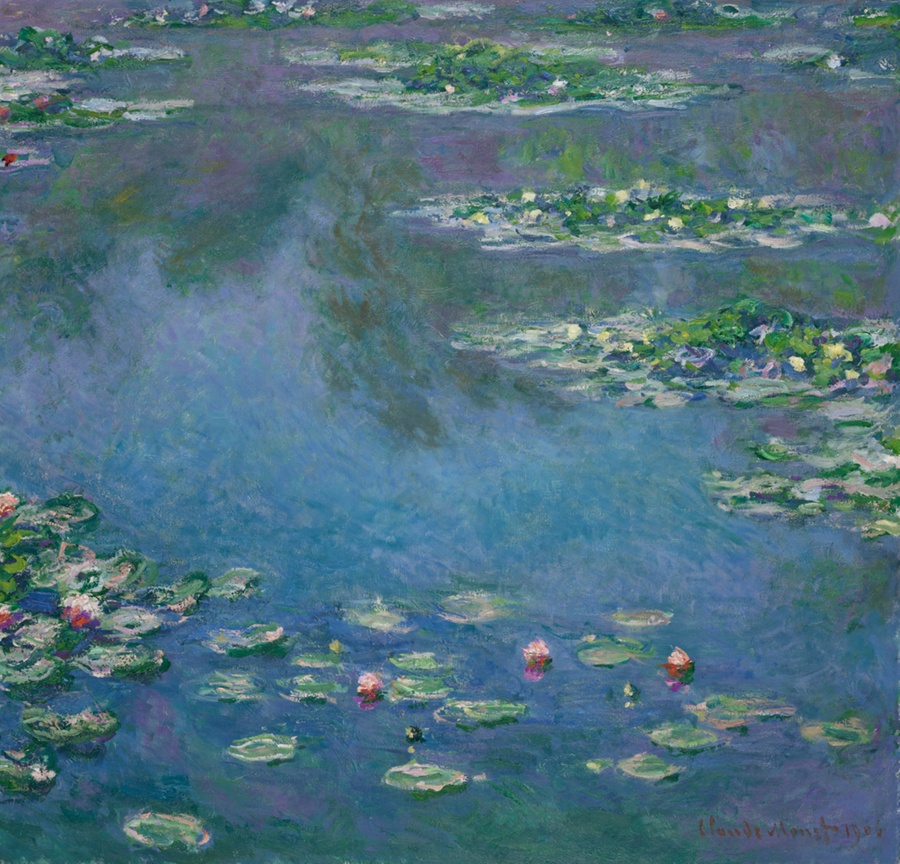
Small shifts in light, weather, and season change the apparent structure of a subject. Repeating a motif was a disciplined method, not an admission that one canvas had failed. Water Lilies offers one test of that way of working. Its surface, scale, and subject can be compared with another object by Claude Monet without assuming every decision was repeated.
Gardens, stations, and water
His haystacks, Rouen Cathedral, and water-lily paintings make time an essential part of viewing. The pond became a world of reflection in which the horizon can almost disappear. The familiar titles in a career can hide the choices that made each picture distinct. Start with Water Lilies: its source record identifies an object, and its image makes visible a particular arrangement. Ask where the eye is held and what has been given less description. The next linked work may answer that question differently. Seen together, these objects give Claude Monet a history of decisions rather than a single emblem of talent.
Impressionism and its limits
Claude Monet is associated with Impressionism. The Impressionists made changing light, modern leisure, and everyday experience central to painting. Their independent exhibitions challenged the authority of the official Paris Salon. Open brushwork and unusual cropping varied from artist to artist; the group included Monet’s outdoor studies, Degas’s rehearsal rooms, and Morisot’s intimate scenes. The word Impressionism can organize a gallery or a book chapter, but the visible evidence is in objects. With Water Lilies, ask how Claude Monet directs attention and what the source record says about material and date. Compare that encounter with another artist’s work from the period. The resulting differences may make the label less neat, but more useful.
A closer look at Water Lilies
Monet's pond becomes an expanse of reflected sky, floating leaves, and shifting patches of color. Monet reduces the garden pond to a shifting field of reflected light and floating forms. The horizon disappears, leaving the viewer to move between surface, depth, and sky without a fixed starting point. Repeated visits to this subject let Monet test how changing conditions alter what can be seen. Now set it beside Stacks of Wheat (End of Summer). Monet returns to a stack of wheat at the end of summer, recording a particular encounter of form and light. Monet returns to a modest agricultural subject and makes light the changing condition of the scene. The stack keeps a recognizable form while color and shadow shift around it. Repetition across a series turns a single view into an inquiry about time and perception. Both works are linked below this profile, with their own object records and images. They reward comparison because they show Claude Monet making different decisions, sometimes with a different material, even when a familiar concern carries across the two.
Monet beyond the postcard
The title of his Impression, Sunrise gave critics a name for the movement. After settling at Giverny, Monet returned again and again to haystacks, poplars, the Rouen Cathedral, and his garden pond. Repetition was a method of seeing: each canvas records a different meeting of light, weather, and time. The paintings became beloved, but their familiarity can hide how radical their loose surfaces and serial attention once seemed. They ask viewers to compare seeing across moments. A third work, Arrival of the Normandy Train, Gare Saint-Lazare, complicates any account built from a single celebrated picture. Monet places a train beneath the smoky roof of Saint-Lazare station, treating modern transport and shifting air as one visual event. Steam softens the edge of a train and the station roof. Monet uses the modern terminal as a place where architecture, movement, and light continually change one another. The third image makes room for a less familiar part of the career. Claude Monet’s legacy is richer when these separate works remain visible beside one another.
Water Lilies draws the viewer into a pond without a firm horizon. Stacks of Wheat keeps a stable form while light shifts, and Arrival of the Normandy Train lets steam alter the shape of a modern station. These are different ways of holding a changeable moment. Their settings were made or used by people, from a cultivated garden to a working terminal, a reminder that Monet’s light was always encountered somewhere particular.
Explore Impressionism ↗
