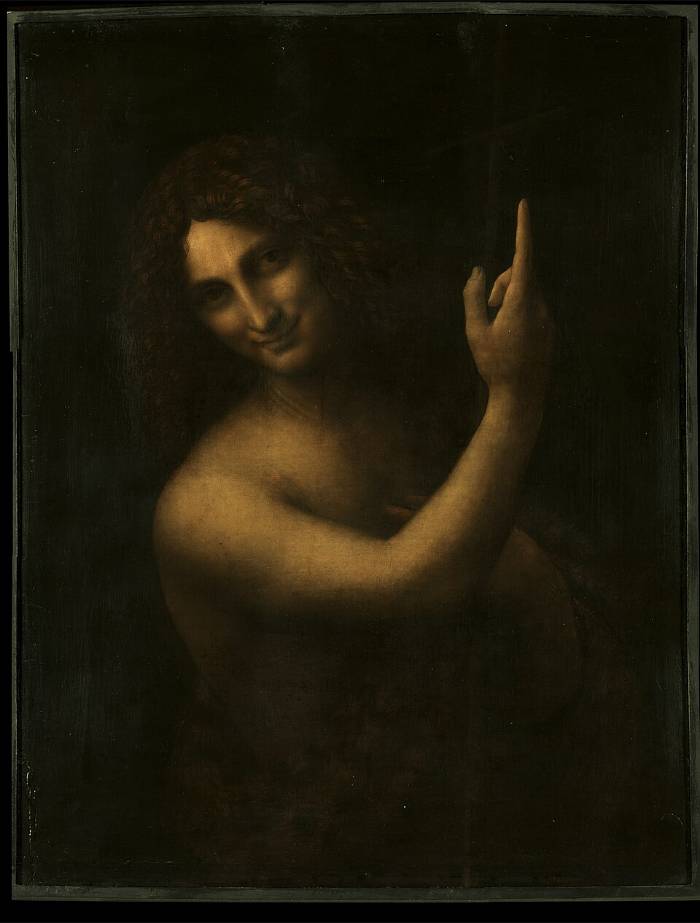
Leonardo's Saint John the Baptist seems to step out of the dark just long enough to share a secret. He smiles, raises one finger, and leaves the viewer to follow it into a space the painting barely shows. It is a religious image with the timing of an encounter: somebody has caught your attention, and you are not quite sure what he knows.
A figure made out of darkness
The walnut panel is modest in size, about 73 centimetres high. Its background offers almost nothing solid to locate John. His face, chest, arm, and curling hair emerge gradually from shadow. Leonardo's soft transitions make edges hard to pin down, as though the figure were appearing while we look. The darkness is not empty filler. Without it, the raised hand would be a gesture in a room; with it, the gesture feels addressed directly to us.
John is traditionally a preacher in the wilderness who announces the coming of Christ. A cross is present, but it does not dominate the painting. His upward finger carries much of the message. It points beyond the visible panel, asking a viewer to connect this singular body to a larger sacred story. Leonardo gives us fewer narrative props than we might expect and makes that absence productive.
The smile and the question
It is hard to decide whether John's expression is inviting, knowing, playful, or something less comfortable. Leonardo had long explored how a face could resist one fixed reading. The smile here is not simply a repeat of the Mona Lisa's. John turns his body and directs a finger into the dark, creating a question with an apparent answer that lies outside the picture. The expression keeps our attention moving between the face and the hand.
His youthful beauty can also surprise viewers expecting a severe, weathered prophet. The long hair and softly modeled flesh place spiritual authority in a body that looks almost theatrical. That tension is part of the work, not an accident to be explained away by a modern nickname for the painting.
A painting Leonardo kept close
The Louvre dates the work broadly between about 1508 and 1519. Its record says Leonardo probably conceived it around the beginning of that span and kept working on it slowly until his death. The circumstances of the commission remain uncertain. That long, uncertain making matters more than a neat single date: a small panel could continue to absorb revisions while the artist changed courts, patrons, and countries.
The paint is oil on walnut, a support that asks for a different kind of handling from canvas. Leonardo's patient blending leaves few hard seams between light and shadow. It can be tempting to describe the effect as misty and stop there. Look again at the raised finger. Its readability depends on exactly where the hand separates from the surrounding dark. Softness has been used with considerable precision.
An unusually travelled saint
The painting's later ownership is a story of royal collections. After likely entering the collection of Francis I, it left France, belonged to Charles I in England, and eventually returned to a French royal collection under Louis XIV. It has been shown at the Louvre since the early nineteenth century. The route did not change the direction of John's finger, but it changed the people standing before him and the questions they brought.
Today it is easy to encounter Leonardo first through reproductions and legends about codes. This work rewards a slower, simpler test. See how much of the body you can follow before an edge disappears. Then ask where your eye goes after the hand. The panel turns looking into an incomplete journey: it offers a guide, but not a map of what lies above.
Why the unfinished feeling lasts
Nothing in the picture is visibly bustling, yet it rarely feels settled. John appears and recedes; his smile begins an exchange the painting cannot finish for us. The effect belongs to Leonardo's craft as much as to the subject's religious role. He makes the unseen feel close by giving the viewer one illuminated hand and the freedom, or burden, to follow it.