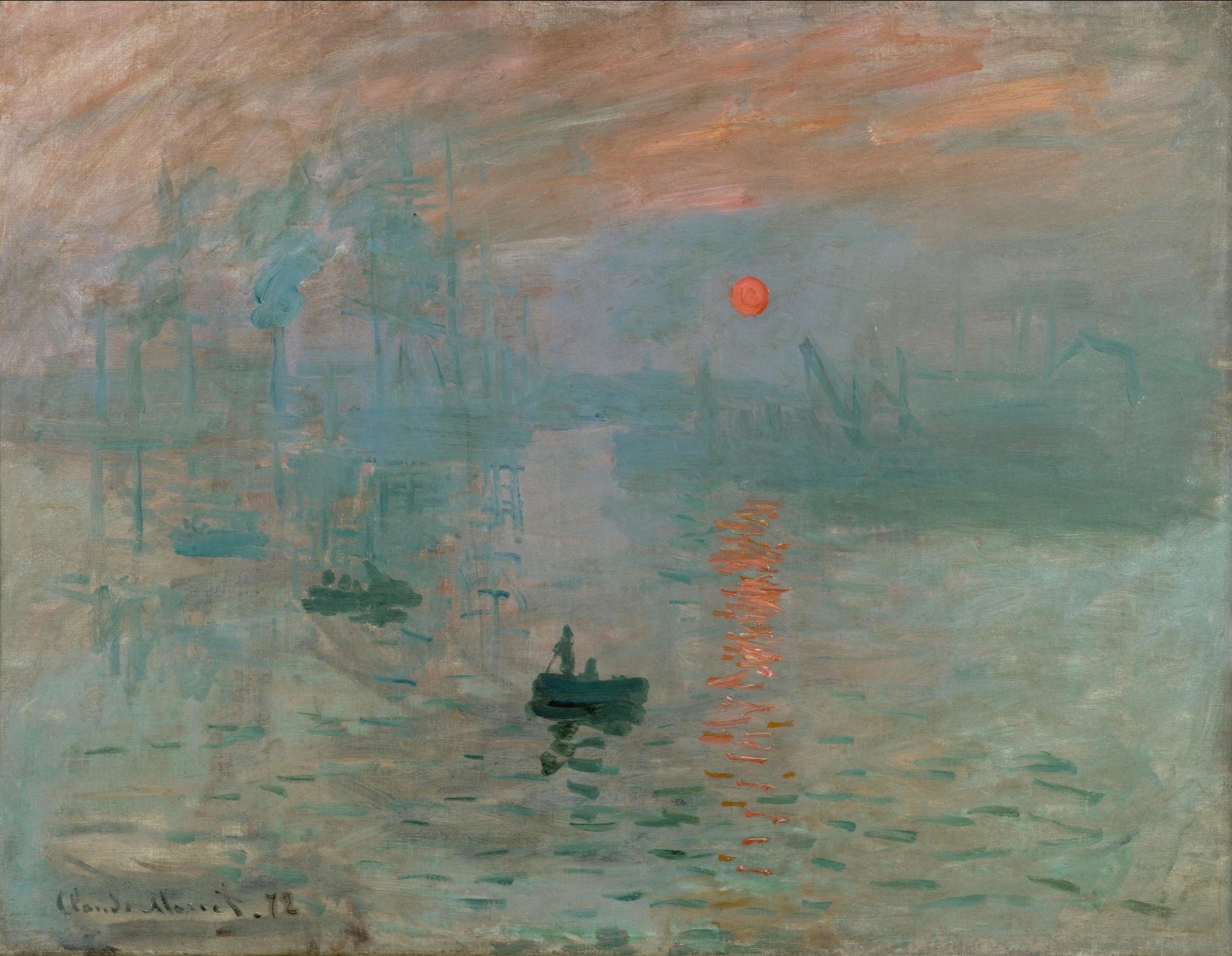
The sun is a small orange coin in a harbour full of mist. Monet's Impression, Sunrise helped give an art movement its name, yet it is also a remarkably specific view of Le Havre: boats, cranes, chimneys, and water beginning a working day. Its haze is not an escape from modern life. It is the condition through which modern life appears.
A morning at the port
Monet painted the scene in 1872 from a hotel window overlooking the outer harbour of Le Havre. The Musée Marmottan Monet identifies the quay structures and the opening toward a basin for larger ships. Rowboats move close to us while masts, cranes, and smokestacks recede into vapour. The picture catches a port whose economic activity has not waited for clear weather.
The orange sun and its reflection give the eye a quick anchor. Take them away in imagination and the scene becomes harder to organize. Their color is striking because nearly everything around them is blue-grey or greenish. Monet uses a small warm note to make the whole damp atmosphere visible.
Quick paint, deliberate decisions
Broad strokes suggest the foreground boats, while the distant machinery is only partly resolved. The surface can look unfinished if judged by the standards of a polished Salon painting. Monet was after something else: the first impression of objects seen through changing air. Speed of handling does not mean absence of thought. He knew where to place the sun and how much information the mist could bear.
The museum's record says Monet added the small boats and orange accents toward the end. That is a useful reminder that an image which looks captured in an instant still has a sequence of decisions behind it. The painter could return to a mark, sharpen an effect, and decide what the viewer needed to find.
How a name escaped the canvas
Monet showed the painting at the independent exhibition of 1874. A critic, Louis Leroy, used its title when mocking the exhibitors, and the word Impressionism later became the movement's name. The story is famous, but it can distract from this particular canvas. Monet did not paint a manifesto in orange and grey. He painted a harbour morning and gave it a title loose enough to match the experience.
The work belongs to the Musée Marmottan Monet in Paris. Its journey into art-history shorthand has made it much more public than the quiet rowboats in the foreground suggest. Standing with the image now, we can still move from the famous label back to the working place and the unsettled weather that started it.
The detail that keeps it human
Follow the nearest boat across the broken reflection. It is a small human presence among large industrial forms and a sky that will change within minutes. Monet does not give us a portrait of its occupants or a schedule for the ships. The tiny movement is enough to keep the harbour from becoming an abstract study of fog.
Impression, Sunrise remains famous because it altered how a group of artists was named. It remains worth looking at because the paint still lets us feel a particular morning forming in front of our eyes. The movement may have taken the word; the painting kept the weather.