
Between America and Paris
Cassatt built a career in Paris and exhibited with the Impressionists. Her pictures of women and children are often intimate, yet their structure is daring: unusual viewpoints, bold color, and patterned surfaces. Mary Cassatt (1844–1926) worked in United States and France. An American working in Paris, Cassatt built a career through study, exhibition, and a close connection with Degas and the Impressionist circle. She also encouraged American collecting of modern French art. The settings of Mary Cassatt’s life mattered to the opportunities and constraints of making art. The works collected here let those conditions meet visible choices.
Compositions of care
Bold patterns and unexpected angles complicate the apparent ease of her scenes. Japanese prints helped her think about flat areas, cropping, and the relation of figures to their surroundings. A career can contain both practiced habits and departures. The Child's Bath gives a concrete place to study how Mary Cassatt balanced the two in one made object.
Prints, portraits, and close views
The Child’s Bath presents care as both a human action and a tightly organized pattern of bodies, cloth, and floor. The viewpoint draws us close without making the subjects decorative. The named projects are landmarks, but a career also happens between landmarks. The Child's Bath offers a way to slow that history down. Describe its most active passage, then notice the quieter choices that keep the composition together. Its source entry gives material and date, facts that help place this particular object. Follow another work by Mary Cassatt and the line between preparation, revision, and fresh experiment becomes less tidy and more interesting.
Impressionism and its limits
Mary Cassatt is associated with Impressionism. The Impressionists made changing light, modern leisure, and everyday experience central to painting. Their independent exhibitions challenged the authority of the official Paris Salon. Open brushwork and unusual cropping varied from artist to artist; the group included Monet’s outdoor studies, Degas’s rehearsal rooms, and Morisot’s intimate scenes. A shared label is not proof of a shared aim. Mary Cassatt worked among people, institutions, and images that may be grouped under one movement today, yet The Child's Bath needed its own composition. Notice which choices appear tied to its first audience and which speak to a broader artistic concern. This way of looking allows the history around the work to matter without swallowing the work itself.
A closer look at The Child's Bath
Cassatt views washing from above, joining touch and care to a daring arrangement of figures and patterned floor. Cassatt views the figures from above, drawing attention to the shared act of washing. Patterned textiles and tilted shapes hold the composition together while the gestures of adult and child make it feel personal. The work joins formal experiment to a subject drawn from daily care. Now set it beside Woman Bathing. Cassatt uses the act of bathing to study a figure, a patterned surface, and the experience of observation. Cassatt builds the bathing scene around the relationship between the figure and the patterned space around her. A high viewpoint shifts attention away from theatrical display toward the practical action. Line, color, and gesture hold private routine and formal invention together. Both works are linked below this profile, with their own object records and images. They reward comparison because they show Mary Cassatt making different decisions, sometimes with a different material, even when a familiar concern carries across the two.
The reach of Cassatt’s work
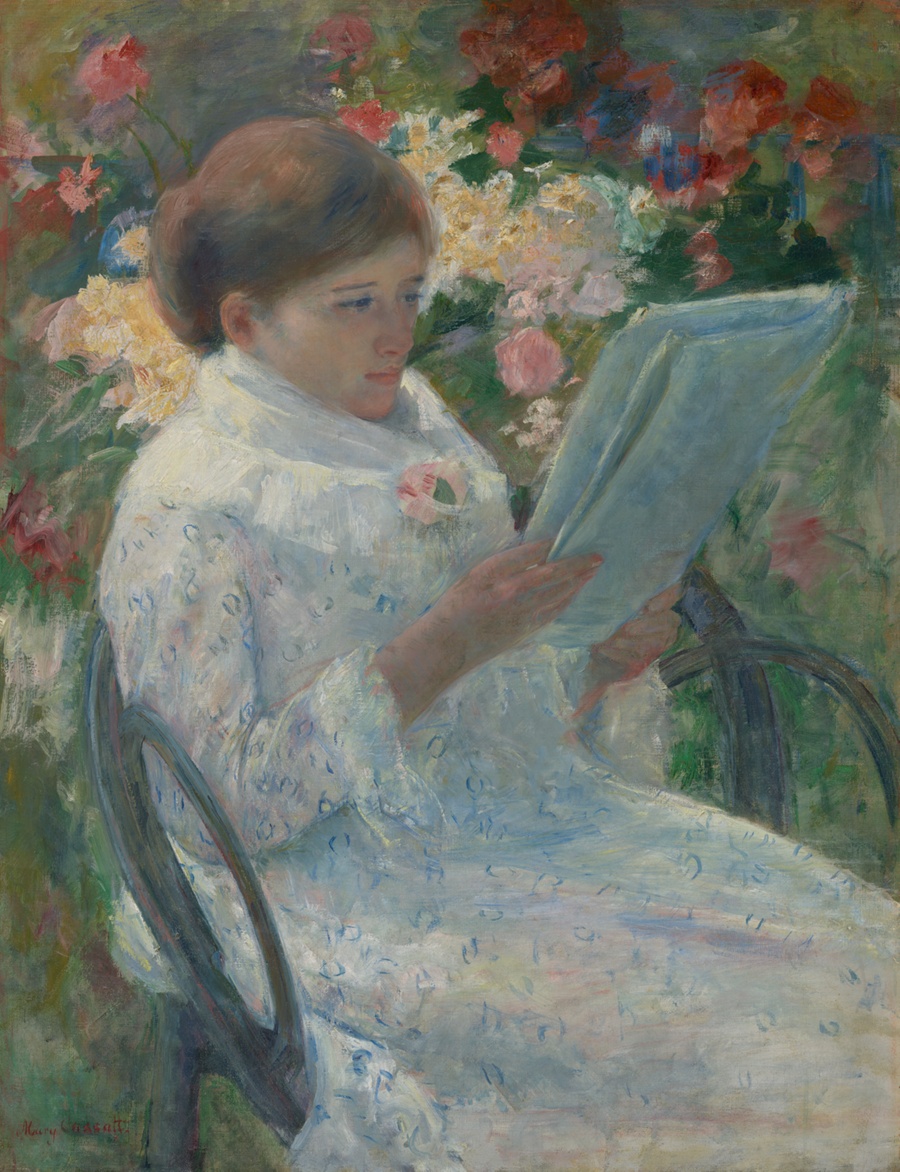
Japanese prints helped shape her compositions. Cassatt also supported the collection of Impressionist art in the United States, influencing how the movement entered American museums and public life. Her pictures of women and children are often called gentle, but they also examine attention, touch, and agency. The subject cannot be separated from the experiment in form. A third work, On a Balcony, complicates any account built from a single celebrated picture. Cassatt shows a balcony as a threshold between a woman and the world beyond her, with framing central to the encounter. The balcony frames a reader against flowers and the space beyond. Cassatt makes a private act of attention visible through the relationship between figure, railing, and view. The surviving work gives us more than a list of achievements. Its contrasts show Mary Cassatt revising, repeating, and sometimes leaving behind earlier solutions.
The Child’s Bath gives a high view of shared care. Woman Bathing studies a private action through printmaking, while On a Balcony makes the boundary between sitter and outside world visible. These works show Cassatt varying viewpoint and process around subjects often called domestic. Their formal ambitions are easier to recognize when the angle of a body, a patterned floor, and the physical qualities of a printed line are given equal attention.
Explore Impressionism ↗