
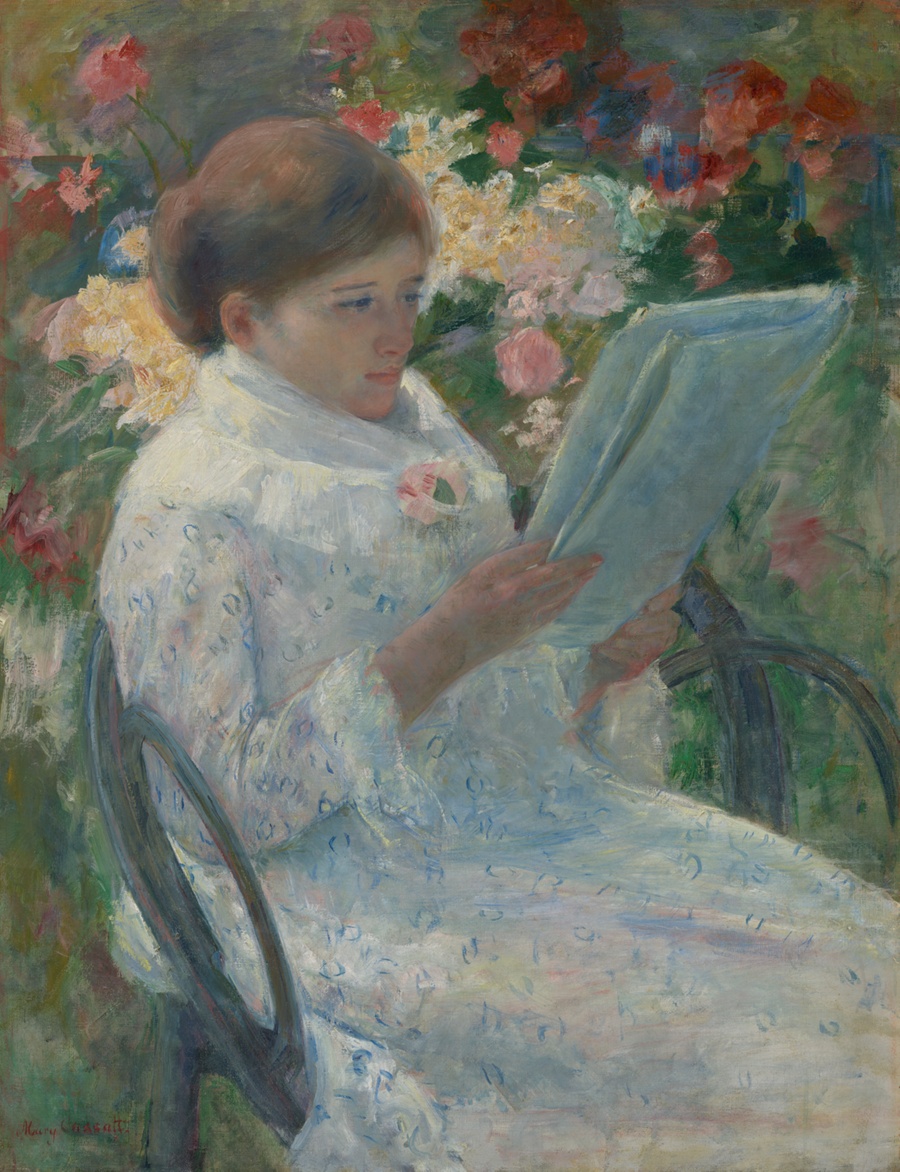
On a Balcony in its time
Cassatt shows a balcony as a threshold between a woman and the world beyond her, with framing central to the encounter. On a Balcony is dated 1878–79 and is held by Art Institute of Chicago. The source record names it “On a Balcony.” The listed facts locate On a Balcony in history, while its visible choices give the viewer something to discover directly.
The choices in the image
The balcony frames a reader against flowers and the space beyond. Cassatt makes a private act of attention visible through the relationship between figure, railing, and view. The strength of On a Balcony is partly in what it asks us to connect. A gesture, shape, or patch of color can answer another elsewhere in the image. Trace one such connection before deciding what the scene means.
Paint, paper, and process
The collection records On a Balcony as oil on canvas. The medium of On a Balcony belongs in the story because a drawing, print, and painting offer different routes from a maker’s hand to a viewer. The linked record names this one precisely. Looking at On a Balcony as an object means asking what the listed materials allow the artist to revise, repeat, or leave visible. Return to the image of On a Balcony for the arrangement of forms, then use the source link to learn what kind of object carries them.
Mary Cassatt and this work
The Child’s Bath presents care as both a human action and a tightly organized pattern of bodies, cloth, and floor. The viewpoint draws us close without making the subjects decorative. A balcony opens a view while marking a boundary. Cassatt lets railing, flowers, and figure determine how far the viewer can enter the scene and how much remains beyond. Looking at On a Balcony within Mary Cassatt’s larger body of work can be useful, but the relationship runs in both directions. The picture may look effortless at first; its organization asks how forms, marks, and empty areas were made to work together. Its subject, medium, and visible emphasis may seem consistent with other works, or they may reveal a different route. Follow the linked works rather than relying on one celebrated image. A biography becomes more convincing when actual objects are allowed to disagree with a tidy summary. The choices visible in On a Balcony make one part of Mary Cassatt’s career tangible without reducing that career to a single signature look.
The world around On a Balcony
Her pictures of women and children are often called gentle, but they also examine attention, touch, and agency. The subject cannot be separated from the experiment in form. The world of 1878–79 was the first setting for On a Balcony. Its later life in collections and reproductions has changed how easily, and how often, people see it. The image of On a Balcony and its source record belong together: one offers a close view, the other identifies the object and its material.
Image and object record
Art Institute of Chicago identifies On a Balcony as a work by Mary Cassatt from 1878–79 and records its medium as oil on canvas. The collection credits the object to Gift of Mrs. Albert J. Beveridge in memory of her aunt, Delia Spencer Field. Follow the linked object record for its catalogue entry and any further notes on its history.

