Portraiture across cities
Born in Florence to American parents, John Singer Sargent trained in Paris and built a career across Europe and the United States. His commissioned portraits brought acclaim, but travel, watercolor, murals, and scenes of working life occupied him as well. His practice moved between social performance and quick observation. John Singer Sargent (1856–1925) worked in United States and Europe. Sargent’s itinerant childhood and Paris training preceded a transatlantic career. Commissions made him a sought-after portraitist, while travel and informal work gave him subjects beyond the society sitters who secured his reputation. Each documented work on this page occupies one point in a longer career. Together they make a more varied account of John Singer Sargent than a single celebrated image can give.
Brushwork under the polish
Direct brushwork is often celebrated in his work, yet quickness could be built on careful observation. A figure may emerge from a dark interior through a few accents of light rather than an even description of every surface. No single technique explains every part of John Singer Sargent’s career. Venetian Glass Workers is a starting point for noticing both continuity and experiment in the other works.
People, places, and commissions
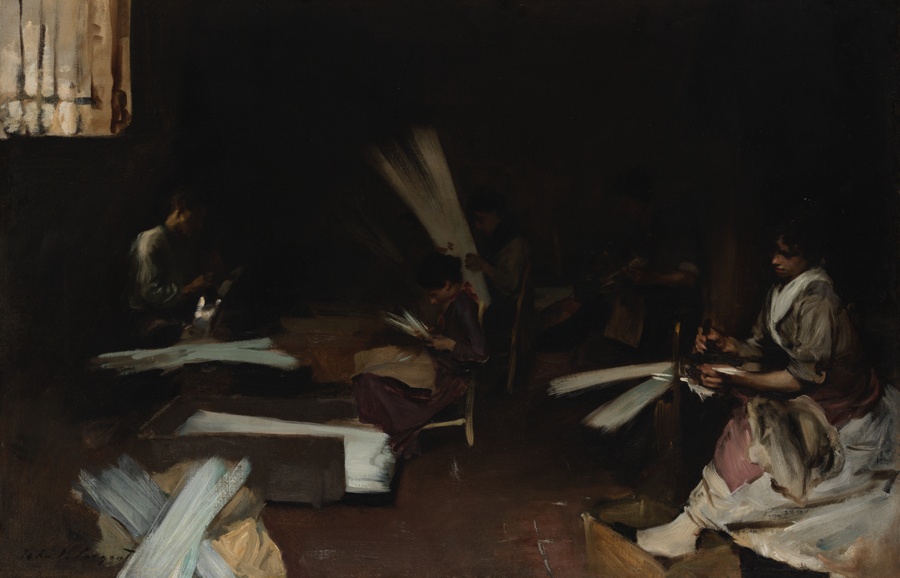
Venetian Glass Workers places several people and long pale forms within a workshop. Its attention to labor contrasts with the public performance expected from an elite portrait. The projects in this life were made for viewers, patrons, or buyers with their own expectations. Venetian Glass Workers reached them through a particular material and format. Its arrangement can be studied without treating it as a perfect illustration of what John Singer Sargent always did. A second work may keep an interest but reverse the balance of color, line, or subject. That difference is evidence of an artist working through new demands rather than repeating a formula.
Portraiture and its limits
John Singer Sargent is associated with Portraiture. The label Portraiture locates one strand of this career, but no short movement name can contain every decision in a lifetime of work. A movement name can tell us about exhibitions, markets, or a later historian’s way of grouping works. For John Singer Sargent, its value depends on what it explains in a specific object. Return to Venetian Glass Workers and describe the subject before reaching for the label. Which visual problem does it share with nearby artists, and where does it take another path? A good comparison can sharpen the historical category without making it rigid.
A closer look at Venetian Glass Workers
Sargent locates glass workers within the darkness of a Venetian workshop, setting their labor apart from his better-known commissioned portraits. The workshop is largely dark, yet the pale glass and light clothing make the workers visible at separate stations. Sargent leaves large areas only lightly described, allowing the eye to register activity without turning each person into a posed portrait. It is a view of making as well as of atmosphere. Now set it beside The Fountain, Villa Torlonia, Frascati, Italy. Sargent treats an Italian fountain and surrounding figures with direct brushwork, showing an informal side of his practice. Figures gather around the pale stone fountain. Sargent allows the setting and gesture to matter as much as any individual likeness. Both works are linked below this profile, with their own object records and images. They reward comparison because they show John Singer Sargent making different decisions, sometimes with a different material, even when a familiar concern carries across the two.
Sargent beyond society portraits
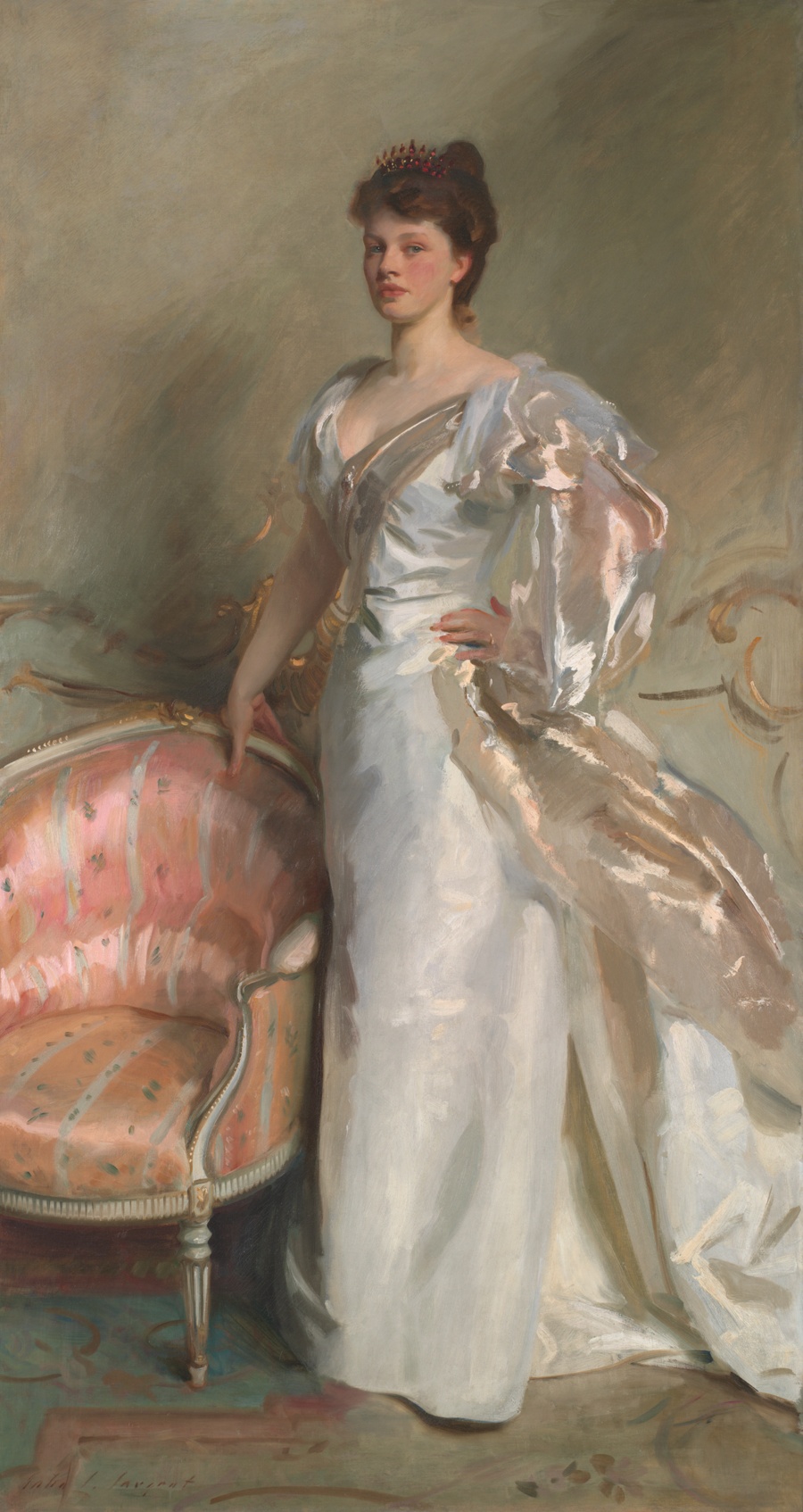
Sargent could use a few direct strokes to suggest a figure, fabric, or fall of light. Venetian Glass Workers turns from his famous society portraits toward labor in a dim interior. Looking across these works makes his facility seem less like a fixed style and more like a response to different subjects and audiences. Recent scholarship has complicated a once narrow image of Sargent as a painter of luxury. His varied subjects, working relationships, and decisions about who becomes visible deserve study together. A third work, Mrs. George Swinton, complicates any account built from a single celebrated picture. Sargent uses pose, fabric, and scale to stage a society portrait while retaining the liveliness of a person before him. The sitter's dress, pose, and surrounding objects give the portrait a public scale. Sargent's brushwork keeps the carefully staged image alert to the presence of a real person. The difference among these objects is part of John Singer Sargent’s legacy. It asks later viewers to remember a working artist rather than a fixed style.
Venetian Glass Workers gives the labor of a dark workshop space and light. The Fountain, Villa Torlonia follows figures in a more informal Italian setting, while Mrs. George Swinton is a portrait staged at public scale. The contrast is useful: Sargent’s brushwork could serve a commission, a glimpse of a place, or the activity of making. His range comes into focus when the society portrait is seen beside the less formal works.