
A rescue written in the clouds
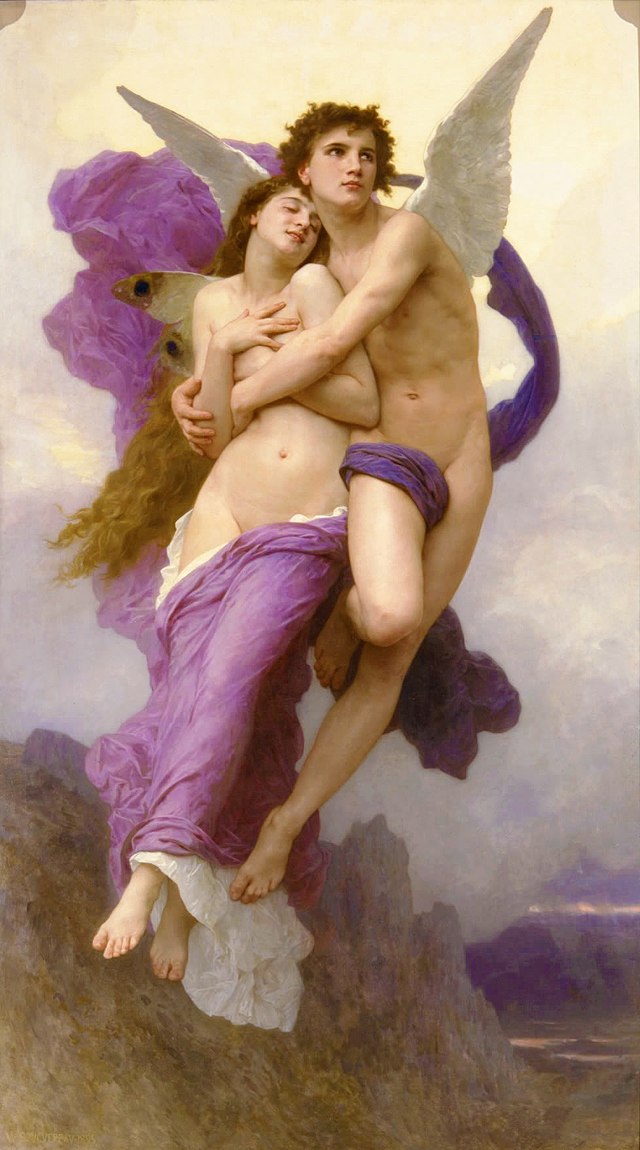
The first thing to notice in The Abduction of Psyche is that nobody appears to be struggling. Cupid lifts Psyche from a rocky ledge, but her closed eyes and hand pressed to her chest suggest surrender or astonishment rather than fear. His face is alert; hers is elsewhere. Between them, Bouguereau finds a moment that is both exhilarating and strangely quiet. The painting is a love story suspended in midair, and its title asks a question the image refuses to settle easily.
Painted in 1895, the large oil on canvas measures about 209 by 120 centimetres. Its tall format gives the figures somewhere to go. They rise from a narrow foreground of stone into pale sky, while a purple veil and Psyche’s hair seem to trail behind them. Look at the bottom of the canvas: her feet have already left the ground. It is a small detail, but it makes the impossible action feel as if it has only just begun.
Who are Cupid and Psyche?
The characters come from a story told in the second-century Roman novel often called The Golden Ass, by Apuleius. Psyche is a mortal princess whose beauty provokes Venus’s jealousy. Venus sends her son Cupid to make the young woman fall in love with someone unworthy. Instead, Cupid falls in love himself. Their relationship survives secrecy, separation, Psyche’s nearly impossible tasks, and a dangerous trip to the underworld. At the end, divine intervention allows the mortal heroine to join Cupid among the immortals.
Bouguereau does not supply a caption identifying one precise sentence from that long tale. The upward flight can suggest reunion, rescue, or the passage into a different life. The French title, L’Enlèvement de Psyché, adds to the openness: enlèvement can carry the sense of being carried away as well as the darker force of “abduction.” Psyche’s expression gives viewers reason to question the English title, though it does not turn the myth into a simple romance without conflict. Her journey has been hard won.
How Bouguereau makes flight believable
The scene should collapse under its own weight. Two adult bodies are floating above a mountain, supported by wings that belong to a figure of flesh and bone. Bouguereau answers this physical problem with compositional order. Cupid’s arm crosses Psyche’s torso and locks the pair into a single rising shape. Her bent leg, falling hair, and winding drapery repeat the direction of movement without sending the eye out of the picture. The cliffs far below establish height; the softly lit bodies keep the improbable event close enough to feel.
The purple fabric is especially busy. It gathers under the figures, billows behind them, and catches the eye against skin painted in warm creams and pinks. Psyche’s butterfly-like wings are smaller and darker than Cupid’s broad white pair. In classical language her name also means “soul,” and the butterfly became one of her signs. Bouguereau lets that association appear in the image while keeping the two faces, rather than any symbol, at its emotional centre.
The painter behind the polish
Bouguereau belonged to the world of the Paris Salon, where ambitious paintings could be studied at close range by enormous crowds. His finish was a point of pride: contours are carefully controlled, and the transitions between light and shadow look almost effortless. That ease is the result of preparation and disciplined drawing. In this painting, the smooth surfaces also perform a narrative job. Nothing rough or distracting interrupts the glance that carries us from Psyche’s face to Cupid’s and out into the open sky.
That perfection will not persuade everybody. The figures are idealised, the story sentimental, and the sky offers little resistance to their escape. Yet dismissing the picture as merely pretty misses its clever tension. Cupid looks ahead while Psyche turns inward; the painting has momentum, but its two protagonists do not seem to experience the moment in quite the same way. The difference is where the story keeps breathing.
Looking once more
The painting is in a private collection, so its public record is less detailed than many museum entries. The available records identify Bouguereau, the 1895 date, the oil-on-canvas medium, and the dimensions. They cannot tell us exactly what thought he wanted Psyche to have, and a good image would not need them to. Follow the line from the rocky ledge to her loose toes, then up to Cupid’s fixed gaze. The painting turns a familiar myth into a question about what it feels like to be lifted out of one world and into another.

