
The painter everyone knew
A hundred years ago, William-Adolphe Bouguereau hardly needed an introduction. Collectors wanted his pictures, crowds saw them at the Paris Salon, and younger painters studied the exacting craft behind their luminous figures. Today many people meet him through a reproduction: a goddess, a child, a pair of lovers, skin glowing in impossible light. The apparent ease can conceal both the hard labour of the studio and the odd turns of a reputation that went from triumph to embarrassment and back to curiosity.
Bouguereau was born in La Rochelle in 1825. He learned to draw in Bordeaux before moving to Paris, where he trained at the École des Beaux-Arts and in the studio of François-Édouard Picot. His goal was not simply to paint well in private. The French academic system offered a route through competitions, official exhibitions, prizes, commissions, and teaching. Bouguereau learned to move through that system with remarkable determination.
Rome, rivalry, and a working method
In 1850 he shared first prize in the Prix de Rome, a competition whose winners could study in Italy. Time in Rome brought him close to Renaissance painting and ancient sculpture, works that would continue to shape his ideas about the body, balance, and beauty. Returning to France, he developed a career that ranged from decorative and religious commissions to portraits, rural subjects, and mythology. The categories sound distant now, but for Salon visitors they meant different kinds of ambition and different public expectations.
His finished canvases can make the paint seem to have arrived without a brush. In reality, drawing anchored the work. Figures were planned, poses tested, and forms modelled with extraordinary care. In The Bathers, one woman sits while the other rises against sea and sky. Their arrangement is almost architectural: a rhythm of limbs and light keeps two still bodies active. What feels spontaneous is an intricate design that has learned to hide its scaffolding.
Bouguereau could turn that training toward very different emotional registers. Young Mother Gazing at Her Child narrows the action to the space between two faces. The Proposal depends on social signals: the angle of a body, an offered gesture, the pause before an answer. The people are idealised, but the scenes ask the viewer to read small human exchanges rather than grand heroic action.
Psyche takes flight
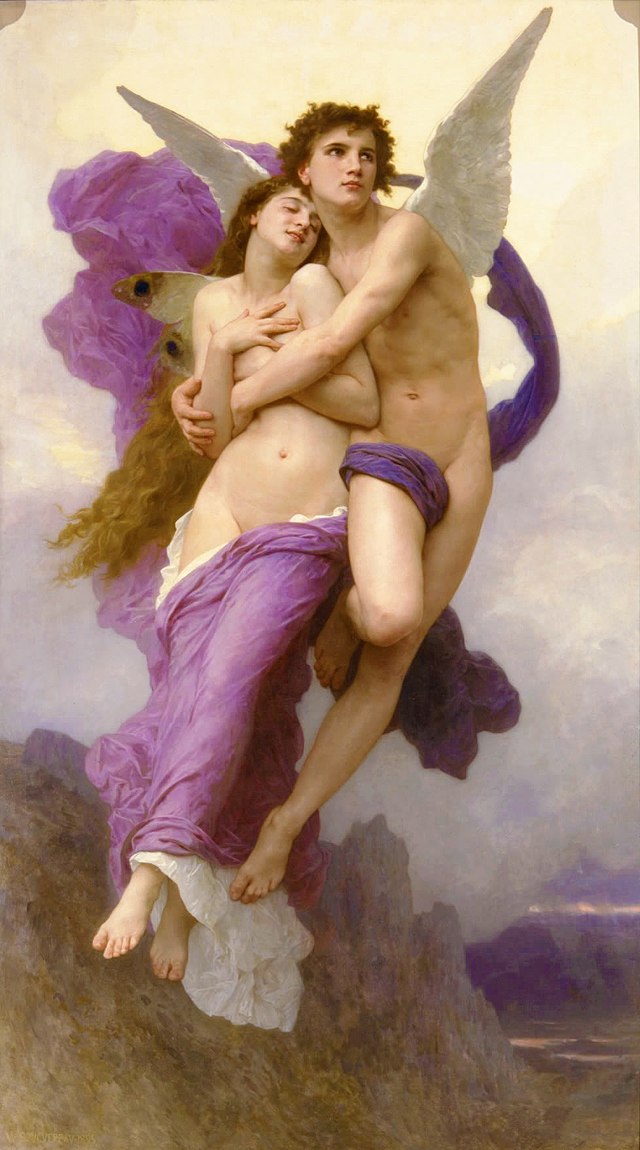
By the time he painted The Abduction of Psyche in 1895, Bouguereau had spent decades mastering the language of mythological painting. Cupid carries a mortal princess away from a rocky height, her purple drapery swirling around them. The picture has all the traits for which he is celebrated and criticised: painstaking anatomy, glowing skin, theatrical feeling, and a world where beauty appears to soften danger. Yet the faces complicate the sweetness. Cupid looks outward with purpose; Psyche closes her eyes. They share an embrace, but not quite the same experience of flight.
The tale comes from Apuleius’s Roman novel about Cupid and Psyche. It includes jealousy, separation, ordeals, and eventually an escape from mortality. Bouguereau compresses that unruly story into a single upward movement. Whether we read the picture as rescue, reunion, or transformation, its power lies in making a myth feel immediate. We can almost sense the moment Psyche’s feet leave the ledge.
Success and the changing fashion for art
Bouguereau’s fame was built within institutions whose taste later artists challenged. While he continued to win honours and sell paintings, the Impressionists and other modern painters were rethinking subjects, surfaces, and the rules of exhibition. It is tempting to turn this into a neat battle between old and new. The real scene was more crowded. Artists competed for attention, collectors liked different things, and dealers moved between worlds. Paul Durand-Ruel, later famous for supporting Impressionists, also handled Bouguereau’s work.
By the twentieth century, histories of modern art often treated the smooth academic canvas as the thing innovation had overcome. Bouguereau’s reputation fell sharply. That reversal tells us something about historical taste; it does not make the paintings disappear. A century of criticism can sharpen our eyes as much as a century of admiration. We can ask what his ideal bodies leave out, what his sentimental stories assume, and why their craft still holds viewers.
How to look at him now
Start with the painting in front of you rather than the verdict attached to his name. Look for the drawing that holds a pose together. Notice where a hand or gaze supplies the plot. Then compare the quiet pressure of Young Mother Gazing at Her Child with the airborne drama of The Abduction of Psyche. Both are controlled, but they use that control to different ends.
Bouguereau died in 1905. He left a vast body of work and an unusually revealing history of changing fame. His paintings can be admired for their technical assurance, questioned for their ideals, and enjoyed for their storytelling in the same visit. That mixture is more interesting than either worship or dismissal. The figures may live in carefully arranged worlds, but our response to them need not be carefully arranged at all.