
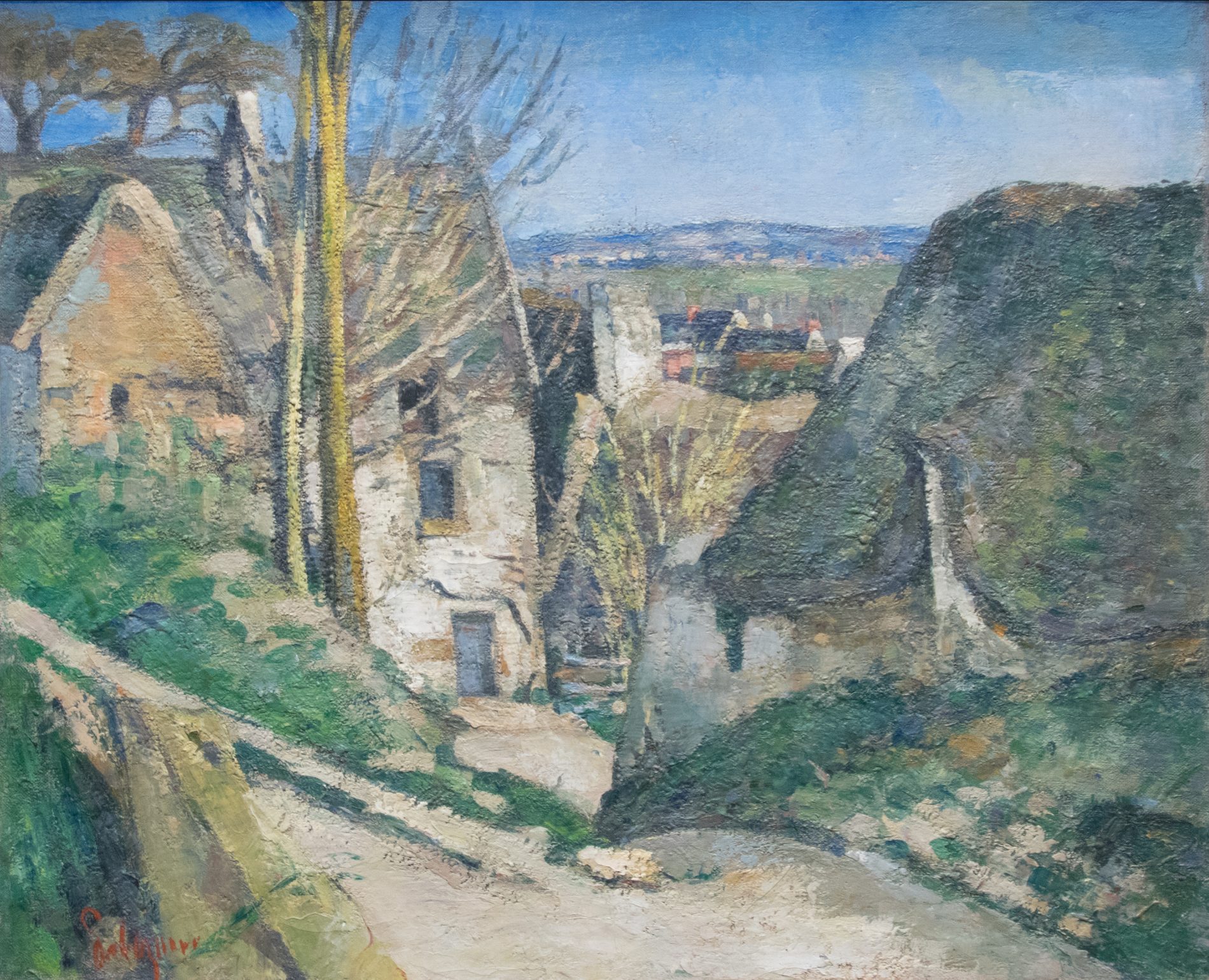
The title promises a dramatic story. The painting offers an empty lane, close-packed houses, and a pale opening toward the valley. Cézanne's The House of the Hanged Man, made at Auvers in 1873, does not show a hanging or explain the name. It asks us to stay with the quieter drama of a road that bends away and buildings that seem to press toward one another.
A road with no easy exit
A path rises to the left while another slips downhill into the center of the picture. Banks and branches push in from the sides. There is no single clear route for the eye. Cézanne makes the village feel tightly assembled, as though every wall and slope has weight. The distance opens briefly, but the foreground holds us close to the roads and houses.
No figures step out to guide us through the scene. The absence can make the place feel solitary, especially beside a title that suggests an untold event. Yet an empty street is not evidence of a tragedy in front of the artist. The painting's most reliable story is in its visible arrangement: the way built space and hillside keep shifting our sense of direction.
A friendship in the background
Cézanne worked around Auvers-sur-Oise and Pontoise with Camille Pissarro, whose friendship mattered greatly to his development. The Musée d'Orsay notes lighter colors and broken strokes in this 1873 canvas compared with Cézanne's earlier work. He was taking ordinary surroundings seriously, a direction shared with artists who would soon be called Impressionists. That connection is visible without making the two painters interchangeable.
Cézanne's paint has a particular density. Small strokes build the roofs, road, and trees until the surface feels almost packed. Where a fleeting light effect might loosen the scene, these close planes hold it together. He experiments with a fresh palette while remaining interested in how a view can be given structure.
A puzzling debut in public
The House of the Hanged Man was one of three Cézanne canvases shown at the first Impressionist exhibition in 1874. Its ordinary subject and unusual handling puzzled critics. The museum's account adds a useful twist: this was the first work Cézanne managed to sell to a collector. A picture can unsettle one part of its first audience and still find someone willing to live with it.
That early history is easy to overlook when Cézanne's landscapes now seem central to modern art. The sale did not mean that every viewer suddenly understood his aims. It shows a painter testing an approach in public, with the uncertainty that goes with putting a difficult picture before people who expect a different sort of finish.
Look past the title, then return to it
Follow the left-hand road, notice where it leaves the frame, and try the central descent instead. Your eye has to choose and then reconsider. Cézanne uses the village's geometry to make looking active. Cool colors and stiff branches add to the restrained mood without converting the image into an illustration of its ominous title.
The title remains part of the work's experience. It may make us alert to the empty houses and the absence of people. But it should not be allowed to invent facts that the painting or records do not supply. The House of the Hanged Man is powerful because its tension lives in a real painted place: a road, a cluster of walls, and a view that never becomes fully comfortable.

