
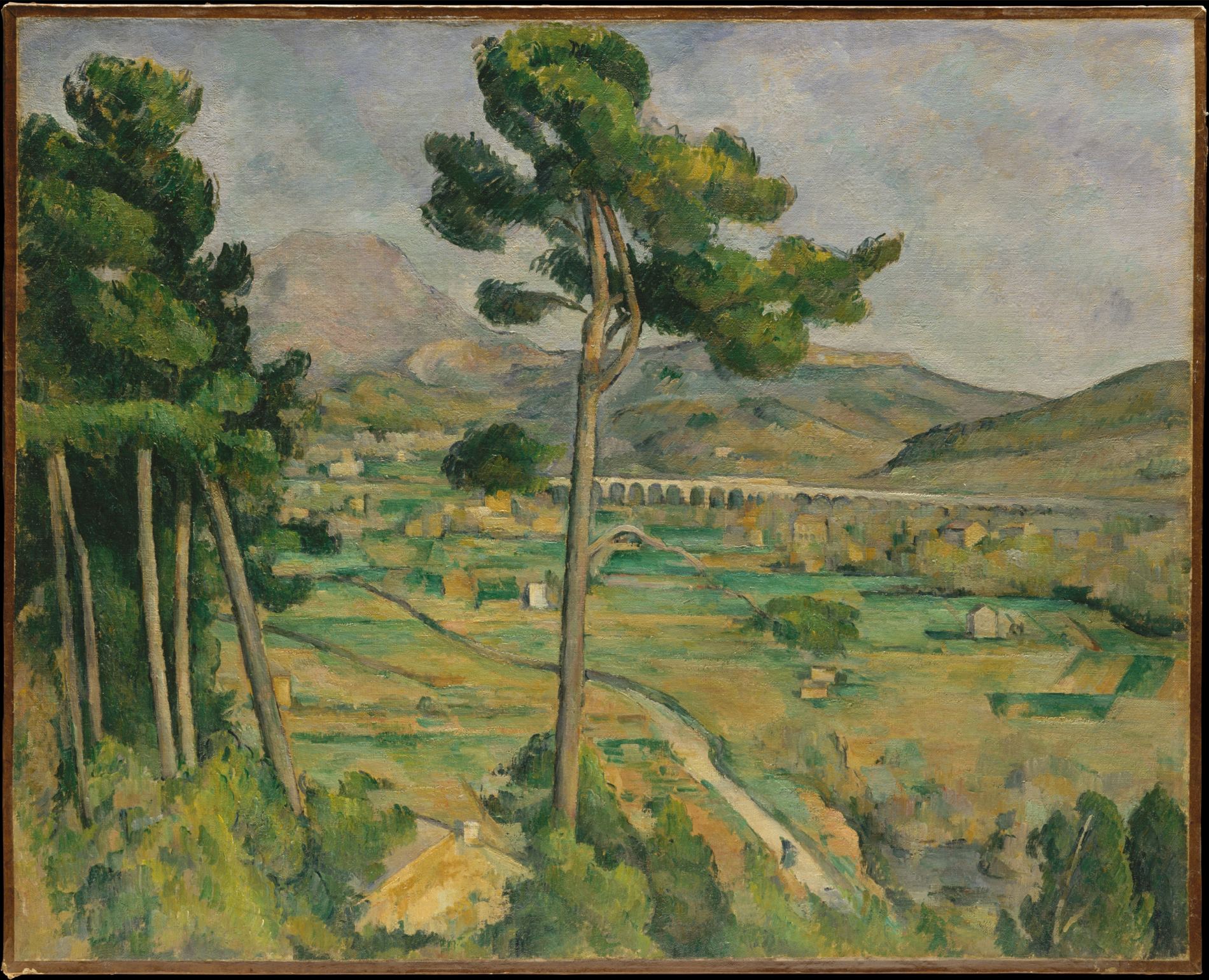
A mountain rises beyond a valley, and a railway viaduct cuts across the green below. Cézanne could have made this a contrast between timeless nature and a modern intrusion. Instead, Mont Sainte-Victoire and the Viaduct makes the built bridge part of the landscape's structure. Look closely and the whole view seems assembled from decisions about shape, color, and distance.
A place near home
Cézanne painted from a viewpoint near Montbriand, his sister's property outside Aix-en-Provence. The mountain was familiar to him and would return in many works. Here its pale silhouette sits behind the Arc River valley. The railway viaduct passes through the middle distance, giving the eye a horizontal path across the scene before the mountain pulls it upward.
The Met's record identifies a nearby farmhouse wall at the edge of the view. Such details keep the composition tied to a real position on the ground. Cézanne did not paint a generic mountain; he worked from a place he could revisit and rethink. The repetitions across his career are not copies of one view, but experiments made in conversation with it.
The bridge is not an interruption
At first the viaduct may seem small beside the mountain. Its line is crucial, though. It steadies the middle of the canvas and gives the valley a measured rhythm. Cézanne lets the bridge echo older forms of architecture, even as it belongs to the age of rail. It is easier to notice the mountain's shape once the bridge has trained the eye to compare long horizontals and firm supports.
Trees and fields are not described blade by blade. Short strokes of green and ochre build masses that shift between near and far. The sky is given equal attention as a structure of color, not just blank space left behind the peak. The pieces hold together without dissolving into a perfectly smooth illusion.
Making a durable view
The painting dates from about 1882 to 1885. Cézanne had learned from Impressionism's attention to light but wanted to give the changing view a firmer order. That aim can sound abstract until we look at the mountain's edges. They are not traced with one hard outline; neighboring strokes gradually make the mass convincing. Solidity arrives from relationships among marks.
This is not a photograph of a moment when every leaf was fixed. Cézanne's repeated looking lets different parts of the valley find their own weight. The bridge, near foliage, and distant peak remain distinct while sharing one color system. A viewer can feel both the pleasure of place and the pleasure of watching a painting think through how place might be built.
Return to the viaduct
Mont Sainte-Victoire became a landmark in the story of modern art. It is tempting to approach every version as a step toward abstraction. This canvas first deserves to be treated as an encounter with a mountain and the valley beneath it. The railway is there because the view included a modern route through land that was neither empty nor untouched.
Let your eye cross the viaduct, climb to the peak, and descend through the greens in the foreground. The route is as deliberate as a walk. Cézanne makes the landscape stable enough to travel and varied enough to require another pass. That is why this mountain continues to feel present, not merely famous.

